QUESTION IMAGE
Question
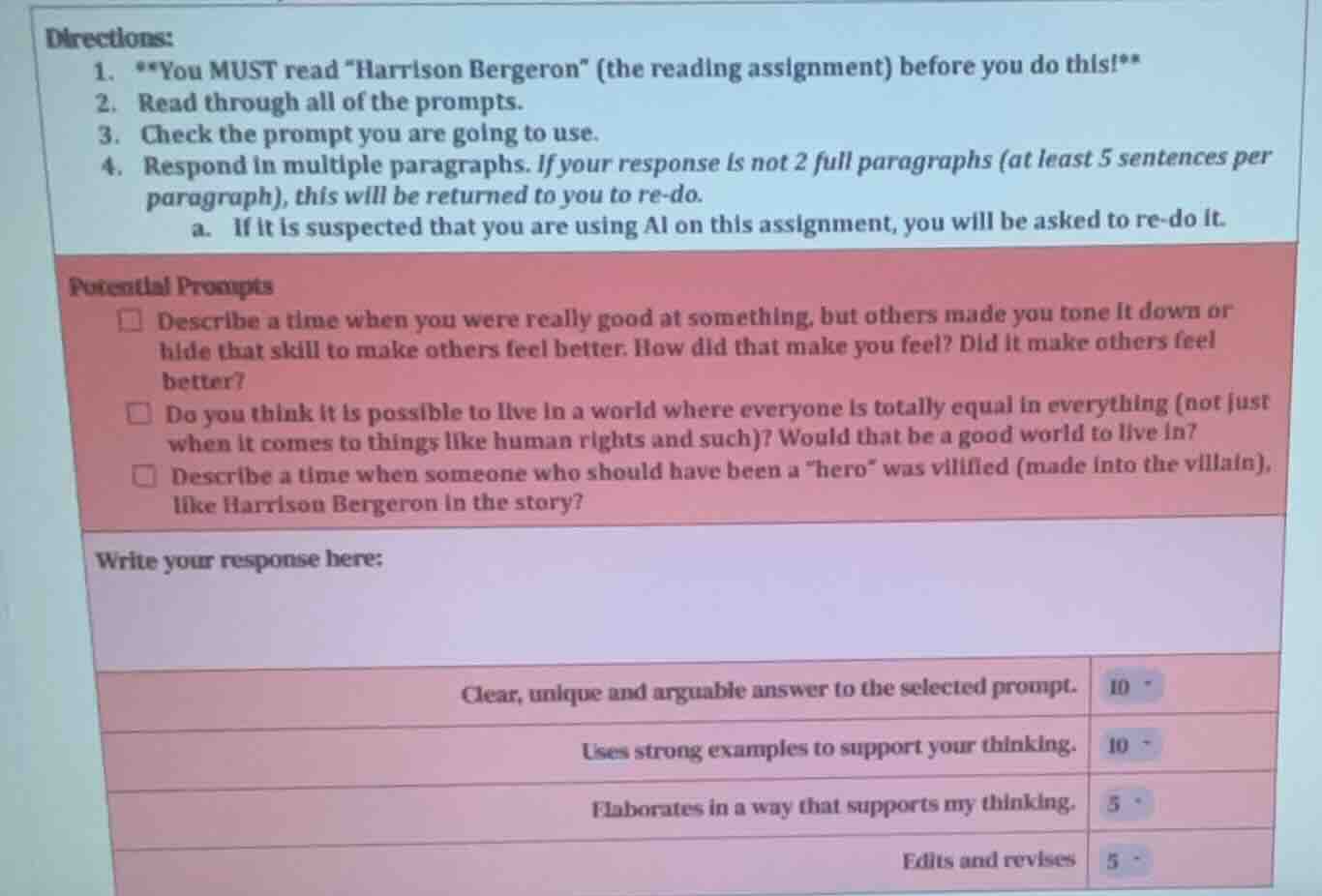
directions:
- you must read \harrison bergeron\ (the reading assignment) before you do this!
- read through all of the prompts.
- check the prompt you are going to use.
- respond in multiple paragraphs. if your response is not 2 full paragraphs (at least 5 sentences per paragraph), this will be returned to you to re-do.
a. if it is suspected that you are using ai on this assignment, you will be asked to re-do it.
potential prompts
- describe a time when you were really good at something, but others made you tone it down or hide that skill to make others feel better. how did that make you feel? did it make others feel better?
- do you think it is possible to live in a world where everyone is totally equal in everything (not just when it comes to things like human rights and such)? would that be a good world to live in?
- describe a time when someone who should have been a \hero\ was vilified (made into the villain), like harrison bergeron in the story?
write your response here:
Analyze the assignment requirements and prompts
The image presents a writing assignment based on Kurt Vonnegut's dystopian short story "Harrison Bergeron." The instructions require selecting one of three potential prompts and responding in at least two full paragraphs (minimum of 5 sentences per paragraph).
The three potential prompts are:
- Describe a personal experience of having to tone down or hide a skill to make others feel better, how it felt, and if it helped others.
- Discuss whether a world of total equality in everything (not just human rights) is possible and if it would be a good world to live in.
- Describe a real-life or historical situation where someone who should have been a "hero" was vilified (made into a villain), similar to Harrison Bergeron.
Select a prompt and outline the response
Prompt 2 is selected for a structured, analytical response: "Do you think it is possible to live in a world where everyone is totally equal in everything (not just human rights)? Would that be a good world to live in?"
Paragraph 1: Address the impossibility of total equality in all human aspects (talents, physical traits, intelligence) and explain why enforcing it artificially destroys individuality.
Paragraph 2: Discuss why such a world would not be a good place to live, drawing on the thematic warning of "Harrison Bergeron" where forced uniformity leads to societal stagnation and oppression.
Draft the two-paragraph response
Paragraph 1 (5 sentences):
Living in a world where everyone is completely equal in every single aspect of life is both physically and socially impossible. Human beings are inherently diverse, possessing unique combinations of talents, physical attributes, intellectual capacities, and personal interests. To achieve absolute equality in these areas, a society would have to artificially suppress individual strengths and advantages, much like the handicapping system depicted in Kurt Vonnegut's "Harrison Bergeron." Such forced leveling does not elevate those who struggle; instead, it systematically drags down those with natural abilities to a state of forced mediocrity. Consequently, true equality of outcome can only be maintained through authoritarian control and the systematic erasure of personal identity.
Paragraph 2 (5 sentences):
A world of total, enforced equality would ultimately be a terrible and stagnant place to live. Without the drive of competition, personal ambition, and the celebration of unique talents, human progress and innovation would completely grind to a halt. A healthy society thrives on the diverse contributions of its members, where individual excellence inspires others and pushes the boundaries of what humanity can achieve. Forcing everyone to conform to a single standard of mediocrity breeds resentment, apathy, and a profound loss of personal freedom. Therefore, while we must always strive for equal rights and opportunities under the law, we must reject the dystopian notion of absolute uniformity in favor of celebrating our individual differences.

Snap & solve any problem in the app
Get step-by-step solutions on Sovi AI
Photo-based solutions with guided steps
Explore more problems and detailed explanations
Selected Prompt:
Do you think it is possible to live in a world where everyone is totally equal in everything (not just human rights)? Would that be a good world to live in?
Living in a world where everyone is completely equal in every single aspect of life is both physically and socially impossible. Human beings are inherently diverse, possessing unique combinations of talents, physical attributes, intellectual capacities, and personal interests. To achieve absolute equality in these areas, a society would have to artificially suppress individual strengths and advantages, much like the handicapping system depicted in Kurt Vonnegut's "Harrison Bergeron." Such forced leveling does not elevate those who struggle; instead, it systematically drags down those with natural abilities to a state of forced mediocrity. Consequently, true equality of outcome can only be maintained through authoritarian control and the systematic erasure of personal identity.
A world of total, enforced equality would ultimately be a terrible and stagnant place to live. Without the drive of competition, personal ambition, and the celebration of unique talents, human progress and innovation would completely grind to a halt. A healthy society thrives on the diverse contributions of its members, where individual excellence inspires others and pushes the boundaries of what humanity can achieve. Forcing everyone to conform to a single standard of mediocrity breeds resentment, apathy, and a profound loss of personal freedom. Therefore, while we must always strive for equal rights and opportunities under the law, we must reject the dystopian notion of absolute uniformity in favor of celebrating our individual differences.