QUESTION IMAGE
Question
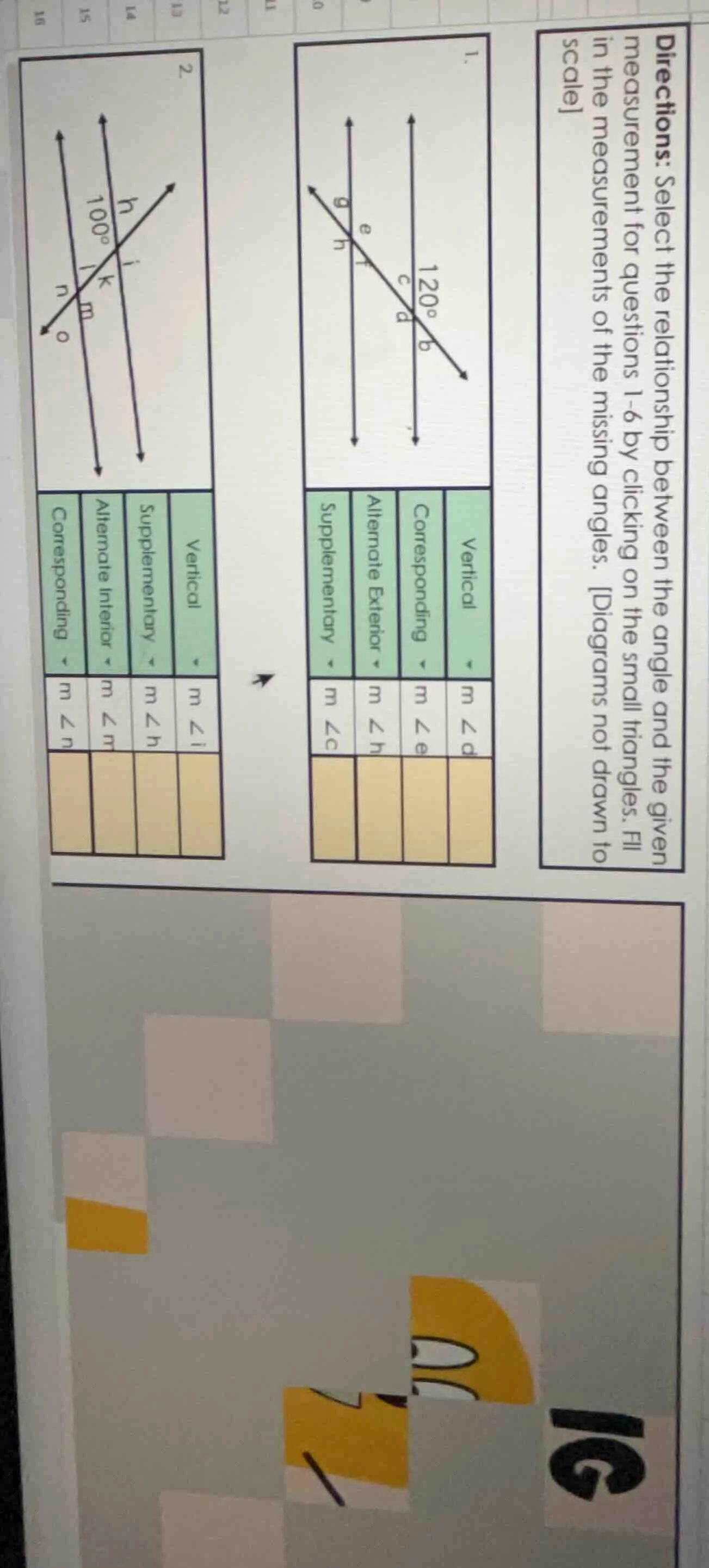
directions: select the relationship between the angle and the given measurement for questions 1-6 by clicking on the small triangles. fill in the measurements of the missing angles. diagrams not drawn to scale
- diagram with 120°, angles b, c, d, e, f, h, etc. and table for ( m angle d ), ( m angle e ), ( m angle h ), ( m angle c )
- partially visible diagram and table
Step1: Find \( m\angle b \) (linear pair with \( 120^\circ \))
A linear pair of angles sums to \( 180^\circ \). So, \( m\angle b = 180^\circ - 120^\circ = 60^\circ \). Since \( \angle d \) and \( \angle b \) are vertical angles (equal), \( m\angle d = 60^\circ \).
Step2: Find \( m\angle c \) (vertical angle with \( 120^\circ \))
Vertical angles are equal, so \( m\angle c = 120^\circ \).
Step3: Find \( m\angle e \) (corresponding or alternate - depending on lines, but here \( \angle e \) and \( \angle c \) are same - side interior? Wait, no, the two horizontal lines are parallel (assumed, as it's a transversal setup). \( \angle e \) and the \( 120^\circ \) angle: actually, \( \angle e \) and \( \angle b \) are corresponding? Wait, no, let's re - check. The transversal cuts two parallel lines. \( \angle e \) and \( \angle d \): no, \( \angle e \) and \( \angle c \) are same - side interior? Wait, no, the angle adjacent to \( \angle e \) (let's say \( \angle f \)) and \( \angle b \) are corresponding. Wait, maybe better: \( \angle e \) and the \( 120^\circ \) angle: since \( \angle e \) and \( \angle c \) are same - side interior? No, \( \angle c = 120^\circ \), and \( \angle e \) and \( \angle c \) are same - side interior, so they should be supplementary? Wait, no, if the lines are parallel, same - side interior angles are supplementary. Wait, but \( \angle e \) and \( \angle d \): \( \angle d = 60^\circ \), and \( \angle e \) and \( \angle d \) are same - side interior? No, maybe \( \angle e \) is equal to \( \angle c \)? Wait, no, let's use vertical angles and linear pairs. \( \angle h \): \( \angle h \) and \( 120^\circ \) angle: \( \angle h \) is equal to \( \angle b \)? Wait, no, let's start over.
The angle of \( 120^\circ \) and \( \angle b \) form a linear pair, so \( m\angle b=180 - 120 = 60^\circ \). \( \angle d \) is vertical to \( \angle b \), so \( m\angle d = 60^\circ \). \( \angle c \) is vertical to the \( 120^\circ \) angle, so \( m\angle c = 120^\circ \). Now, for \( \angle e \): since the two horizontal lines are parallel (implied by the transversal), \( \angle e \) and \( \angle c \) are same - side interior angles? No, \( \angle e \) and \( \angle d \): wait, \( \angle e \) and \( \angle b \) are corresponding angles (if lines are parallel), so \( m\angle e = 120^\circ \)? Wait, no, I think I made a mistake. Let's look at \( \angle h \): \( \angle h \) and the \( 120^\circ \) angle: \( \angle h \) is equal to \( \angle b \)? No, \( \angle h \) and \( \angle d \) are corresponding? Wait, maybe the two horizontal lines are parallel, so \( \angle h \) is equal to \( \angle d \)'s supplement? No, let's use the fact that in a transversal cutting parallel lines, corresponding angles are equal, alternate interior angles are equal, and linear pairs sum to \( 180^\circ \).
Wait, the \( 120^\circ \) angle and \( \angle c \) are vertical angles, so \( m\angle c = 120^\circ \). \( \angle c \) and \( \angle e \): if the two horizontal lines are parallel, \( \angle c \) and \( \angle e \) are same - side interior angles, so they are supplementary? No, same - side interior angles are supplementary. So \( m\angle e=180 - 120 = 60^\circ \)? Wait, no, that contradicts. Wait, maybe the angle labeled \( 120^\circ \) and \( \angle b \) are adjacent, forming a linear pair, so \( m\angle b = 60^\circ \). Then \( \angle d \) is vertical to \( \angle b \), so \( m\angle d = 60^\circ \). \( \angle e \) is vertical to \( \angle c \)? No, \( \angle e \) and \( \angle h \): \( \angle h \) is equal to \( \angle d \)'s supplement? Wai…
Snap & solve any problem in the app
Get step-by-step solutions on Sovi AI
Photo-based solutions with guided steps
Explore more problems and detailed explanations
\( m\angle d = 60^\circ \), \( m\angle e = 120^\circ \), \( m\angle h = 60^\circ \), \( m\angle c = 120^\circ \)