QUESTION IMAGE
Question
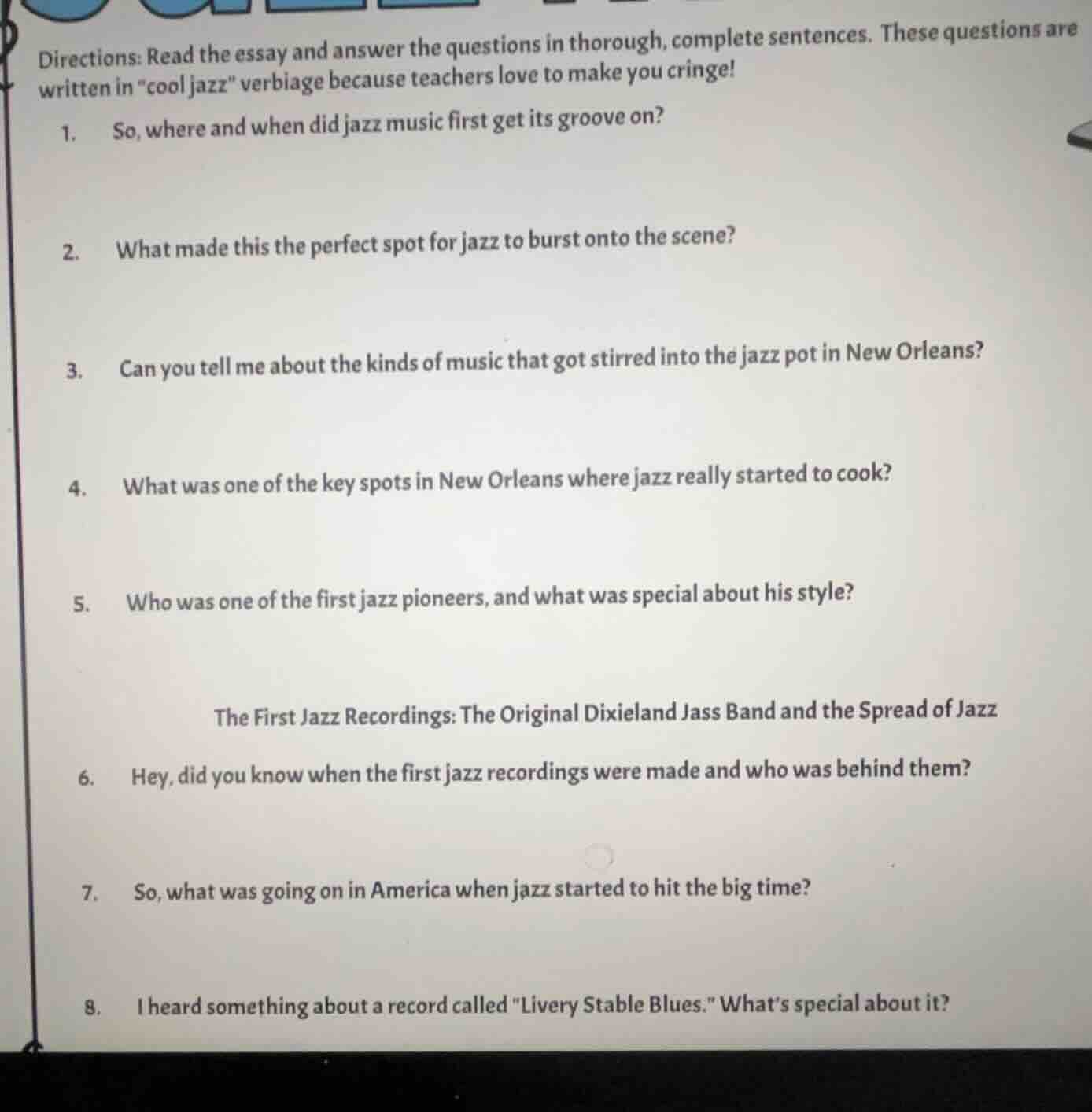
directions: read the essay and answer the questions in thorough, complete sentences. these questions are written in \cool jazz\ verbiage because teachers love to make you cringe!
- so, where and when did jazz music first get its groove on?
- what made this the perfect spot for jazz to burst onto the scene?
- can you tell me about the kinds of music that got stirred into the jazz pot in new orleans?
- what was one of the key spots in new orleans where jazz really started to cook?
- who was one of the first jazz pioneers, and what was special about his style?
the first jazz recordings: the original dixieland jass band and the spread of jazz
- hey, did you know when the first jazz recordings were made and who was behind them?
- so, what was going on in america when jazz started to hit the big time?
- i heard something about a record called \livery stable blues.\ whats special about it?
To answer these questions, we would need to refer to the essay (which is not fully provided here). However, here are general explanations for how to approach each question based on typical jazz history knowledge:
Question 1:
Jazz first emerged in New Orleans, Louisiana, in the late 19th to early 20th century (around the 1890s - 1910s). The city’s multicultural environment (African, European, Caribbean influences) and vibrant music scene fostered its development.
Question 2:
New Orleans was ideal due to its diverse population (African - American, Creole, European), cultural mixing, a thriving nightlife with demand for live music, and the blending of musical traditions like African rhythms, European melodies, and brass band music from parades.
Question 3:
Musical influences included African - American spirituals, work songs, blues; European classical music (harmonies, instruments); Caribbean rhythms; and brass band music from New Orleans’ parade culture (marching bands with trumpets, trombones, clarinets).
Question 4:
The Storyville district (a red - light district) was a key spot. It had numerous clubs, brothels, and venues where musicians played, allowing for improvisation and collaboration across styles.
Question 5:
Buddy Bolden is often cited as an early pioneer. His style featured loud, improvisational trumpet playing, syncopated rhythms, and a bluesy feel, helping shape jazz’s improvisational core.
Question 6:
The first jazz recordings were made in 1917 by The Original Dixieland Jass Band (later “Jazz”). They recorded in New York, with their “Livery Stable Blues” (among others) being early jazz records.
Question 7:
When jazz rose (1910s - 1920s), America was in the Roaring Twenties: urbanization, Prohibition (speakeasies boosted live music), social change (women’s suffrage, cultural experimentation), and a desire for new, energetic entertainment.
Question 8:
“Livery Stable Blues” (1917) by The Original Dixieland Jass Band is special as one of the first commercially released jazz records, helping popularize jazz beyond New Orleans and influencing its spread.
Since the essay’s content is needed for precise answers, these are general historical context - based responses. If you provide the essay, more accurate answers can be given.

Snap & solve any problem in the app
Get step-by-step solutions on Sovi AI
Photo-based solutions with guided steps
Explore more problems and detailed explanations
To answer these questions, we would need to refer to the essay (which is not fully provided here). However, here are general explanations for how to approach each question based on typical jazz history knowledge:
Question 1:
Jazz first emerged in New Orleans, Louisiana, in the late 19th to early 20th century (around the 1890s - 1910s). The city’s multicultural environment (African, European, Caribbean influences) and vibrant music scene fostered its development.
Question 2:
New Orleans was ideal due to its diverse population (African - American, Creole, European), cultural mixing, a thriving nightlife with demand for live music, and the blending of musical traditions like African rhythms, European melodies, and brass band music from parades.
Question 3:
Musical influences included African - American spirituals, work songs, blues; European classical music (harmonies, instruments); Caribbean rhythms; and brass band music from New Orleans’ parade culture (marching bands with trumpets, trombones, clarinets).
Question 4:
The Storyville district (a red - light district) was a key spot. It had numerous clubs, brothels, and venues where musicians played, allowing for improvisation and collaboration across styles.
Question 5:
Buddy Bolden is often cited as an early pioneer. His style featured loud, improvisational trumpet playing, syncopated rhythms, and a bluesy feel, helping shape jazz’s improvisational core.
Question 6:
The first jazz recordings were made in 1917 by The Original Dixieland Jass Band (later “Jazz”). They recorded in New York, with their “Livery Stable Blues” (among others) being early jazz records.
Question 7:
When jazz rose (1910s - 1920s), America was in the Roaring Twenties: urbanization, Prohibition (speakeasies boosted live music), social change (women’s suffrage, cultural experimentation), and a desire for new, energetic entertainment.
Question 8:
“Livery Stable Blues” (1917) by The Original Dixieland Jass Band is special as one of the first commercially released jazz records, helping popularize jazz beyond New Orleans and influencing its spread.
Since the essay’s content is needed for precise answers, these are general historical context - based responses. If you provide the essay, more accurate answers can be given.