QUESTION IMAGE
Question
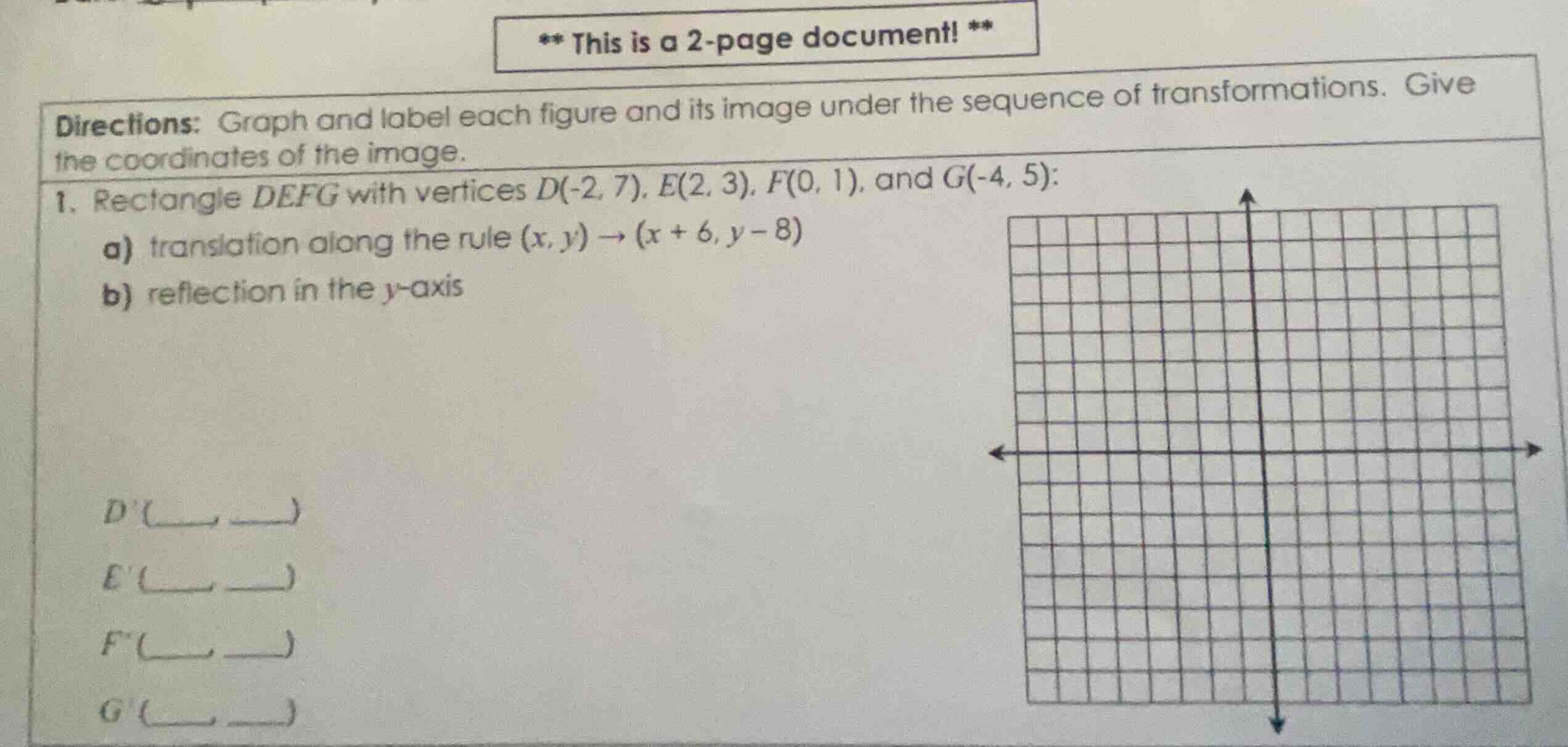
directions: graph and label each figure and its image under the sequence of transformations. give the coordinates of the image.
- rectangle \\(defg\\) with vertices \\(d(-2, 7)\\), \\(e(2, 3)\\), \\(f(0, 1)\\), and \\(g(-4, 5)\\):
a) translation along the rule \\((x, y) \
ightarrow (x + 6, y - 8)\\)
b) reflection in the \\(y\\)-axis
\\(d(\underline{\quad}, \underline{\quad})\\)
\\(e(\underline{\quad}, \underline{\quad})\\)
\\(f(\underline{\quad}, \underline{\quad})\\)
\\(g(\underline{\quad}, \underline{\quad})\\)
Identify the given vertices and sequence
We are given rectangle \(DEFG\) with the following initial vertices:
- \(D(-2, 7)\)
- \(E(2, 3)\)
- \(F(0, 1)\)
- \(G(-4, 5)\)
We need to apply a sequence of two transformations to find the final coordinates of the image \(D'E'F'G'\):
- Translation along the rule \((x, y)
ightarrow (x + 6, y - 8)\)
- Reflection in the \(y\)-axis
Apply the translation rule
Let's apply the translation rule \((x, y)
ightarrow (x + 6, y - 8)\) to each vertex to find the intermediate coordinates, which we will call \(D_1, E_1, F_1, G_1\):
- For \(D(-2, 7)\):
- For \(E(2, 3)\):
- For \(F(0, 1)\):
- For \(G(-4, 5)\):
Apply the reflection rule
Next, we apply a reflection in the \(y\)-axis to the intermediate coordinates \(D_1, E_1, F_1, G_1\).
The rule for reflecting a point over the \(y\)-axis is:
Applying this rule gives the final coordinates \(D', E', F', G'\):
- For \(D_1(4, -1)\):
- For \(E_1(8, -5)\):
- For \(F_1(6, -7)\):
- For \(G_1(2, -3)\):

Snap & solve any problem in the app
Get step-by-step solutions on Sovi AI
Photo-based solutions with guided steps
Explore more problems and detailed explanations
Rectangle \(DEFG\) with vertices \(D(-2, 7)\), \(E(2, 3)\), \(F(0, 1)\), and \(G(-4, 5)\):
a) translation along the rule \((x, y)
ightarrow (x + 6, y - 8)\)
b) reflection in the \(y\)-axis
\(D'\) <blank>\((-4, -1)\)</blank>
\(E'\) <blank>\((-8, -5)\)</blank>
\(F'\) <blank>\((-6, -7)\)</blank>
\(G'\) <blank>\((-2, -3)\)</blank>