QUESTION IMAGE
Question
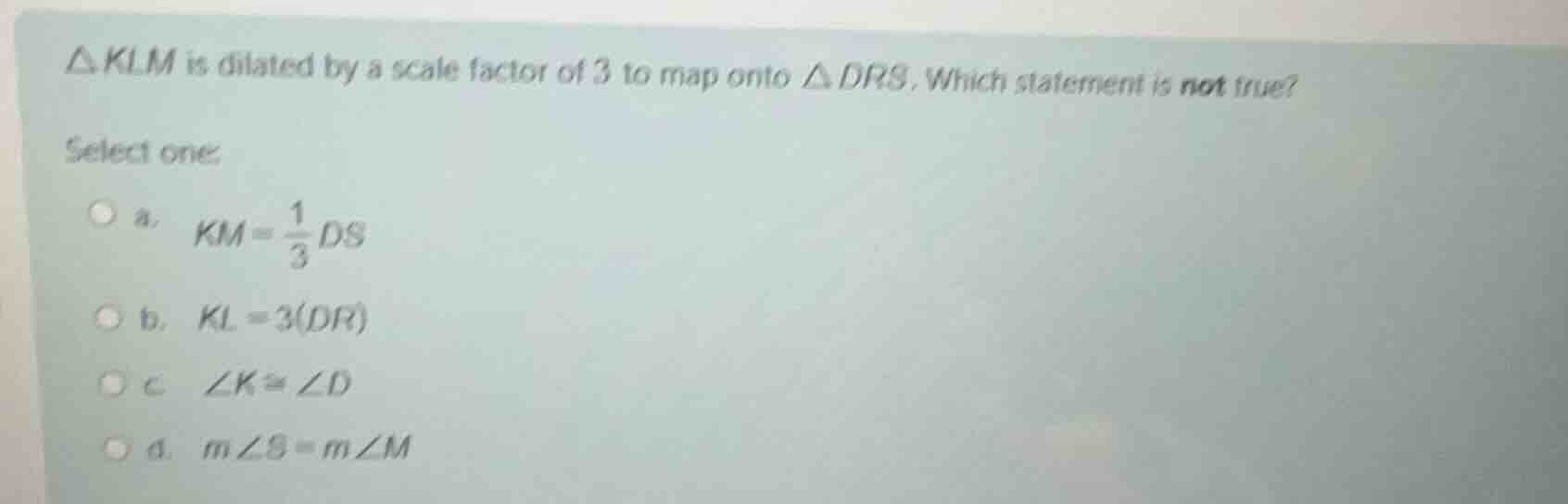
\\(\delta klm\\) is dilated by a scale factor of 3 to map onto \\(\delta drs\\). which statement is not true?
select one:
a. \\(km = \frac{1}{3} ds\\)
b. \\(kl = 3(dr)\\)
c. \\(\angle k \cong \angle d\\)
d. \\(m\angle s = m\angle m\\)
🆕 New Concept Discovered: Dilations and Similarity
How shapes change size but keep their angles and proportions.
Step 1: Understand the dilation mapping
When \(\Delta KLM\) is dilated to map onto \(\Delta DRS\), the corresponding vertices and sides match up in order:
- Vertex \(K\) corresponds to vertex \(D\)
- Vertex \(L\) corresponds to vertex \(R\)
- Vertex \(M\) corresponds to vertex \(S\)
This means \(\Delta KLM \sim \Delta DRS\) (the triangles are similar).
Step 2: Analyze the properties of dilation
A dilation by a scale factor of \(k = 3\) has two key properties:
- Angles stay the same: Corresponding angles are congruent.
- \(\angle K \cong \angle D\) (Statement c is true)
- \(m\angle M = m\angle S\) (Statement d is true)
- Sides change proportionally: Every side length of the new triangle (\(\Delta DRS\)) is \(3\) times the length of the corresponding side of the original triangle (\(\Delta KLM\)).
- \(DR = 3 \cdot KL\)
- \(RS = 3 \cdot LM\)
- \(DS = 3 \cdot KM\)
Step 3: Evaluate the side-length statements
Let's look at the remaining statements:
- Statement a: \(KM = \frac{1}{3} DS\)
Since \(DS = 3 \cdot KM\), dividing both sides by \(3\) gives \(KM = \frac{1}{3} DS\). This statement is true.
- Statement b: \(KL = 3(DR)\)
Since \(\Delta DRS\) is the larger image, the relationship is \(DR = 3(KL)\). Rearranging this gives \(KL = \frac{1}{3}(DR)\). Therefore, \(KL = 3(DR)\) is false.

Snap & solve any problem in the app
Get step-by-step solutions on Sovi AI
Photo-based solutions with guided steps
Explore more problems and detailed explanations
b. \(KL = 3(DR)\)