QUESTION IMAGE
Question
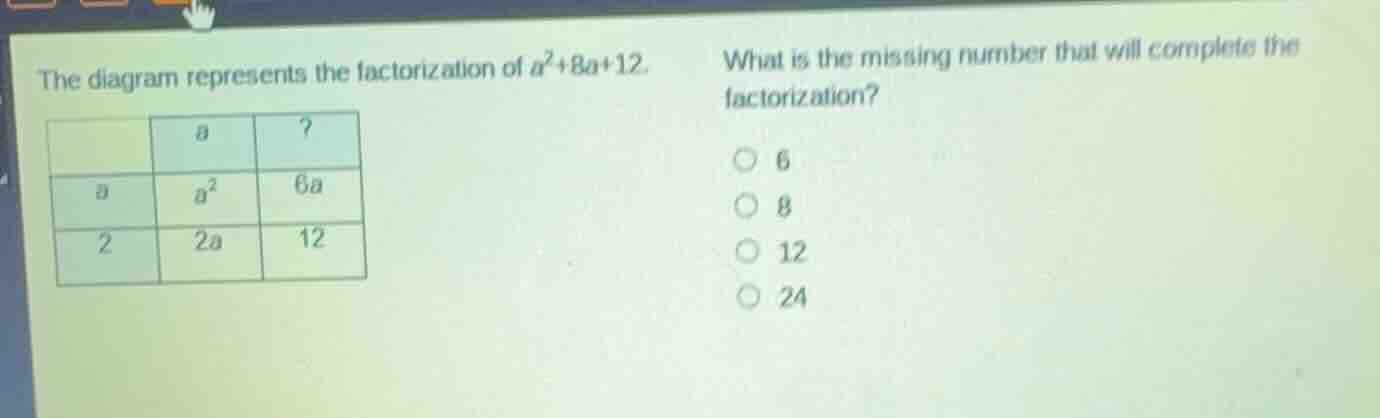
the diagram represents the factorization of \\(a^2+8a+12\\).
what is the missing number that will complete the factorization?
6
8
12
24
<pre_analysis>
{
"quality": "clear",
"question_count": 1,
"skills_matched": [
"step_cot",
"multiple_choice_formatter",
"explain_then_answer",
"quick"
],
"needs_drawing": false,
"concepts_used": [
"Area Model Multiplication",
"Factoring Polynomials"
],
"new_concepts": [],
"current_concepts": [
"Area Model Multiplication",
"Factoring Polynomials"
]
}
</pre_analysis>
<reasoning>
Analyze the area model structure
The table represents an area model for multiplying two binomials to factor \(a^2 + 8a + 12\).
The row headers are \(a\) and \(2\).
The column headers are \(a\) and \(?\).
Determine the missing value
The cell at the intersection of row \(a\) and column \(?\) contains \(6a\).
Therefore:
\[
a \times ? = 6a
\]
\[
? = 6
\]
Verify with other cells
The cell at the intersection of row \(2\) and column \(?\) contains \(12\).
Using \(? = 6\):
\[
2 \times 6 = 12
\]
This is consistent.
The sum of the inner cells is:
\[
a^2 + 6a + 2a + 12 = a^2 + 8a + 12
\]
This matches the target polynomial.
</reasoning>
<answer>
<mcq-correct>(A) 6</mcq-correct>
<mcq-option>(B) 8</mcq-option>
<mcq-option>(C) 12</mcq-option>
<mcq-option>(D) 24</mcq-option>
</answer>
<post_analysis>
{
"subject": "Mathematics",
"question_type": "Multiple Choice",
"knowledge_point": [
"Mathematics",
"Algebra",
"Area Model Multiplication"
]
}
</post_analysis>
Snap & solve any problem in the app
Get step-by-step solutions on Sovi AI
Photo-based solutions with guided steps
Explore more problems and detailed explanations
<pre_analysis>
{
"quality": "clear",
"question_count": 1,
"skills_matched": [
"step_cot",
"multiple_choice_formatter",
"explain_then_answer",
"quick"
],
"needs_drawing": false,
"concepts_used": [
"Area Model Multiplication",
"Factoring Polynomials"
],
"new_concepts": [],
"current_concepts": [
"Area Model Multiplication",
"Factoring Polynomials"
]
}
</pre_analysis>
<reasoning>
Analyze the area model structure
The table represents an area model for multiplying two binomials to factor \(a^2 + 8a + 12\).
The row headers are \(a\) and \(2\).
The column headers are \(a\) and \(?\).
Determine the missing value
The cell at the intersection of row \(a\) and column \(?\) contains \(6a\).
Therefore:
\[
a \times ? = 6a
\]
\[
? = 6
\]
Verify with other cells
The cell at the intersection of row \(2\) and column \(?\) contains \(12\).
Using \(? = 6\):
\[
2 \times 6 = 12
\]
This is consistent.
The sum of the inner cells is:
\[
a^2 + 6a + 2a + 12 = a^2 + 8a + 12
\]
This matches the target polynomial.
</reasoning>
<answer>
<mcq-correct>(A) 6</mcq-correct>
<mcq-option>(B) 8</mcq-option>
<mcq-option>(C) 12</mcq-option>
<mcq-option>(D) 24</mcq-option>
</answer>
<post_analysis>
{
"subject": "Mathematics",
"question_type": "Multiple Choice",
"knowledge_point": [
"Mathematics",
"Algebra",
"Area Model Multiplication"
]
}
</post_analysis>