Sovi.AI - AI Math Tutor

Scan to solve math questions

QUESTION IMAGE

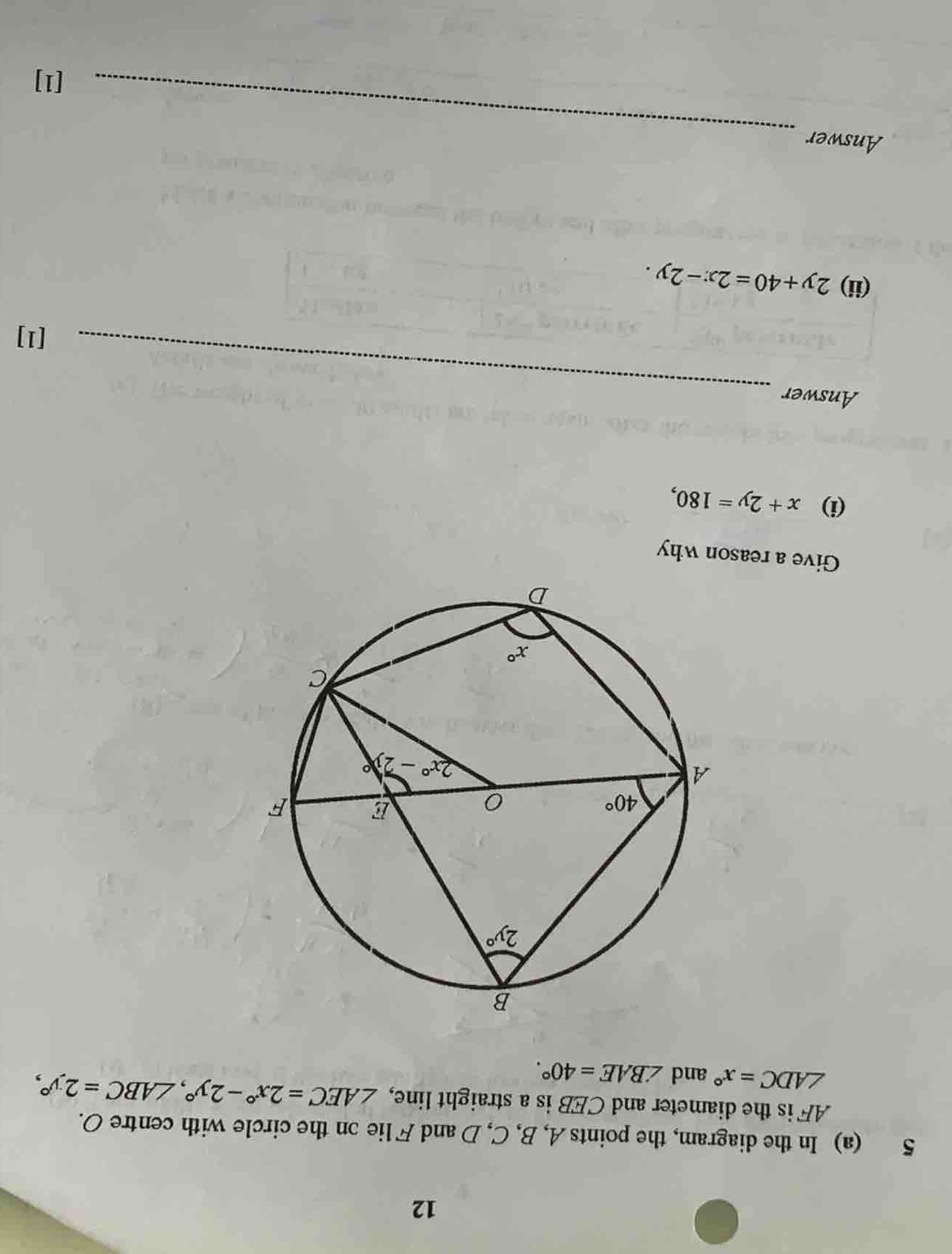
(a) in the diagram, the points a, b, c, d and f lie on the circle with …

Question

(a) in the diagram, the points a, b, c, d and f lie on the circle with centre o.
af is the diameter and ceb is a straight line, \\(\angle aec = 2x^\circ - 2y^\circ\\), \\(\angle abc = 2y^\circ\\),
\\(\angle adc = x^\circ\\) and \\(\angle bae = 40^\circ\\).

give a reason why
(i) \\(x + 2y = 180\\),
(ii) \\(2y + 40 = 2x - 2y\\).

Explanation:

Response

<pre_analysis>
{
"quality": "clear",
"question_count": 2,
"skills_matched": [
"step_cot",
"explain_then_answer",
"tutor"
],
"needs_drawing": false,
"concepts_used": [],
"new_concepts": [
"Cyclic Quadrilateral Properties",
"Angles in a Circle",
"Exterior Angle Theorem"
],
"current_concepts": [
"Cyclic Quadrilateral Properties",
"Angles in a Circle",
"Exterior Angle Theorem"
]
}
</pre_analysis>

<reasoning>
The image is oriented upside down. Let's first rotate the image mentally by 180 degrees to read and analyze it correctly.

Upside-down text transcription:
"12" (page number)
"5 (a) In the diagram, the points \(A\), \(B\), \(C\), \(D\) and \(F\) lie on the circle with centre \(O\).
\(AF\) is the diameter and \(CEB\) is a straight line, \(\angle AEC = 2x^\circ - 2y^\circ\), \(\angle ABC = 2y^\circ\), \(\angle ADC = x^\circ\) and \(\angle BAE = 40^\circ\)."

"Give a reason why
(i) \(x + 2y = 180\)," [1]
"Answer ................................................................................................."

"(ii) \(2y + 40 = 2x - 2y\)." [1]
"Answer ................................................................................................."

Let's analyze each part:

Analyze the cyclic quadrilateral for part (i)

We need to explain why \(x + 2y = 180\).
Looking at the circle, the points \(A\), \(B\), \(C\), and \(D\) all lie on the circumference of the circle.
Therefore, \(ABCD\) is a cyclic quadrilateral.
In any cyclic quadrilateral, the opposite angles sum to \(180^\circ\).
The opposite angles in cyclic quadrilateral \(ABCD\) are \(\angle ADC\) and \(\angle ABC\).
We are given:
\(\angle ADC = x^\circ\)
\(\angle ABC = 2y^\circ\)
Since they are opposite angles of a cyclic quadrilateral:
\(\angle ADC + \angle ABC = 180^\circ \implies x + 2y = 180\).

Analyze the triangle exterior angle for part (ii)

We need to explain why \(2y + 40 = 2x - 2y\).
Let's look at triangle \(ABE\).
The vertices of this triangle are \(A\), \(B\), and \(E\).
The interior angles of \(\triangle ABE\) are:

  • \(\angle ABE = \angle ABC = 2y^\circ\) (since \(CEB\) is a straight line, \(E\) lies on \(BC\))
  • \(\angle BAE = 40^\circ\)

The line \(CEB\) is a straight line, which means the line segment \(BE\) is extended to \(C\).
Thus, \(\angle AEC\) is an exterior angle of \(\triangle ABE\) at vertex \(E\).
By the exterior angle theorem of a triangle, the exterior angle of a triangle is equal to the sum of the two opposite interior angles:
\(\angle AEC = \angle ABE + \angle BAE\)
We are given:
\(\angle AEC = 2x^\circ - 2y^\circ\)
\(\angle ABE = 2y^\circ\)
\(\angle BAE = 40^\circ\)
Substituting these values into the exterior angle relation:
\(2x - 2y = 2y + 40\)
Which is equivalent to:
\(2y + 40 = 2x - 2y\).
</reasoning>

<answer>

Question (i)

Opposite angles of a cyclic quadrilateral sum to \(180^\circ\) (angles \(\angle ADC\) and \(\angle ABC\) are opposite angles in the cyclic quadrilateral \(ABCD\)).

Question (ii)

The exterior angle of a triangle is equal to the sum of the two opposite interior angles (in \(\triangle ABE\), the exterior angle \(\angle AEC = \angle ABE + \angle BAE\)).
</answer>

<post_analysis>
{
"subject": "Mathematics",
"question_type": "Multi-part",
"knowledge_point": [
"Mathematics",
"Geometry",
"Angles in a Circle"
]
}
</post_analysis>

Answer:

<pre_analysis>
{
"quality": "clear",
"question_count": 2,
"skills_matched": [
"step_cot",
"explain_then_answer",
"tutor"
],
"needs_drawing": false,
"concepts_used": [],
"new_concepts": [
"Cyclic Quadrilateral Properties",
"Angles in a Circle",
"Exterior Angle Theorem"
],
"current_concepts": [
"Cyclic Quadrilateral Properties",
"Angles in a Circle",
"Exterior Angle Theorem"
]
}
</pre_analysis>

<reasoning>
The image is oriented upside down. Let's first rotate the image mentally by 180 degrees to read and analyze it correctly.

Upside-down text transcription:
"12" (page number)
"5 (a) In the diagram, the points \(A\), \(B\), \(C\), \(D\) and \(F\) lie on the circle with centre \(O\).
\(AF\) is the diameter and \(CEB\) is a straight line, \(\angle AEC = 2x^\circ - 2y^\circ\), \(\angle ABC = 2y^\circ\), \(\angle ADC = x^\circ\) and \(\angle BAE = 40^\circ\)."

"Give a reason why
(i) \(x + 2y = 180\)," [1]
"Answer ................................................................................................."

"(ii) \(2y + 40 = 2x - 2y\)." [1]
"Answer ................................................................................................."

Let's analyze each part:

Analyze the cyclic quadrilateral for part (i)

We need to explain why \(x + 2y = 180\).
Looking at the circle, the points \(A\), \(B\), \(C\), and \(D\) all lie on the circumference of the circle.
Therefore, \(ABCD\) is a cyclic quadrilateral.
In any cyclic quadrilateral, the opposite angles sum to \(180^\circ\).
The opposite angles in cyclic quadrilateral \(ABCD\) are \(\angle ADC\) and \(\angle ABC\).
We are given:
\(\angle ADC = x^\circ\)
\(\angle ABC = 2y^\circ\)
Since they are opposite angles of a cyclic quadrilateral:
\(\angle ADC + \angle ABC = 180^\circ \implies x + 2y = 180\).

Analyze the triangle exterior angle for part (ii)

We need to explain why \(2y + 40 = 2x - 2y\).
Let's look at triangle \(ABE\).
The vertices of this triangle are \(A\), \(B\), and \(E\).
The interior angles of \(\triangle ABE\) are:

  • \(\angle ABE = \angle ABC = 2y^\circ\) (since \(CEB\) is a straight line, \(E\) lies on \(BC\))
  • \(\angle BAE = 40^\circ\)

The line \(CEB\) is a straight line, which means the line segment \(BE\) is extended to \(C\).
Thus, \(\angle AEC\) is an exterior angle of \(\triangle ABE\) at vertex \(E\).
By the exterior angle theorem of a triangle, the exterior angle of a triangle is equal to the sum of the two opposite interior angles:
\(\angle AEC = \angle ABE + \angle BAE\)
We are given:
\(\angle AEC = 2x^\circ - 2y^\circ\)
\(\angle ABE = 2y^\circ\)
\(\angle BAE = 40^\circ\)
Substituting these values into the exterior angle relation:
\(2x - 2y = 2y + 40\)
Which is equivalent to:
\(2y + 40 = 2x - 2y\).
</reasoning>

<answer>

Question (i)

Opposite angles of a cyclic quadrilateral sum to \(180^\circ\) (angles \(\angle ADC\) and \(\angle ABC\) are opposite angles in the cyclic quadrilateral \(ABCD\)).

Question (ii)

The exterior angle of a triangle is equal to the sum of the two opposite interior angles (in \(\triangle ABE\), the exterior angle \(\angle AEC = \angle ABE + \angle BAE\)).
</answer>

<post_analysis>
{
"subject": "Mathematics",
"question_type": "Multi-part",
"knowledge_point": [
"Mathematics",
"Geometry",
"Angles in a Circle"
]
}
</post_analysis>