QUESTION IMAGE
Question
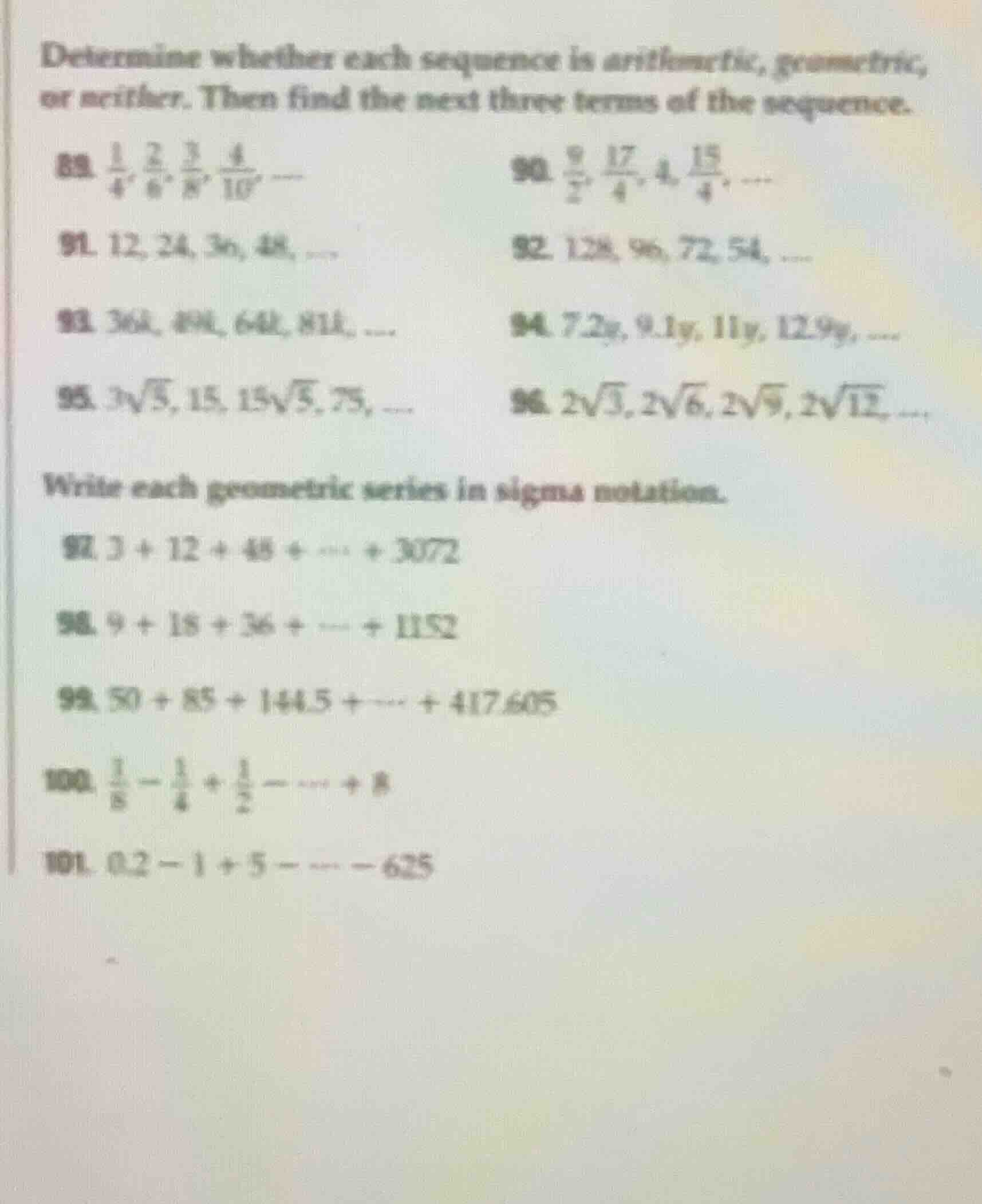
determine whether each sequence is arithmetic, geometric, or neither. then find the next three terms of the sequence.
- \\(\frac{1}{4}, \frac{2}{6}, \frac{3}{8}, \frac{4}{10}, \dots\\)
- \\(\frac{9}{2}, \frac{17}{4}, 4, \frac{15}{4}, \dots\\)
- \\(12, 24, 36, 48, \dots\\)
- \\(128, 96, 72, 54, \dots\\)
- \\(36k, 49k, 64k, 81k, \dots\\)
- \\(7.2y, 9.1y, 11y, 12.9y, \dots\\)
- \\(3\sqrt{5}, 15, 15\sqrt{5}, 75, \dots\\)
- \\(2\sqrt{3}, 2\sqrt{6}, 2\sqrt{9}, 2\sqrt{12}, \dots\\)
write each geometric series in sigma notation.
- \\(3 + 12 + 48 + \dots + 3072\\)
- \\(9 + 18 + 36 + \dots + 1152\\)
- \\(50 + 85 + 144.5 + \dots + 417.605\\)
- \\(\frac{1}{8} - \frac{1}{4} + \frac{1}{2} - \dots + 8\\)
- \\(0.2 - 1 + 5 - \dots - 625\\)
Classify and extend sequences (89-96)
- 89: \(\frac{1}{4}, \frac{2}{6}, \frac{3}{8}, \frac{4}{10}, \dots\)
- Differences: \(\frac{1}{3} - \frac{1}{4} = \frac{1}{12}\), \(\frac{3}{8} - \frac{1}{3} = \frac{1}{24}\) (not arithmetic).
- Ratios: \(\frac{4}{3}
e \frac{9}{8}\) (not geometric).
- Pattern: \(\frac{n}{2n+2}\). Next terms: \(\frac{5}{12}, \frac{6}{14} = \frac{3}{7}, \frac{7}{16}\).
- 90: \(\frac{9}{2}, \frac{17}{4}, 4, \frac{15}{4}, \dots \Rightarrow \frac{18}{4}, \frac{17}{4}, \frac{16}{4}, \frac{15}{4}, \dots\)
- Arithmetic with \(d = -\frac{1}{4}\).
- Next terms: \(\frac{14}{4} = \frac{7}{2}, \frac{13}{4}, \frac{12}{4} = 3\).
- 91: \(12, 24, 36, 48, \dots\)
- Arithmetic with \(d = 12\).
- Next terms: \(60, 72, 84\).
- 92: \(128, 96, 72, 54, \dots\)
- Ratios: \(\frac{96}{128} = \frac{3}{4}\), \(\frac{72}{96} = \frac{3}{4}\), \(\frac{54}{72} = \frac{3}{4}\). Geometric with \(r = \frac{3}{4}\).
- Next terms: \(54 \cdot \frac{3}{4} = \frac{81}{2} = 40.5\), \(\frac{81}{2} \cdot \frac{3}{4} = \frac{243}{8} = 30.375\), \(\frac{243}{8} \cdot \frac{3}{4} = \frac{729}{32} = 22.78125\).
- 93: \(36k, 49k, 64k, 81k, \dots\)
- Pattern: \(n^2 k\) starting at \(n=6\). Neither arithmetic nor geometric.
- Next terms: \(100k, 121k, 144k\).
- 94: \(7.2y, 9.1y, 11y, 12.9y, \dots\)
- Arithmetic with \(d = 1.9y\).
- Next terms: \(14.8y, 16.7y, 18.6y\).
- 95: \(3\sqrt{5}, 15, 15\sqrt{5}, 75, \dots\)
- Geometric with \(r = \sqrt{5}\).
- Next terms: \(75\sqrt{5}, 375, 375\sqrt{5}\).
- 96: \(2\sqrt{3}, 2\sqrt{6}, 2\sqrt{9}, 2\sqrt{12}, \dots \Rightarrow 2\sqrt{3}, 2\sqrt{6}, 6, 4\sqrt{3}, \dots\)
- Neither arithmetic nor geometric.
- Next terms: \(2\sqrt{15}, 2\sqrt{18} = 6\sqrt{2}, 2\sqrt{21}\).
Write geometric series in sigma notation (97-101)
- 97: \(3 + 12 + 48 + \dots + 3072\)
- \(a_1 = 3\), \(r = 4\).
- \(3 \cdot 4^{n-1} = 3072 \Rightarrow 4^{n-1} = 1024 \Rightarrow n-1 = 5 \Rightarrow n = 6\).
- \(\sum_{k=1}^{6} 3(4)^{k-1}\).
- 98: \(9 + 18 + 36 + \dots + 1152\)
- \(a_1 = 9\), \(r = 2\).
- \(9 \cdot 2^{n-1} = 1152 \Rightarrow 2^{n-1} = 128 \Rightarrow n-1 = 7 \Rightarrow n = 8\).
- \(\sum_{k=1}^{8} 9(2)^{k-1}\).
- 99: \(50 + 85 + 144.5 + \dots + 417.605\)
- \(a_1 = 50\), \(r = 1.7\).
- \(50 \cdot (1.7)^{n-1} = 417.605 \Rightarrow (1.7)^{n-1} = 8.3521 \Rightarrow n-1 = 4 \Rightarrow n = 5\).
- \(\sum_{k=1}^{5} 50(1.7)^{k-1}\).
- 100: \(\frac{1}{8} - \frac{1}{4} + \frac{1}{2} - \dots + 8\)
- \(a_1 = \frac{1}{8}\), \(r = -2\).
- \(\frac{1}{8} \cdot (-2)^{n-1} = 8 \Rightarrow (-2)^{n-1} = 64 \Rightarrow n-1 = 6 \Rightarrow n = 7\).
- \(\sum_{k=1}^{7} \frac{1}{8}(-2)^{k-1}\).
- 101: \(0.2 - 1 + 5 - \dots - 625\)
- \(a_1 = 0.2\), \(r = -5\).
- \(0.2 \cdot (-5)^{n-1} = -625 \Rightarrow (-5)^{n-1} = -3125 \Rightarrow n-1 = 5 \Rightarrow n = 6\).
- \(\sum_{k=1}^{6} 0.2(-5)^{k-1}\).

Snap & solve any problem in the app
Get step-by-step solutions on Sovi AI
Photo-based solutions with guided steps
Explore more problems and detailed explanations
Question 89
- Classification: Neither
- Next three terms: \(\frac{5}{12}, \frac{3}{7}, \frac{7}{16}\)
Question 90
- Classification: Arithmetic
- Next three terms: \(\frac{7}{2}, \frac{13}{4}, 3\)
Question 91
- Classification: Arithmetic
- Next three terms: \(60, 72, 84\)
Question 92
- Classification: Geometric
- Next three terms: \(\frac{81}{2}, \frac{243}{8}, \frac{729}{32}\) (or \(40.5, 30.375, 22.78125\))
Question 93
- Classification: Neither
- Next three terms: \(100k, 121k, 144k\)
Question 94
- Classification: Arithmetic
- Next three terms: \(14.8y, 16.7y, 18.6y\)
Question 95
- Classification: Geometric
- Next three terms: \(75\sqrt{5}, 375, 375\sqrt{5}\)
Question 96
- Classification: Neither
- Next three terms: \(2\sqrt{15}, 6\sqrt{2}, 2\sqrt{21}\)
Question 97
$$\sum_{k=1}^{6} 3(4)^{k-1}$$
Question 98
$$\sum_{k=1}^{8} 9(2)^{k-1}$$
Question 99
$$\sum_{k=1}^{5} 50(1.7)^{k-1}$$
Question 100
$$\sum_{k=1}^{7} \frac{1}{8}(-2)^{k-1}$$
Question 101
$$\sum_{k=1}^{6} 0.2(-5)^{k-1}$$