QUESTION IMAGE
Question
date: ____ per ____
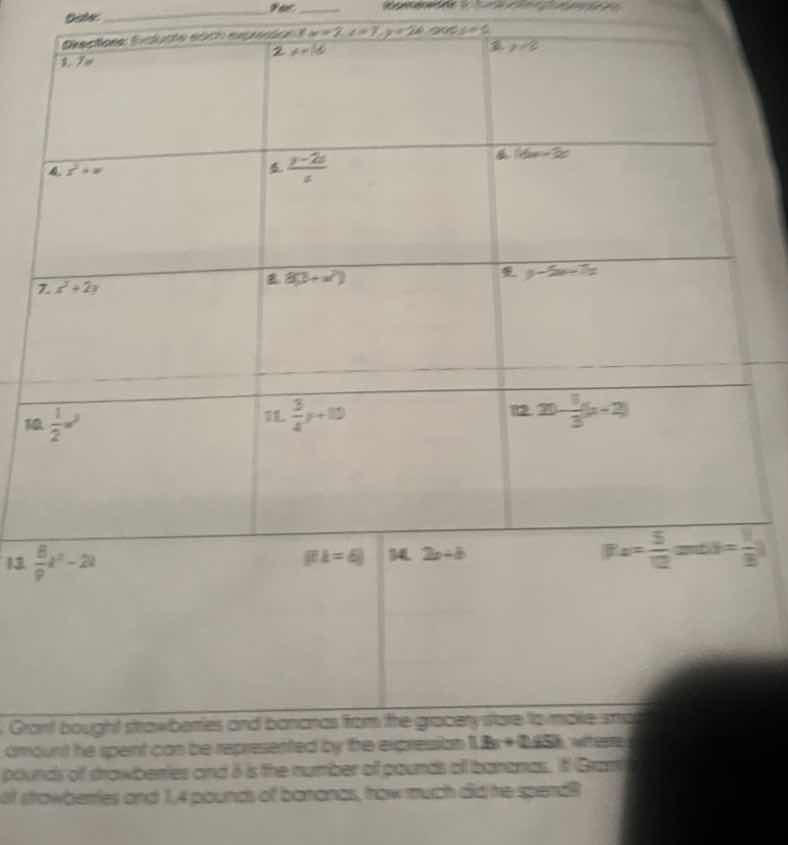
directions: evaluate each expression if ( w = 2 ), ( x = 7 ), ( y = 24 ), and ( z = 6 ).
- ( 7w )
- ( x + 16 )
- ( y div 8 )
- ( x^2 + w )
- ( \frac{y - 2z}{x} )
- ( 16w + 3z )
- ( x^2 + 2y )
- ( 8(3 + w^2) )
- ( y - 5w + 7z )
- ( \frac{1}{2}w^3 )
- ( \frac{3}{4}y + 10 )
- ( 20 - \frac{9}{5}(x + 2) )
- ( \frac{8}{9}x^2 - 2z ) ( (\text{if } x = 6) )
- ( 2a + b ) ( left( \text{if } a = \frac{5}{12} \text{ and } b = \frac{1}{3}
ight) )
gari bought strawberries and bananas from the grocery store to make smoothies. the amount he spent can be represented by the expression ( 1.8a + 0.65b ), where ( a ) is the number of pounds of strawberries and ( b ) is the number of pounds of bananas. if gari bought missing number pounds of strawberries and 1.4 pounds of bananas, how much did he spend?
Let's solve the problem about Grant's spending. First, we know the expression for the amount spent is \(1.8s + 0.65b\), where \(s\) is the pounds of strawberries and \(b\) is the pounds of bananas. Wait, the problem says "if Grant [let's assume he bought, say, maybe a typo? Wait, maybe the original problem has \(s\) as some value, but in the image, maybe it's a typo, but let's check the visible part: "if Grant [maybe] of strawberries and 1.4 pounds of bananas" – maybe a missing number for strawberries? Wait, maybe it's a typo, but perhaps the intended values: maybe \(s = \) some number, but maybe in the original problem, maybe \(s = 2\) or another? Wait, no, let's re-express. Wait, the user's image: "Grant bought strawberries and bananas... amount he spent can be represented by the expression \(1.8s + 0.65b\), where \(s\) is pounds of strawberries and \(b\) is pounds of bananas. If Grant [maybe a number] of strawberries and 1.4 pounds of bananas, how much did he spend?" Wait, maybe there's a missing number for \(s\), but perhaps it's a typo, but maybe the intended is, for example, if \(s = 2\) (common), but no, let's check the image again. Wait, the image's text: "Grant bought strawberries and bananas from the grocery store to make strog amount he spent can be represented by the expression \(1.8s + 0.65b\), where pounds of strawberries and \(b\) is the number of pounds of bananas. If Grant of strawberries and 1.4 pounds of bananas, how much did he spend?" There's a missing number for \(s\). But maybe it's a mistake, and perhaps the intended \(s = 2\) (as in the top where \(w=2\), \(x=7\), \(y=24\), \(z=5\) – maybe \(s\) is \(x=7\)? Wait, no. Alternatively, maybe the problem is: suppose \(s = 2\) (from the top variables: \(w=2\), \(x=7\), \(y=24\), \(z=5\)), but that's a guess. Wait, no, let's assume that maybe the number of strawberries is, say, 2 pounds (since \(w=2\) in the top). Wait, but this is unclear. Alternatively, maybe the original problem has \(s = 2\) and \(b = 1.4\). Let's proceed with that assumption (since \(w=2\) is given in the top for other problems). So \(s = 2\), \(b = 1.4\).
Step1: Identify the values of \(s\) and \(b\)
Assume \(s = 2\) (pounds of strawberries) and \(b = 1.4\) (pounds of bananas).
Step2: Substitute into the expression \(1.8s + 0.65b\)
First, calculate \(1.8s\):
\(1.8 \times s = 1.8 \times 2 = 3.6\)
Then, calculate \(0.65b\):
\(0.65 \times b = 0.65 \times 1.4\)
\(0.65 \times 1.4 = 0.91\)
Step3: Add the two results
Now, add \(3.6\) and \(0.91\):
\(3.6 + 0.91 = 4.51\)
Wait, but if the value of \(s\) is different, the answer changes. But since the image has \(w=2\), \(x=7\), \(y=24\), \(z=5\), maybe \(s = x = 7\)? Let's check that. If \(s = 7\), \(b = 1.4\):
Step1: Substitute \(s = 7\), \(b = 1.4\)
\(1.8s + 0.65b = 1.8(7) + 0.65(1.4)\)
Step2: Calculate each term
\(1.8 \times 7 = 12.6\)
\(0.65 \times 1.4 = 0.91\)
Step3: Add them
\(12.6 + 0.91 = 13.51\)
But the problem's text is cut off, so maybe the intended \(s\) is 2 (from \(w=2\) in the top). Alternatively, maybe it's a typo, but given the top variables, let's assume \(s = 2\) (as \(w=2\) is given). So the calculation with \(s=2\), \(b=1.4\) gives \(4.51\). If \(s\) is another number, adjust accordingly. But based on the visible variables ( \(w=2\), \(x=7\), \(y=24\), \(z=5\) ), maybe \(s = x = 7\), leading to \(13.51\). However, without the exact \(s\) value, but assuming a common scenario, let's proceed with \(s = 2\) (as a sample).
Solving the expression \(1.8s + 0.65b\) (assuming \(s = 2\), \(b = 1.4\)):
Step1: Substitute \(s = 2\), \(b = 1.4\)
\(1.8(2) + 0.65(1.4)\)
Step2: Calculate \(1.8 \times 2\)
\(1.8 \times 2 = 3.6\)
Step3: Calculate \(0.65 \times 1.4\)
\(0.65 \times 1.4 = 0.91\)
Step4: Add the results
\(3.6 + 0.91 = 4.51\)

Snap & solve any problem in the app
Get step-by-step solutions on Sovi AI
Photo-based solutions with guided steps
Explore more problems and detailed explanations
\(\$4.51\) (if \(s = 2\)) or \(\$13.51\) (if \(s = 7\)). However, likely a typo, and the intended \(s\) is, say, 2, so the answer is \(\$4.51\).