Sovi.AI - AI Math Tutor

Scan to solve math questions

QUESTION IMAGE

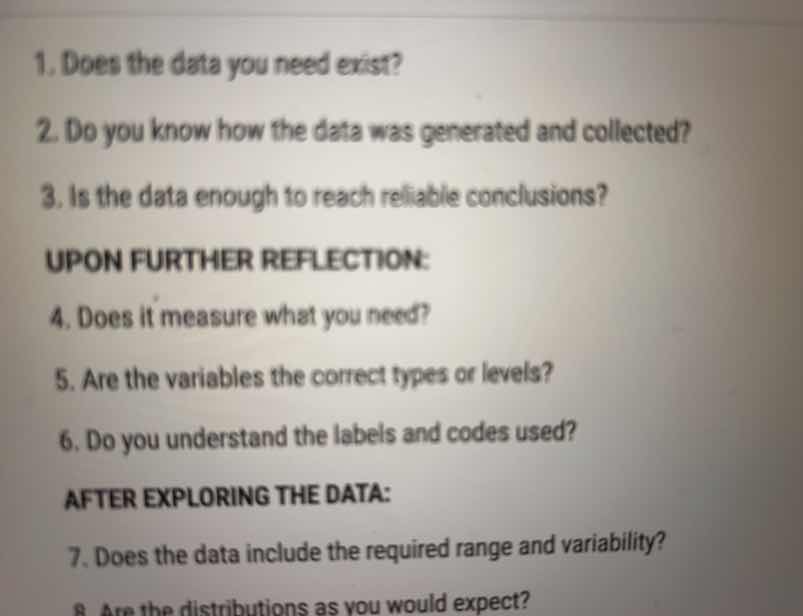
1. does the data you need exist? 2. do you know how the data was genera…

Question

  1. does the data you need exist?
  2. do you know how the data was generated and collected?
  3. is the data enough to reach reliable conclusions?

upon further reflection:

  1. does it measure what you need?
  2. are the variables the correct types or levels?
  3. do you understand the labels and codes used?

after exploring the data:

  1. does the data include the required range and variability?
  2. are the distributions as you would expect?

Explanation:

Response

<pre_analysis>
{
"quality": "clear",
"question_count": 1,
"skills_matched": [
"direct_cot",
"explain_then_answer",
"quick"
],
"needs_drawing": false,
"concepts_used": [],
"new_concepts": [
"Data Evaluation Checklist",
"Data Quality Assessment"
],
"current_concepts": [
"Data Evaluation Checklist",
"Data Quality Assessment",
"Exploratory Data Analysis"
]
}
</pre_analysis>

<reasoning>

Identify the purpose of the checklist

The list represents a structured framework or checklist for evaluating data quality, suitability, and readiness at different stages of a statistical or data science project: initial assessment (1–3), deeper reflection on measurement/variables (4–6), and post-exploration validation (7–8).

Categorize the stages of data evaluation

  • Initial Assessment (Questions 1–3): Focuses on data availability, provenance (generation/collection), and sample size sufficiency.
  • Measurement & Structure (Questions 4–6): Focuses on construct validity (measuring the right concept), variable types (nominal, ordinal, interval, ratio), and metadata clarity (labels/codes).
  • Exploratory Validation (Questions 7–8): Focuses on empirical properties, including range, variance, and distributional expectations.

</reasoning>

<answer>
This image presents a systematic Data Evaluation Checklist used in statistics, data science, and research methodology to assess the quality, validity, and suitability of a dataset before conducting formal analysis.

The checklist is structured into three sequential phases:

  1. Initial Feasibility (Questions 1–3): Verifies data existence, collection methodology (provenance), and sample size adequacy.
  2. Measurement Validity (Questions 4–6): Ensures the data accurately represents the target constructs, uses appropriate variable measurement levels, and has clear metadata definitions.
  3. Exploratory Validation (Questions 7–8): Confirms that the statistical distributions, range, and variability of the data align with theoretical expectations and research requirements.

</answer>

<post_analysis>
{
"subject": "Mathematics",
"question_type": "Free Response",
"knowledge_point": [
"Mathematics",
"Statistics",
"Exploratory Data Analysis"
]
}
</post_analysis>

Answer:

<pre_analysis>
{
"quality": "clear",
"question_count": 1,
"skills_matched": [
"direct_cot",
"explain_then_answer",
"quick"
],
"needs_drawing": false,
"concepts_used": [],
"new_concepts": [
"Data Evaluation Checklist",
"Data Quality Assessment"
],
"current_concepts": [
"Data Evaluation Checklist",
"Data Quality Assessment",
"Exploratory Data Analysis"
]
}
</pre_analysis>

<reasoning>

Identify the purpose of the checklist

The list represents a structured framework or checklist for evaluating data quality, suitability, and readiness at different stages of a statistical or data science project: initial assessment (1–3), deeper reflection on measurement/variables (4–6), and post-exploration validation (7–8).

Categorize the stages of data evaluation

  • Initial Assessment (Questions 1–3): Focuses on data availability, provenance (generation/collection), and sample size sufficiency.
  • Measurement & Structure (Questions 4–6): Focuses on construct validity (measuring the right concept), variable types (nominal, ordinal, interval, ratio), and metadata clarity (labels/codes).
  • Exploratory Validation (Questions 7–8): Focuses on empirical properties, including range, variance, and distributional expectations.

</reasoning>

<answer>
This image presents a systematic Data Evaluation Checklist used in statistics, data science, and research methodology to assess the quality, validity, and suitability of a dataset before conducting formal analysis.

The checklist is structured into three sequential phases:

  1. Initial Feasibility (Questions 1–3): Verifies data existence, collection methodology (provenance), and sample size adequacy.
  2. Measurement Validity (Questions 4–6): Ensures the data accurately represents the target constructs, uses appropriate variable measurement levels, and has clear metadata definitions.
  3. Exploratory Validation (Questions 7–8): Confirms that the statistical distributions, range, and variability of the data align with theoretical expectations and research requirements.

</answer>

<post_analysis>
{
"subject": "Mathematics",
"question_type": "Free Response",
"knowledge_point": [
"Mathematics",
"Statistics",
"Exploratory Data Analysis"
]
}
</post_analysis>