QUESTION IMAGE
Question
data analysis: metastatic cancer
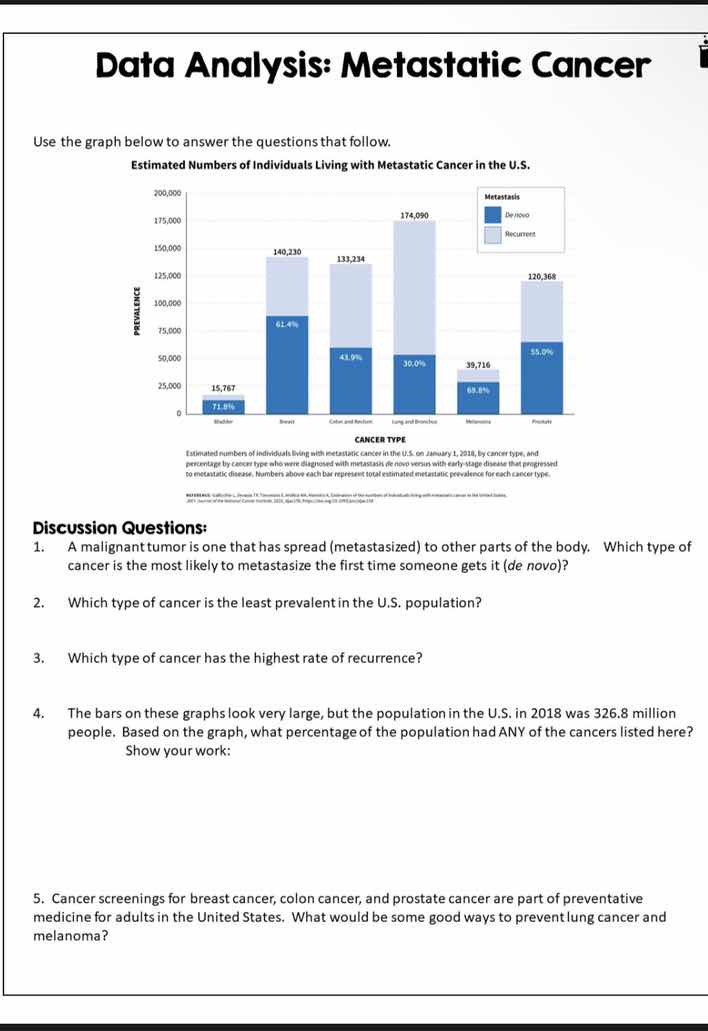
use the graph below to answer the questions that follow.
discussion questions:
- a malignant tumor is one that has spread (metastasized) to other parts of the body. which type of cancer is the most likely to metastasize the first time someone gets it (de novo)?
- which type of cancer is the least prevalent in the u.s. population?
- which type of cancer has the highest rate of recurrence?
- the bars on these graphs look very large, but the population in the u.s. in 2018 was 326.8 million people. based on the graph, what percentage of the population had any of the cancers listed here?
show your work:
- cancer screenings for breast cancer, colon cancer, and prostate cancer are part of preventative medicine for adults in the united states. what would be some good ways to prevent lung cancer and melanoma?
Identify the cancer type most likely to metastasize de novo
The percentage of de novo metastasis is represented by the dark blue portion of each bar and labeled with a percentage. Comparing the percentages:
- Bladder: \(71.8\%\)
- Breast: \(61.4\%\)
- Colon and Rectum: \(43.9\%\)
- Lung and Bronchus: \(30.0\%\)
- Melanoma: \(69.8\%\)
- Prostate: \(55.0\%\)
The highest percentage is Bladder cancer at \(71.8\%\).
Identify the least prevalent cancer type
Prevalence is represented by the total height of each bar, with the total number of individuals written above each bar:
- Bladder: \(15,767\)
- Breast: \(140,230\)
- Colon and Rectum: \(133,234\)
- Lung and Bronchus: \(174,090\)
- Melanoma: \(39,716\)
- Prostate: \(120,368\)
The lowest total number is Bladder cancer with \(15,767\) individuals.
Identify the cancer type with the highest rate of recurrence
The recurrence rate is represented by the light blue portion of the bar, which is \(100\% - \text{de novo percentage}\):
- Bladder: \(100\% - 71.8\% = 28.2\%\)
- Breast: \(100\% - 61.4\% = 38.6\%\)
- Colon and Rectum: \(100\% - 43.9\% = 56.1\%\)
- Lung and Bronchus: \(100\% - 30.0\% = 70.0\%\)
- Melanoma: \(100\% - 69.8\% = 30.2\%\)
- Prostate: \(100\% - 55.0\% = 45.0\%\)
The highest recurrence rate is Lung and Bronchus cancer at \(70.0\%\).
Calculate the percentage of the U.S. population with any of these cancers
Sum the total estimated numbers of individuals:
Divide by the 2018 U.S. population (\(326.8\text{ million} = 326,800,000\)) and multiply by 100:
Determine prevention strategies for lung cancer and melanoma
- Lung cancer: Avoid smoking, avoid secondhand smoke, and limit exposure to radon or industrial carcinogens.
- Melanoma: Wear sunscreen, avoid UV radiation/tanning beds, wear protective clothing, and seek shade.

Snap & solve any problem in the app
Get step-by-step solutions on Sovi AI
Photo-based solutions with guided steps
Explore more problems and detailed explanations
Question 1
Bladder cancer (\(71.8\%\))
Question 2
Bladder cancer (\(15,767\) individuals)
Question 3
Lung and Bronchus cancer (\(70.0\%\) recurrence rate)
Question 4
Question 5
- Lung cancer prevention: Avoid smoking tobacco, avoid secondhand smoke, and test homes for radon gas.
- Melanoma prevention: Apply broad-spectrum sunscreen (SPF 30 or higher), avoid artificial UV radiation (tanning beds), wear protective clothing, and limit direct sun exposure during peak hours.