QUESTION IMAGE
Question
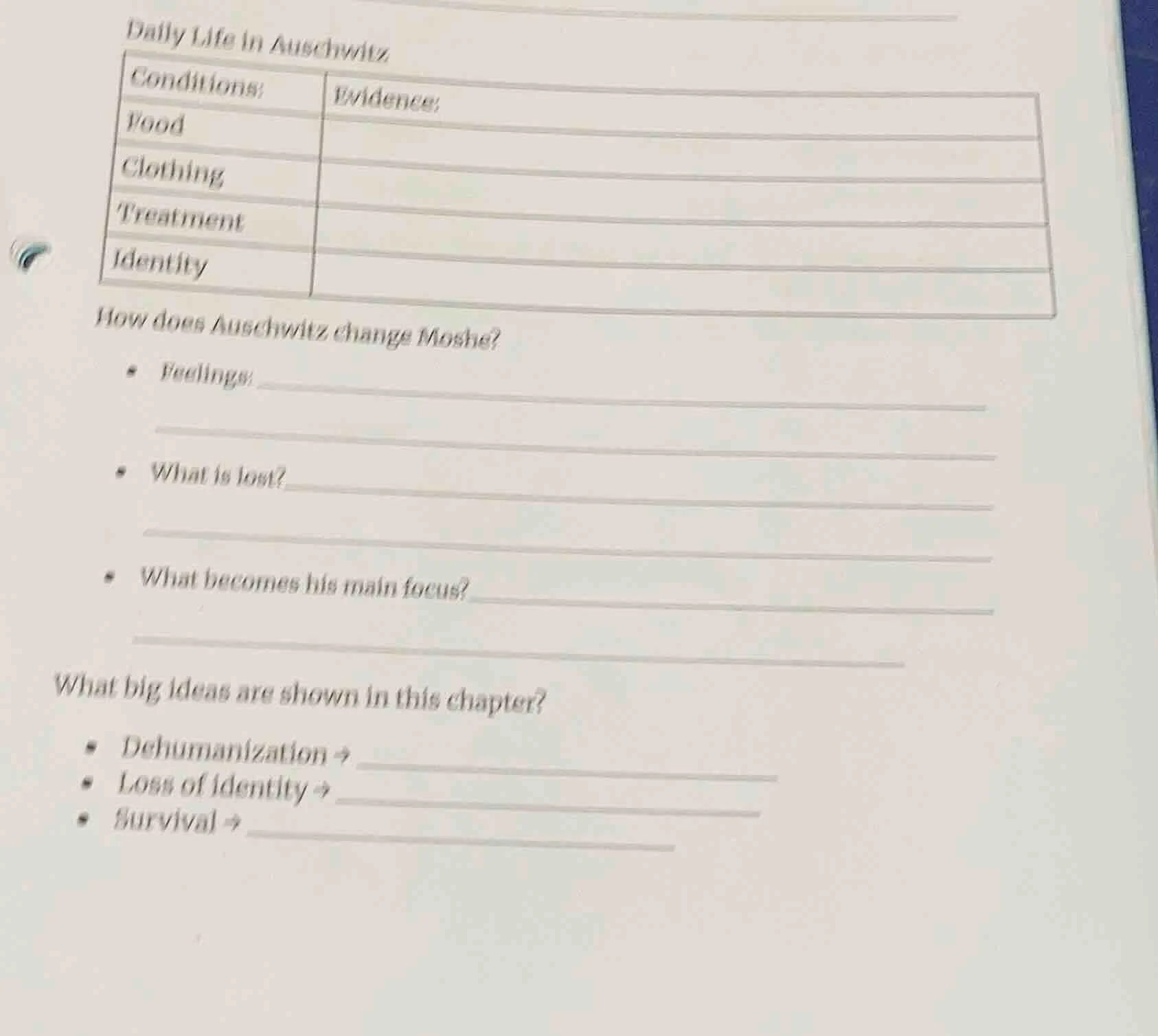
daily life in auschwitz
conditions: | evidence:
food |
clothing |
treatment |
identity |
how does auschwitz change moshe?
- feelings:
- what is lost?
- what becomes his main focus?
what big ideas are shown in this chapter?
- dehumanization →
- loss of identity →
- survival →
To answer these questions, we analyze the context of Auschwitz (from "Night" by Elie Wiesel, assuming Moshe is a character experiencing its horrors):
1. Daily Life in Auschwitz (Table Completion)
| Conditions | Evidence |
|---|---|
| Clothing | Prisoner uniforms (striped pajamas), lack of warmth, ragged conditions. |
| Treatment | Brutal labor, beatings, dehumanizing abuse, medical experiments (for some). |
| Identity | Loss of personal identity (tattooed numbers, stripped of names, forced uniformity). |
2. How does Auschwitz change Moshe?
- Feelings: From hopeful/innocent to traumatized, desensitized, or filled with despair/fear.
- What is lost?: His humanity, innocence, sense of self, and connections to pre - camp life.
- What becomes his main focus?: Survival (finding food, avoiding punishment, staying alive).
3. Big Ideas in the Chapter
- Dehumanization → Prisoners are treated as objects (e.g., numbered, starved, forced labor).
- Loss of Identity → Stripped of names, individuality, and personal history (uniforms, tattoos).
- Survival → The struggle to stay alive becomes the primary goal (prioritizing food, safety, and endurance).
These answers reflect the historical and literary context of Auschwitz’s dehumanizing environment and its impact on prisoners.

Snap & solve any problem in the app
Get step-by-step solutions on Sovi AI
Photo-based solutions with guided steps
Explore more problems and detailed explanations
To answer these questions, we analyze the context of Auschwitz (from "Night" by Elie Wiesel, assuming Moshe is a character experiencing its horrors):
1. Daily Life in Auschwitz (Table Completion)
| Conditions | Evidence |
|---|---|
| Clothing | Prisoner uniforms (striped pajamas), lack of warmth, ragged conditions. |
| Treatment | Brutal labor, beatings, dehumanizing abuse, medical experiments (for some). |
| Identity | Loss of personal identity (tattooed numbers, stripped of names, forced uniformity). |
2. How does Auschwitz change Moshe?
- Feelings: From hopeful/innocent to traumatized, desensitized, or filled with despair/fear.
- What is lost?: His humanity, innocence, sense of self, and connections to pre - camp life.
- What becomes his main focus?: Survival (finding food, avoiding punishment, staying alive).
3. Big Ideas in the Chapter
- Dehumanization → Prisoners are treated as objects (e.g., numbered, starved, forced labor).
- Loss of Identity → Stripped of names, individuality, and personal history (uniforms, tattoos).
- Survival → The struggle to stay alive becomes the primary goal (prioritizing food, safety, and endurance).
These answers reflect the historical and literary context of Auschwitz’s dehumanizing environment and its impact on prisoners.