QUESTION IMAGE
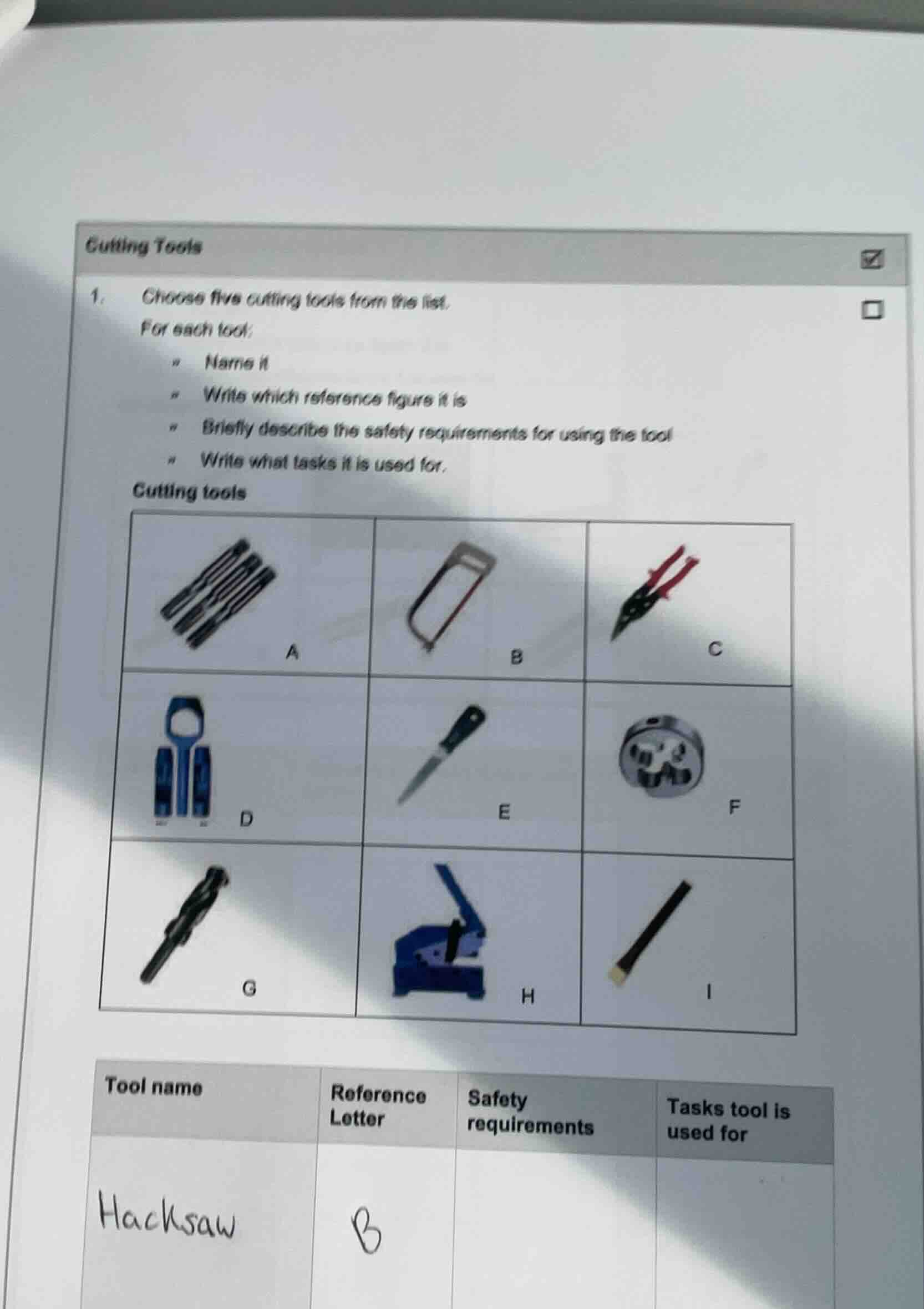
Question
cutting tools
- choose five cutting tools from the list.
for each tool:
- name it
- write which reference figure it is
- briefly describe the safety requirements for using the tool
- write what tasks it is used for.
cutting tools
tool name | reference letter | safety requirements | tasks tool is used for
hacksaw | b | |
Identify five cutting tools
We select five distinct cutting tools from the provided grid:
- Tool B: Hacksaw
- Tool C: Tin snips (or aviation snips)
- Tool E: Utility knife (or craft knife)
- Tool F: Threading die (used with a die stock to cut external threads)
- Tool H: Bench shear (or lever shear)
Determine safety requirements
For each selected tool, we outline essential safety practices:
- Hacksaw (B): Ensure blade is tensioned correctly; cut away from body; secure workpiece in a vice.
- Tin snips (C): Wear protective gloves to avoid sharp metal edges; keep fingers clear of blades.
- Utility knife (E): Always cut away from your body; retract the blade when not in use; keep hands behind the cutting path.
- Threading die (F): Apply cutting fluid; back off regularly to break chips; secure workpiece firmly.
- Bench shear (H): Keep fingers well clear of the blade; lock the handle when not in use; do not force materials thicker than rated capacity.
Determine tool applications
We define the primary tasks for each tool:
- Hacksaw (B): Cutting metal bars, tubes, and plastics.
- Tin snips (C): Cutting sheet metal and thin plastic sheets.
- Utility knife (E): Cutting paper, cardboard, leather, and thin plastics.
- Threading die (F): Cutting external threads on cylindrical metal rods.
- Bench shear (H): Shearing sheet metal, flat bars, or rods.

Snap & solve any problem in the app
Get step-by-step solutions on Sovi AI
Photo-based solutions with guided steps
Explore more problems and detailed explanations
| Tool name | Reference Letter | Safety requirements | Tasks tool is used for |
|---|---|---|---|
| Tin snips | C | Wear heavy-duty gloves; keep fingers clear of the cutting blades. | Cutting and trimming sheet metal. |
| Utility knife | E | Cut away from the body; retract the blade when finished. | Cutting lightweight materials like cardboard and plastic. |
| Threading die | F | Use cutting lubricant; reverse periodically to clear metal chips. | Cutting external threads on round metal rods. |
| Bench shear | H | Keep hands clear of the lever and blade; do not overload. | Shearing sheet metal and metal plates. |