QUESTION IMAGE
Question
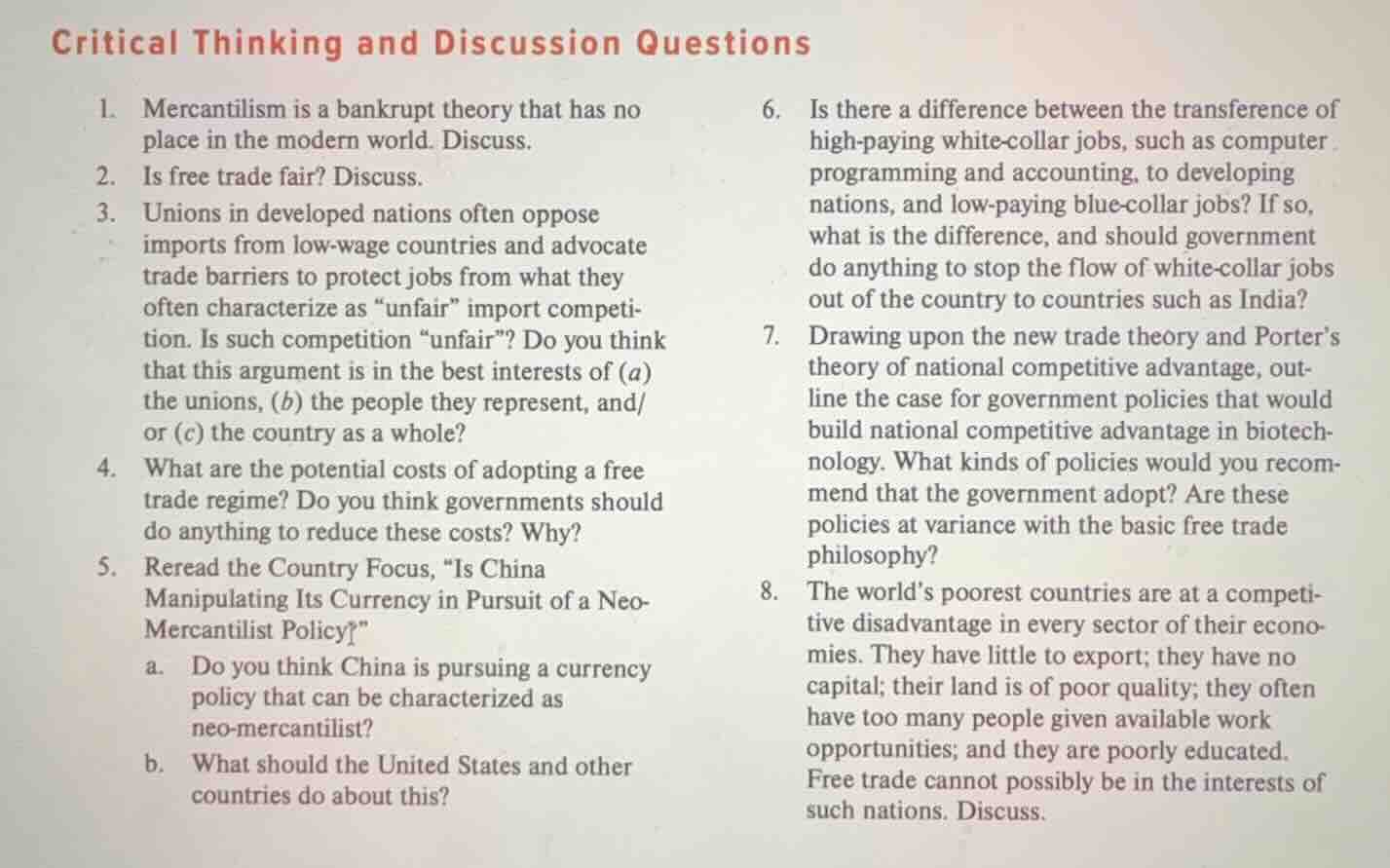
critical thinking and discussion questions
- mercantilism is a bankrupt theory that has no place in the modern world. discuss.
- is free trade fair? discuss.
- unions in developed nations often oppose imports from low-wage countries and advocate trade barriers to protect jobs from what they often characterize as \unfair\ import competition. is such competition \unfair\? do you think that this argument is in the best interests of (a) the unions, (b) the people they represent, and/or (c) the country as a whole?
- what are the potential costs of adopting a free trade regime? do you think governments should do anything to reduce these costs? why?
- reread the country focus, \is china manipulating its currency in pursuit of a neo-mercantilist policy?\
a. do you think china is pursuing a currency policy that can be characterized as neo-mercantilist?
b. what should the united states and other countries do about this?
- is there a difference between the transference of high-paying white-collar jobs, such as computer programming and accounting, to developing nations, and low-paying blue-collar jobs? if so, what is the difference, and should government do anything to stop the flow of white-collar jobs out of the country to countries such as india?
- drawing upon the new trade theory and porters theory of national competitive advantage, outline the case for government policies that would build national competitive advantage in biotechnology. what kinds of policies would you recommend that the government adopt? are these policies at variance with the basic free trade philosophy?
- the worlds poorest countries are at a competitive disadvantage in every sector of their economies. they have little to export; they have no capital; their land is of poor quality; they often have too many people given available work opportunities; and they are poorly educated. free trade cannot possibly be in the interests of such nations. discuss.
Evaluate mercantilism in the modern world
- Mercantilism emphasizes trade surpluses (exports > imports) to accumulate national wealth.
- Modern economic theory views trade as a positive-sum game rather than a zero-sum game.
- While theoretically bankrupt due to ignoring consumer welfare and efficiency gains, neo-mercantilist practices (e.g., currency intervention) persist in global trade strategies.
Analyze the fairness of free trade
- Free trade is theoretically fair because it allows countries to specialize based on comparative advantage, maximizing global efficiency.
- In practice, it can be perceived as unfair due to unequal distribution of gains, market distortions, and domestic job displacement.
Assess trade barriers and union arguments
- Competition from low-wage countries is not inherently "unfair"; it reflects comparative advantage in labor costs.
- Protectionist barriers serve the short-term interests of unions (protecting specific jobs) but harm the represented workers as consumers (higher prices) and the country as a whole (reduced economic efficiency).
Identify costs of free trade and mitigation
- Costs include short-term structural unemployment, industry decline, and rising income inequality.
- Governments should intervene not by restricting trade, but by easing transitions through retraining programs, unemployment insurance, and regional development subsidies.
Analyze currency manipulation and neo-mercantilism
- Keeping a currency artificially undervalued to boost exports and restrict imports is a classic neo-mercantilist strategy.
- Affected nations can respond through diplomatic pressure, countervailing duties, or filing formal disputes with the World Trade Organization (WTO).
Compare white-collar and blue-collar offshoring
- Both involve shifting tasks to lower-cost locations to improve efficiency.
- The difference lies in the speed of transition enabled by digital technology, the higher skill level of displaced workers, and the broader political impact when high-paying service jobs are relocated.
Apply Porter's Diamond to biotechnology
- Governments can build competitive advantage by funding specialized education (factor conditions), supporting research clusters (related/supporting industries), and acting as demanding buyers (domestic demand).
- These targeted interventions are at variance with pure laissez-faire free trade but align with strategic trade policy.
Evaluate free trade for developing nations
- The argument assumes absolute advantage determines trade, whereas comparative advantage shows even the poorest nations benefit by specializing in what they do relatively best.
- Free trade provides access to larger markets, cheaper capital goods, and foreign direct investment essential for development.

Snap & solve any problem in the app
Get step-by-step solutions on Sovi AI
Photo-based solutions with guided steps
Explore more problems and detailed explanations
Question 1
Mercantilism is theoretically outdated because trade is a positive-sum game that increases overall consumer welfare. However, it is not entirely bankrupt in practice, as nations still use neo-mercantilist policies like currency undervaluation to build manufacturing bases and accumulate reserves.
Question 2
Free trade is fair in terms of economic opportunity, allowing nations to trade based on comparative advantage. It can be unfair in outcomes, as the gains are often distributed unequally, benefiting capital owners and highly skilled workers while displacing lower-skilled domestic labor.
Question 3
Low-wage competition is not "unfair" but rather a reflection of comparative advantage. Trade barriers protect union members' jobs in the short term, but they harm those same workers as consumers through higher prices, and they reduce the overall economic efficiency of the country.
Question 4
The primary costs are structural unemployment and regional economic decline. Governments should not block trade but should implement safety nets, job retraining programs, and relocation assistance to help displaced workers transition to competitive sectors.
Question 5
a. Yes, maintaining an undervalued currency to keep exports cheap and imports expensive is a classic neo-mercantilist policy designed to run persistent trade surpluses.
b. Affected nations can utilize WTO dispute mechanisms, apply countervailing duties, or engage in bilateral trade negotiations to encourage market-determined exchange rates.
Question 6
The economic mechanism is identical (arbitrage of labor costs). The difference is that white-collar offshoring occurs faster due to digital infrastructure, affects highly educated workers who previously felt secure, and creates distinct political pressures regarding high-skill domestic employment.
Question 7
Governments can fund specialized university research, offer tax credits for R&D, and foster regional biotech clusters. These policies conflict with pure free-market laissez-faire philosophy, as they represent active state intervention to shape comparative advantage.
Question 8
The argument incorrectly relies on absolute advantage. According to the theory of comparative advantage, even the poorest nations benefit from free trade by specializing in goods with the lowest opportunity cost, gaining access to cheaper imports, foreign investment, and global markets.