QUESTION IMAGE
Question
cphs : advanced algebra: concepts and connections - block (27.0831030)
radical equations and extraneous roots
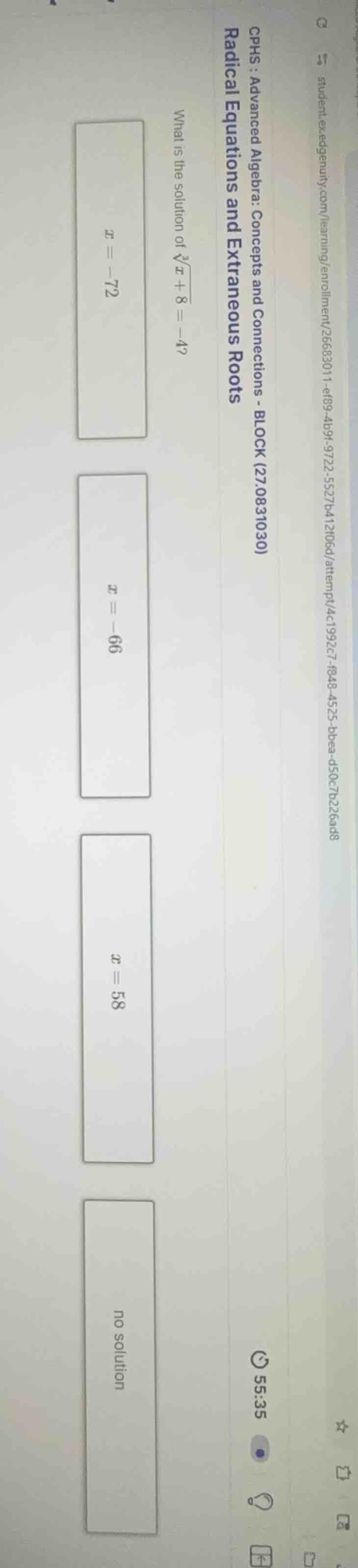
what is the solution of \\(\sqrt3{x + 8} = -4\\)?
\\(x = -72\\)
\\(x = -66\\)
\\(x = 58\\)
no solution
Step1: Cube both sides to eliminate the cube root
To solve the equation \(\sqrt[3]{x + 8}=-4\), we cube both sides of the equation. Recall that \((\sqrt[3]{a})^3=a\) for any real number \(a\). So, cubing the left - hand side \((\sqrt[3]{x + 8})^3=x + 8\), and cubing the right - hand side \((-4)^3=-64\). The equation becomes:
\[x + 8=-64\]
Step2: Solve for \(x\)
Subtract 8 from both sides of the equation \(x + 8=-64\). Using the subtraction property of equality, if \(a + b=c\), then \(a=c - b\). Here, \(a = x\), \(b = 8\), and \(c=-64\). So:
\[x=-64 - 8\]
\[x=-72\]
We can check the solution by substituting \(x = - 72\) back into the original equation:
Left - hand side: \(\sqrt[3]{-72 + 8}=\sqrt[3]{-64}=-4\)
Right - hand side: \(-4\)
Since the left - hand side equals the right - hand side when \(x=-72\), the solution is valid.

Snap & solve any problem in the app
Get step-by-step solutions on Sovi AI
Photo-based solutions with guided steps
Explore more problems and detailed explanations
\(x = - 72\)