QUESTION IMAGE
Question
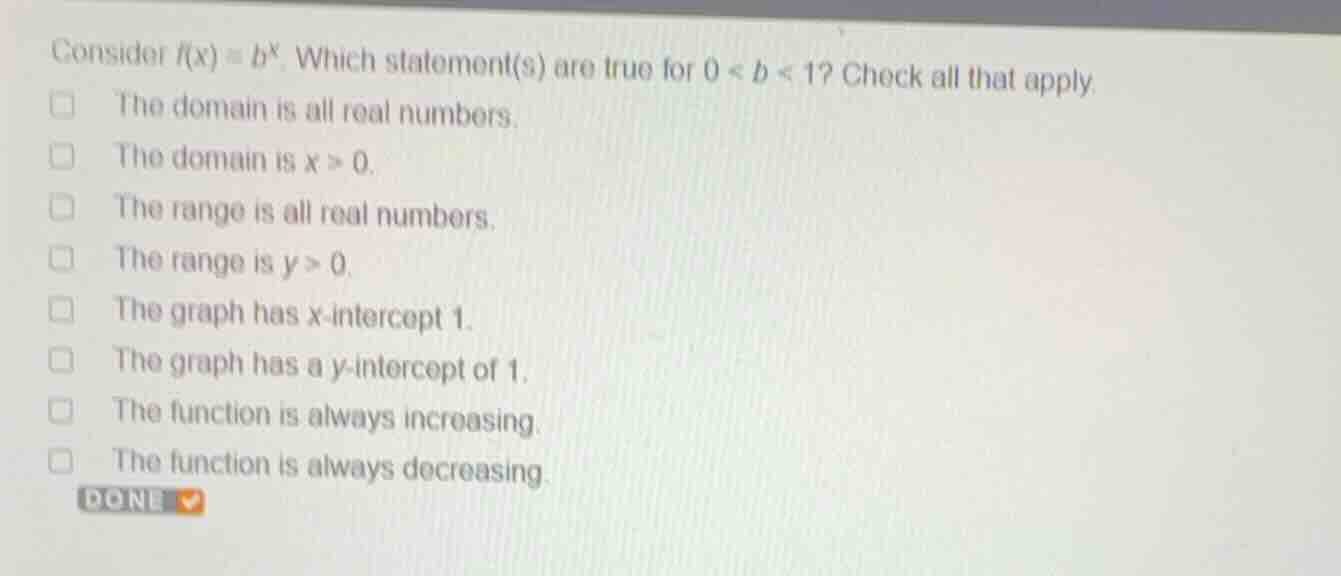
consider \\(f(x) = b^x\\). which statement(s) are true for \\(0 < b < 1\\)? check all that apply.
the domain is all real numbers.
the domain is \\(x > 0\\).
the range is all real numbers.
the range is \\(y > 0\\).
the graph has x-intercept 1.
the graph has a y-intercept of 1.
the function is always increasing.
the function is always decreasing.
Analyze the domain of the function
Using the Domain of Exponential Functions knowledge point
The function \(f(x) = b^x\) is defined for all real numbers \(x\) when \(b > 0\). Since \(0 < b < 1\), the domain is all real numbers.
Analyze the range of the function
Using the Range of Exponential Functions knowledge point
For any real number \(x\), raising a positive base \(b\) to the power of \(x\) always yields a positive result. Thus, \(f(x) > 0\), meaning the range is \(y > 0\).
Determine the intercepts of the graph
Using the Exponential Function Graphs knowledge point
To find the \(y\)-intercept, we evaluate \(f(0) = b^0 = 1\), so the \(y\)-intercept is \(1\). Since \(b^x > 0\) for all \(x\), there is no \(x\)-intercept.
Determine the growth or decay behavior
Using the Exponential Growth and Decay Behavior knowledge point
Since the base \(b\) satisfies \(0 < b < 1\), as \(x\) increases, \(b^x\) decreases. Therefore, the function is always decreasing.

Snap & solve any problem in the app
Get step-by-step solutions on Sovi AI
Photo-based solutions with guided steps
Explore more problems and detailed explanations
- The domain is all real numbers. (Correct answer)
- The domain is x > 0.
- The range is all real numbers.
- The range is y > 0. (Correct answer)
- The graph has x-intercept 1.
- The graph has a y-intercept of 1. (Correct answer)
- The function is always increasing.
- The function is always decreasing. (Correct answer)