QUESTION IMAGE
Question
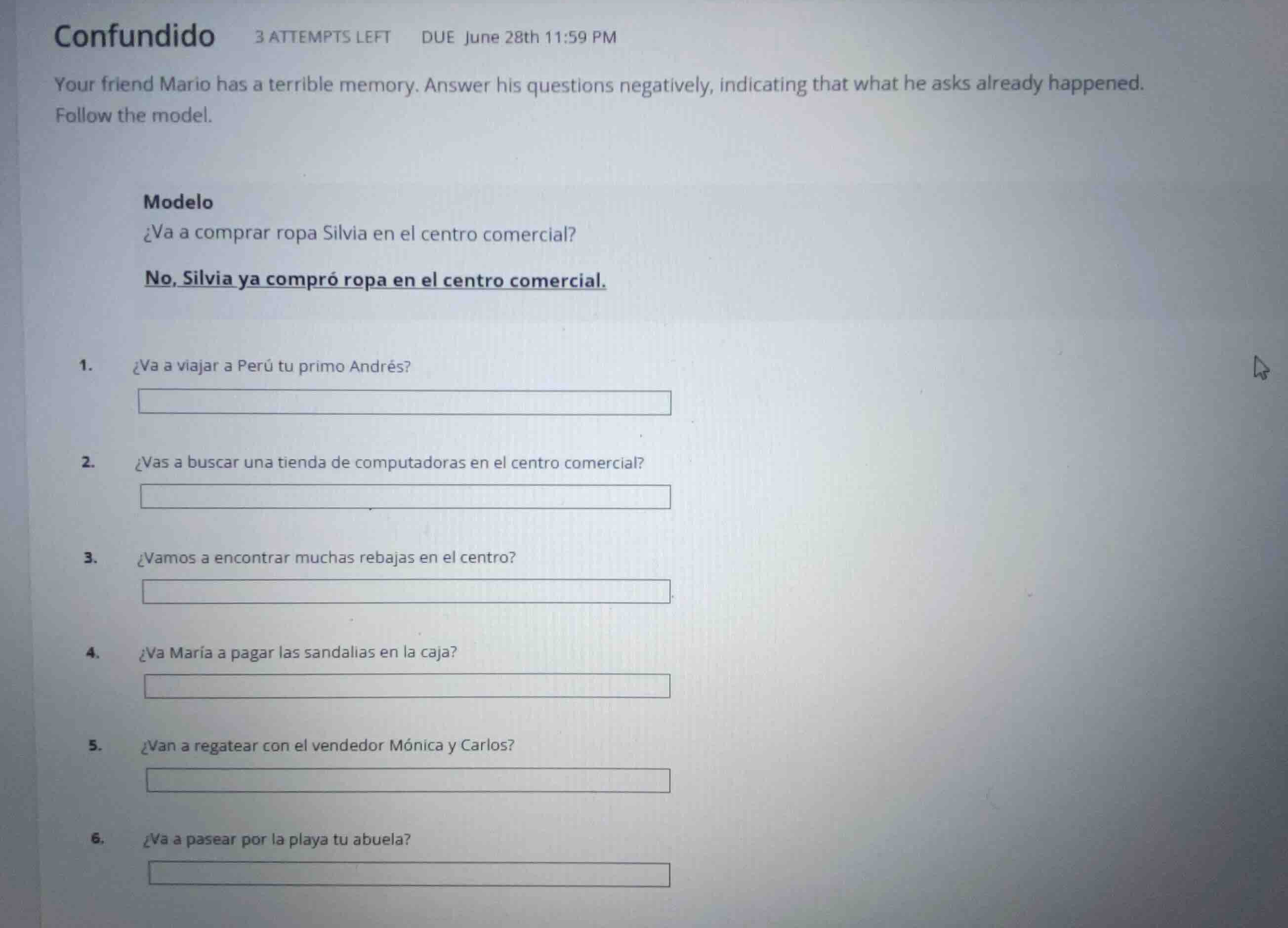
confundido 3 attempts left due june 28th 11:59 pm
your friend mario has a terrible memory. answer his questions negatively, indicating that what he asks already happened. follow the model.
modelo
¿va a comprar ropa silvia en el centro comercial?
no, silvia ya compró ropa en el centro comercial.
- ¿va a viajar a perú tu primo andrés?
- ¿vas a buscar una tienda de computadoras en el centro comercial?
- ¿vamos a encontrar muchas rebajas en el centro?
- ¿va maría a pagar las sandalias en la caja?
- ¿van a regatear con el vendedor mónica y carlos?
- ¿va a pasear por la playa tu abuela?
Analyze the model and structure
The model shows:
- Question: "¿Va a comprar ropa Silvia en el centro comercial?" (Is Silvia going to buy clothes at the mall?)
- Answer: "No, Silvia ya compró ropa en el centro comercial." (No, Silvia already bought clothes at the mall.)
Pattern:
- Start with "No, [Subject] ya [verb in preterite] [rest of the sentence]."
- Change the near future "ir a + infinitive" to the preterite tense of the main verb.
- Adjust pronouns and verb endings to match the subject.
Apply pattern to questions 1-3
- Question 1: "¿Va a viajar a Perú tu primo Andrés?"
- Subject: "tu primo Andrés" (becomes "mi primo Andrés" in the response, or keep "tu primo Andrés" following the exact model structure where "Silvia" remained "Silvia"). Let's use "mi primo Andrés" (my cousin Andrés) as it is a natural response to "your cousin", or "tu primo Andrés" if mirroring the exact words. Usually, "tu" (your) changes to "mi" (my) in conversational answers.
- Verb: "viajar" -> preterite third-person singular (él) -> "viajó".
- Answer: "No, mi primo Andrés ya viajó a Perú."
- Question 2: "¿Vas a buscar una tienda de computadoras en el centro comercial?"
- Subject: "tú" (implied by "vas"). The response should be in the first-person singular "yo" (implied).
- Verb: "buscar" -> preterite first-person singular (yo) -> "busqué" (spelling change: -car -> -qué).
- Answer: "No, ya busqué una tienda de computadoras en el centro comercial."
- Question 3: "¿Vamos a encontrar muchas rebajas en el centro?"
- Subject: "nosotros" (implied by "vamos"). The response should be in the "nosotros" form.
- Verb: "encontrar" -> preterite first-person plural (nosotros) -> "encontramos".
- Answer: "No, ya encontramos muchas rebajas en el centro."
Apply pattern to questions 4-6
- Question 4: "¿Va a pagar María las sandalias en la caja?"
- Subject: "María".
- Verb: "pagar" -> preterite third-person singular (ella) -> "pagó".
- Answer: "No, María ya pagó las sandalias en la caja."
- Question 5: "¿Van a regatear con el vendedor Mónica y Carlos?"
- Subject: "Mónica y Carlos".
- Verb: "regatear" -> preterite third-person plural (ellos) -> "regatearon".
- Answer: "No, Mónica y Carlos ya regatearon con el vendedor."
- Question 6: "¿Va a pasear por la playa tu abuela?"
- Subject: "tu abuela" (becomes "mi abuela").
- Verb: "pasear" -> preterite third-person singular (ella) -> "paseó".
- Answer: "No, mi abuela ya paseó por la playa."

Snap & solve any problem in the app
Get step-by-step solutions on Sovi AI
Photo-based solutions with guided steps
Explore more problems and detailed explanations
Question 1
¿Va a viajar a Perú tu primo Andrés?
<blank>No, mi primo Andrés ya viajó a Perú.</blank>
Question 2
¿Vas a buscar una tienda de computadoras en el centro comercial?
<blank>No, ya busqué una tienda de computadoras en el centro comercial.</blank>
Question 3
¿Vamos a encontrar muchas rebajas en el centro?
<blank>No, ya encontramos muchas rebajas en el centro.</blank>
Question 4
¿Va a pagar María las sandalias en la caja?
<blank>No, María ya pagó las sandalias en la caja.</blank>
Question 5
¿Van a regatear con el vendedor Mónica y Carlos?
<blank>No, Mónica y Carlos ya regatearon con el vendedor.</blank>
Question 6
¿Va a pasear por la playa tu abuela?
<blank>No, mi abuela ya paseó por la playa.</blank>