QUESTION IMAGE
Question
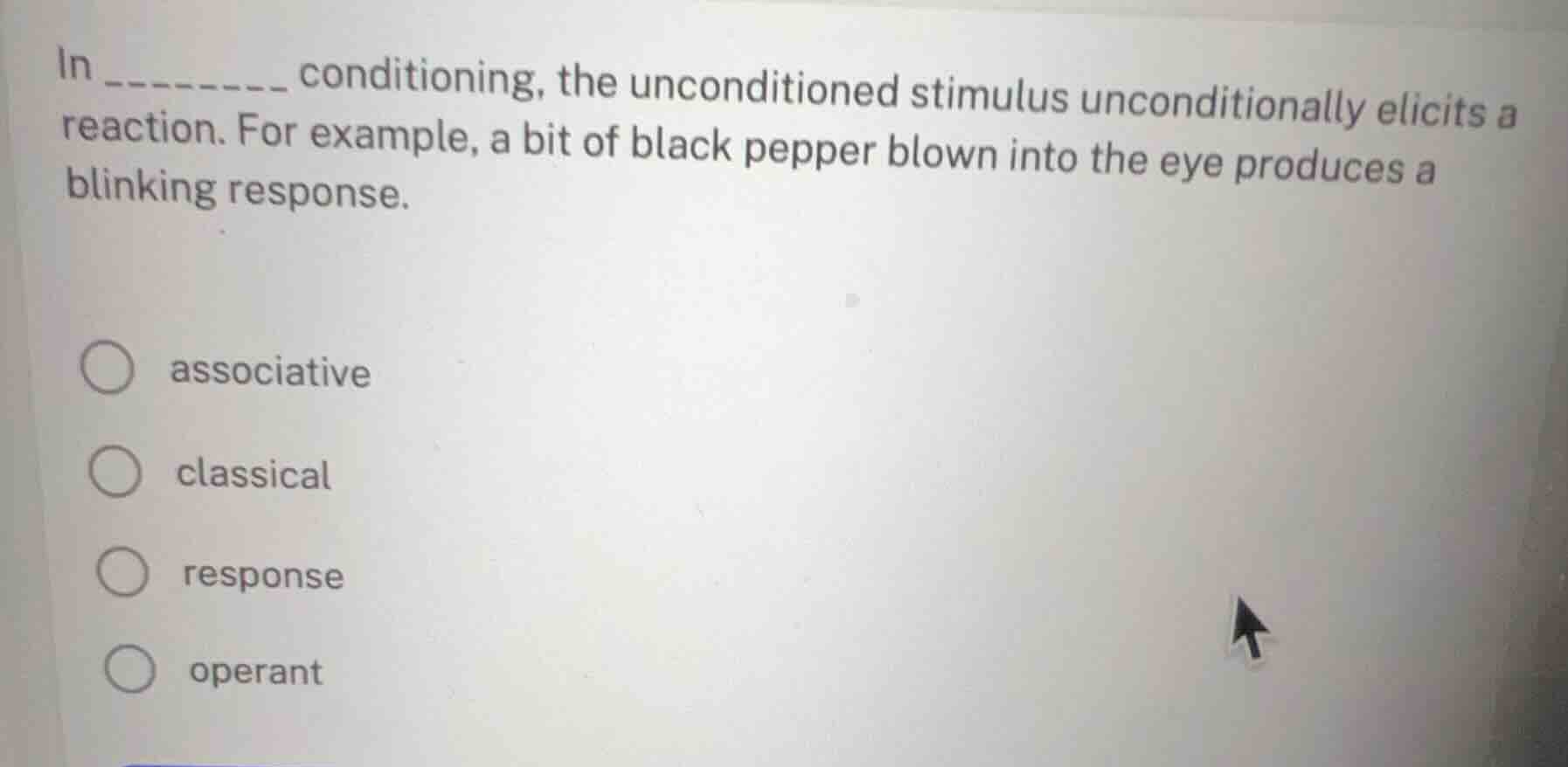
in ________ conditioning, the unconditioned stimulus unconditionally elicits a reaction. for example, a bit of black pepper blown into the eye produces a blinking response.
associative
classical
response
operant
<pre_analysis>
{
"quality": "clear",
"question_count": 1,
"skills_matched": [
"direct_cot",
"multiple_choice_formatter",
"explain_then_answer",
"tutor",
"mastery_adaptive_brevity"
],
"needs_drawing": false,
"concepts_used": [
"Classical Conditioning",
"Conditioned vs Unconditioned Stimulus"
],
"new_concepts": [],
"current_concepts": [
"Classical Conditioning",
"Conditioned vs Unconditioned Stimulus",
"Associative Learning"
]
}
</pre_analysis>
<reasoning>
Identify the key terms in the prompt
Using the Classical Conditioning and Conditioned vs Unconditioned Stimulus knowledge points
The sentence describes a type of learning where an "unconditioned stimulus" unconditionally (naturally and automatically) elicits a reaction. The example given is black pepper blown into the eye (unconditioned stimulus) producing a blinking response (unconditioned response).
Match the description to the correct psychological concept
Using the Classical Conditioning knowledge point
This process of pairing an unconditioned stimulus that naturally triggers a response with a new, neutral stimulus is the defining characteristic of classical conditioning. Operant conditioning, by contrast, involves associating behaviors with consequences (reinforcements or punishments).
</reasoning>
<answer>
<mcq-option>associative</mcq-option>
<mcq-correct>classical</mcq-correct>
<mcq-option>response</mcq-option>
<mcq-option>operant</mcq-option>
</answer>
<post_analysis>
{
"subject": "Social Science",
"question_type": "Multiple Choice",
"knowledge_point": [
"Social Science",
"Psychology",
"Classical Conditioning"
]
}
</post_analysis>
Snap & solve any problem in the app
Get step-by-step solutions on Sovi AI
Photo-based solutions with guided steps
Explore more problems and detailed explanations
<pre_analysis>
{
"quality": "clear",
"question_count": 1,
"skills_matched": [
"direct_cot",
"multiple_choice_formatter",
"explain_then_answer",
"tutor",
"mastery_adaptive_brevity"
],
"needs_drawing": false,
"concepts_used": [
"Classical Conditioning",
"Conditioned vs Unconditioned Stimulus"
],
"new_concepts": [],
"current_concepts": [
"Classical Conditioning",
"Conditioned vs Unconditioned Stimulus",
"Associative Learning"
]
}
</pre_analysis>
<reasoning>
Identify the key terms in the prompt
Using the Classical Conditioning and Conditioned vs Unconditioned Stimulus knowledge points
The sentence describes a type of learning where an "unconditioned stimulus" unconditionally (naturally and automatically) elicits a reaction. The example given is black pepper blown into the eye (unconditioned stimulus) producing a blinking response (unconditioned response).
Match the description to the correct psychological concept
Using the Classical Conditioning knowledge point
This process of pairing an unconditioned stimulus that naturally triggers a response with a new, neutral stimulus is the defining characteristic of classical conditioning. Operant conditioning, by contrast, involves associating behaviors with consequences (reinforcements or punishments).
</reasoning>
<answer>
<mcq-option>associative</mcq-option>
<mcq-correct>classical</mcq-correct>
<mcq-option>response</mcq-option>
<mcq-option>operant</mcq-option>
</answer>
<post_analysis>
{
"subject": "Social Science",
"question_type": "Multiple Choice",
"knowledge_point": [
"Social Science",
"Psychology",
"Classical Conditioning"
]
}
</post_analysis>