QUESTION IMAGE
Question
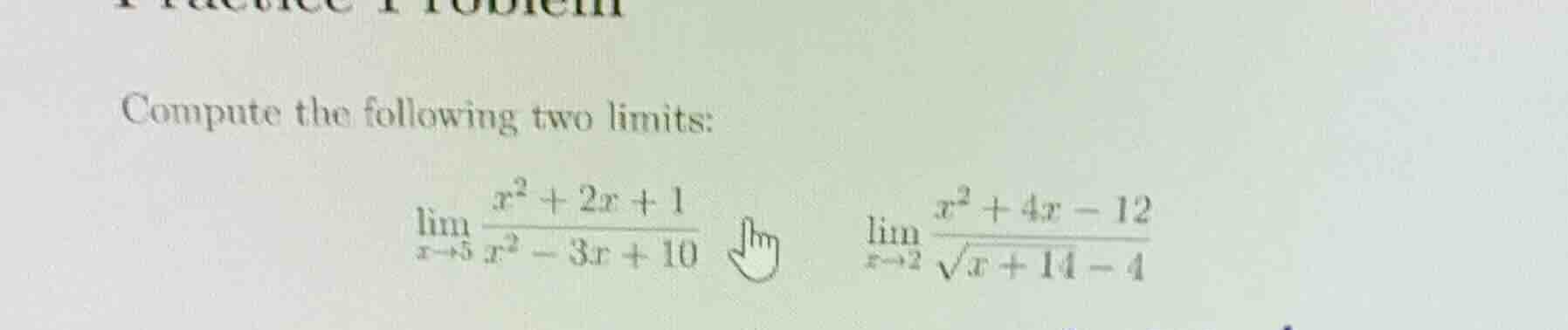
compute the following two limits:
\\(\lim_{x \to 5} \frac{x^2 + 2x + 1}{x^2 - 3x + 10}\\)
\\(\lim_{x \to 2} \frac{x^2 + 4x - 12}{\sqrt{x + 14} - 4}\\)
Evaluate the first limit by direct substitution
We check if direct substitution works.
Substitute \(x = 5\) into the numerator and denominator.
Since the denominator is non-zero, we evaluate directly.
Analyze the second limit for indeterminate form
We check the second limit.
Substitute \(x = 2\) to check the form.
This is an indeterminate form of type \(\frac{0}{0}\).
Simplify the second limit using rationalization
We multiply the numerator and denominator by the conjugate.
Simplify the denominator.
Factor the quadratic expression in the numerator.
Combine these simplified parts.
Cancel common factors and compute the limit
Cancel the common factor \((x - 2)\) for \(x
eq 2\).
Now, evaluate the limit by direct substitution.

Snap & solve any problem in the app
Get step-by-step solutions on Sovi AI
Photo-based solutions with guided steps
Explore more problems and detailed explanations