QUESTION IMAGE
Question
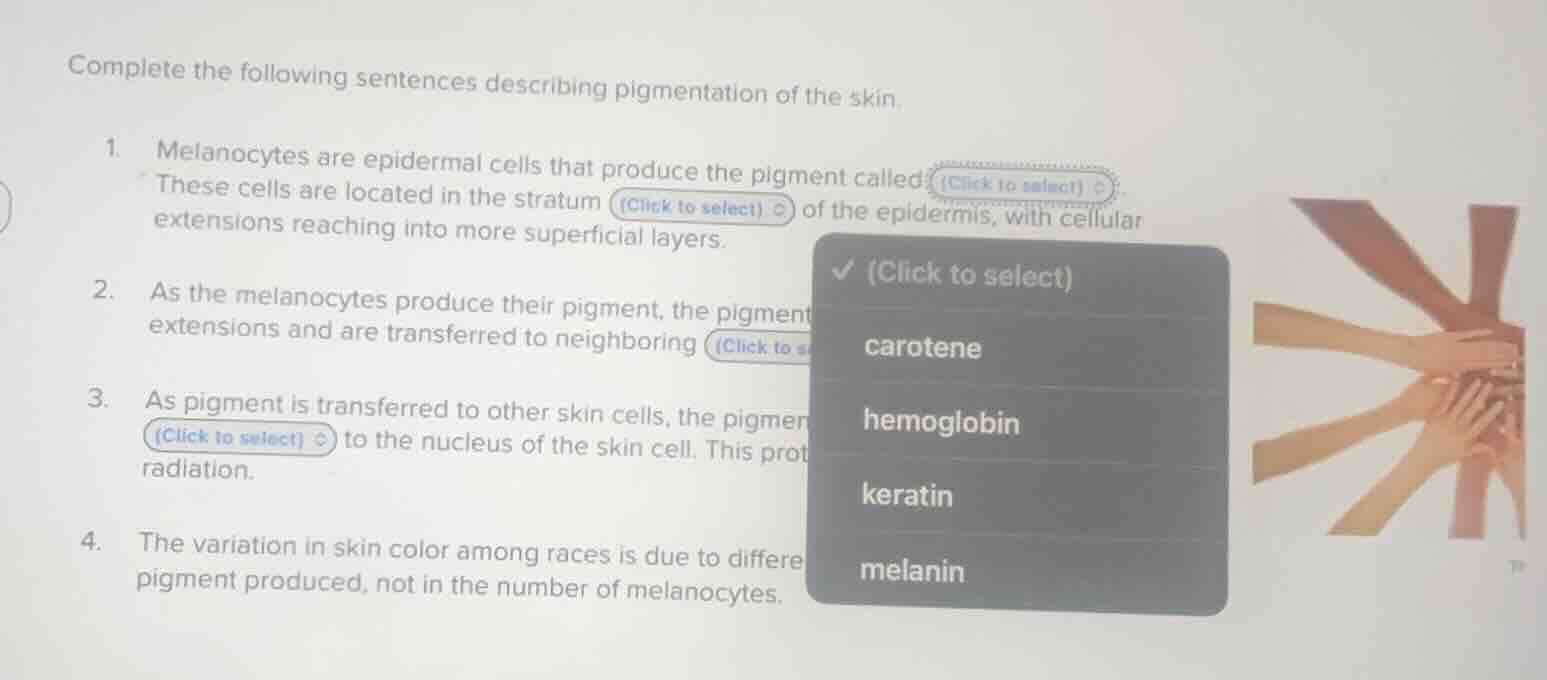
complete the following sentences describing pigmentation of the skin.
- melanocytes are epidermal cells that produce the pigment called (click to select). these cells are located in the stratum (click to select) of the epidermis, with cellular extensions reaching into more superficial layers.
- as the melanocytes produce their pigment, the pigment accumulates in the cellular extensions and are transferred to neighboring (click to select).
- as pigment is transferred to other skin cells, the pigment accumulates (click to select) to the nucleus of the skin cell. this protects the dna from uv radiation.
- the variation in skin color among races is due to differences in the amount of pigment produced, not in the number of melanocytes.
dropdown options for the first blank:
carotene
hemoglobin
keratin
melanin
Identify the pigment produced by melanocytes
Melanocytes are specialized epidermal cells. They produce the primary pigment responsible for skin color, which is melanin. The other options listed in the dropdown (carotene, hemoglobin, keratin) serve different functions: carotene is an orange-yellow pigment from vegetables, hemoglobin is the oxygen-carrying protein in red blood cells, and keratin is a structural protein.
Determine the epidermal layer containing melanocytes
Melanocytes reside in the deepest layer of the epidermis. This layer is the stratum basale (or basal layer). From here, melanocytes extend cellular processes upward to contact neighboring cells in the more superficial layers.
Identify the cells receiving the pigment
Melanin is packaged into intracellular vesicles called melanosomes. These melanosomes travel along the cellular extensions of melanocytes and are transferred to neighboring keratinocytes, which are the primary structural cells of the epidermis.
Determine the protective positioning of melanin
Once transferred into the keratinocytes, the melanin granules accumulate on the superficial side of the cell's nucleus. They form a protective pigment shield superficial (or apical) to the nucleus, acting like a tiny umbrella that absorbs harmful ultraviolet (UV) radiation and protects the DNA from damage.

Snap & solve any problem in the app
Get step-by-step solutions on Sovi AI
Photo-based solutions with guided steps
Explore more problems and detailed explanations
Question 1
Melanocytes are epidermal cells that produce the pigment called <blank>melanin</blank>. These cells are located in the stratum <blank>basale</blank> of the epidermis, with cellular extensions reaching into more superficial layers.
Question 2
As the melanocytes produce their pigment, the pigment granules travel to the ends of the cellular extensions and are transferred to neighboring <blank>keratinocytes</blank>.
Question 3
As pigment is transferred to other skin cells, the pigment granules accumulate on the side <blank>superficial</blank> to the nucleus of the skin cell. This protects the DNA from damaging ultraviolet radiation.
Question 4
The variation in skin color among races is due to differences in the amount and type of pigment produced, not in the number of melanocytes.