QUESTION IMAGE
Question
complete the following problems. show all your work.
learning goal from lesson 6.2, 6.3, and 7.3
i can prove theorems about geometric figures using triangle congruence and similarity.
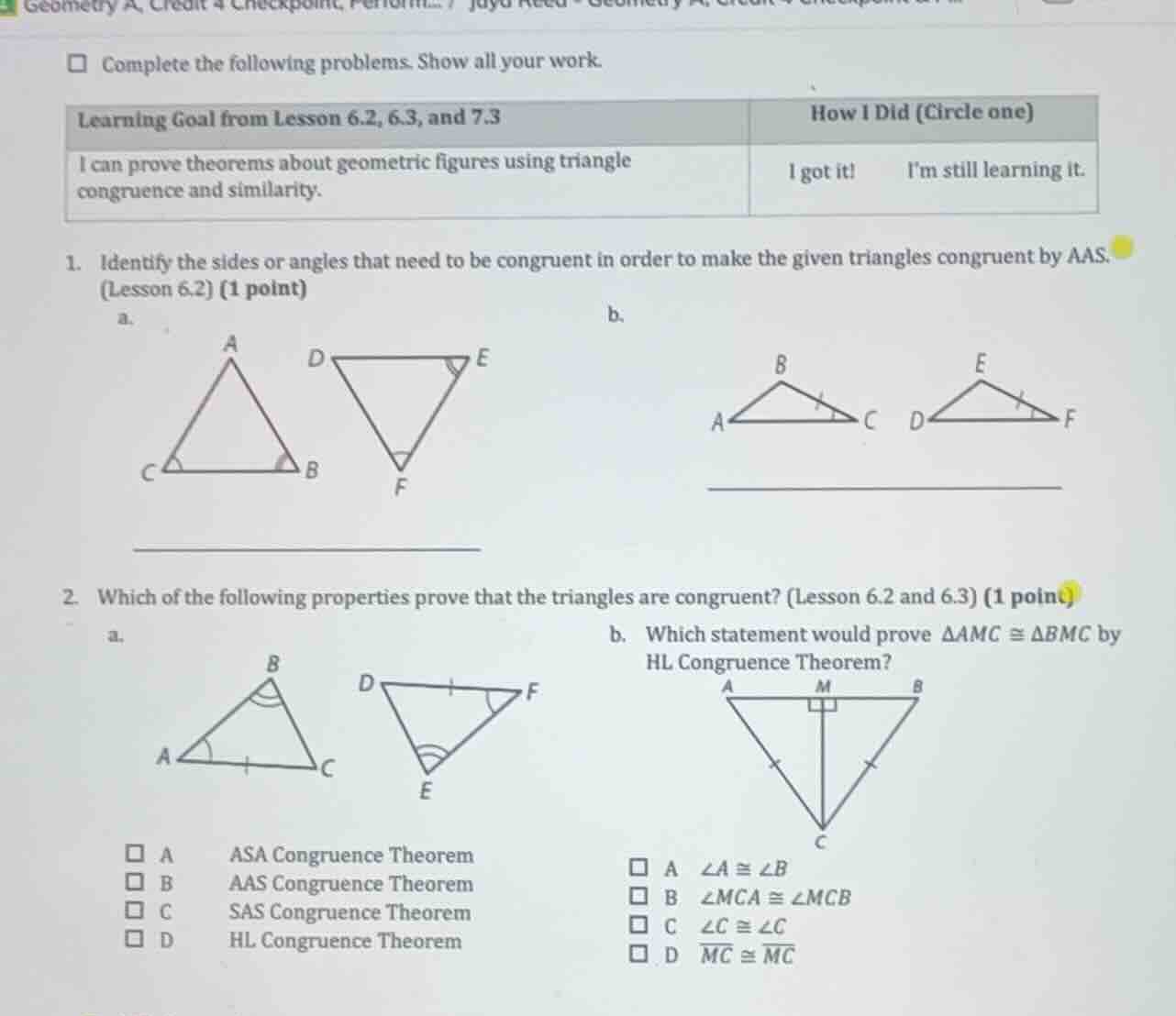
- identify the sides or angles that need to be congruent in order to make the given triangles congruent by aas. (lesson 6.2) (1 point)
a.
b.
- which of the following properties prove that the triangles are congruent? (lesson 6.2 and 6.3) (1 point)
a.
a asa congruence theorem
b aas congruence theorem
c sas congruence theorem
d hl congruence theorem
b. which statement would prove \\(\delta amc \cong \delta bmc\\) by hl congruence theorem?
a \\(\angle a \cong \angle b\\)
b \\(\angle mca \cong \angle mcb\\)
c \\(\angle c \cong \angle c\\)
d \\(mc \cong mc\\)
Analyze Question 1a for AAS Congruence
Given: \(\angle B \cong \angle E\) and \(\angle C \cong \angle F\).
For Angle-Angle-Side (AAS) congruence, we need a non-included side to be congruent.
The included side between the given angles is \(BC\) and \(EF\).
Therefore, the non-included corresponding sides must be congruent:
Analyze Question 1b for AAS Congruence
Given: \(\angle A \cong \angle D\) and \(\overline{BC} \cong \overline{EF}\).
For AAS congruence, the congruent side must be non-included.
The side \(BC\) is opposite to \(\angle A\), and \(EF\) is opposite to \(\angle D\).
We need a second pair of corresponding angles such that the side remains non-included.
The second angle must be:
Analyze Question 2a for Congruence Theorem
Given markings:
- One pair of congruent angles: \(\angle B \cong \angle E\)
- A second pair of congruent angles: \(\angle C \cong \angle F\)
- One pair of congruent sides: \(\overline{AC} \cong \overline{DF}\)
The side \(\overline{AC}\) is opposite to \(\angle B\), and \(\overline{DF}\) is opposite to \(\angle E\) (non-included).
This matches the Angle-Angle-Side (AAS) Congruence Theorem.
Analyze Question 2b for HL Congruence
Given: \(\overline{AC} \cong \overline{BC}\) (hypotenuses of right triangles \(\triangle AMC\) and \(\triangle BMC\)).
The triangles share a common leg: \(\overline{MC} \cong \overline{MC}\) by the Reflexive Property.
To use the Hypotenuse-Leg (HL) Congruence Theorem, we must establish that the triangles are right triangles.
This requires \(\overline{CM} \perp \overline{AB}\), which means \(\angle AMC \cong \angle BMC = 90^\circ\).
Thus, the statement needed is:
Looking at the options:
- A: \(\angle A \cong \angle B\)
- B: \(\angle MCA \cong \angle MCB\)
- C: \(\angle C \cong \angle C\)
- D: \(\overline{MC} \cong \overline{MC}\) (Reflexive property providing the congruent leg).

Snap & solve any problem in the app
Get step-by-step solutions on Sovi AI
Photo-based solutions with guided steps
Explore more problems and detailed explanations
Question 1a
\(\overline{AC} \cong \overline{DF}\) (or \(\overline{AB} \cong \overline{DE}\))
Question 1b
\(\angle C \cong \angle F\)
Question 2a
- A ASA Congruence Theorem
- B AAS Congruence Theorem (Correct answer)
- C SAS Congruence Theorem
- D HL Congruence Theorem
Question 2b
- A \(\angle A \cong \angle B\)
- B \(\angle MCA \cong \angle MCB\)
- C \(\angle C \cong \angle C\)
- D \(\overline{MC} \cong \overline{MC}\) (Correct answer)