QUESTION IMAGE
Question
- comparing different artworks
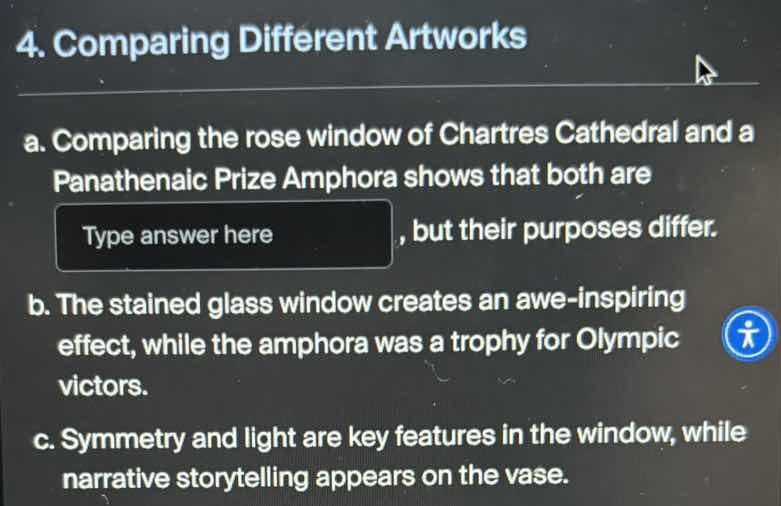
a. comparing the rose window of chartres cathedral and a panathenaic prize amphora shows that both are type answer here, but their purposes differ.
b. the stained glass window creates an awe-inspiring effect, while the amphora was a trophy for olympic victors.
c. symmetry and light are key features in the window, while narrative storytelling appears on the vase.
<pre_analysis>
{
"quality": "clear",
"question_count": 1,
"skills_matched": [
"direct_cot",
"blank_filling_formatter",
"explain_then_answer",
"quick"
],
"needs_drawing": false,
"concepts_used": [
"Art Analysis",
"Artistic Themes"
],
"new_concepts": [
"Gothic Art",
"Ancient Greek Art"
],
"current_concepts": [
"Art Analysis",
"Artistic Themes",
"Gothic Art",
"Ancient Greek Art"
]
}
</pre_analysis>
<reasoning>
Analyze visual and structural commonalities
Both the rose window of Chartres Cathedral (Gothic stained glass) and the Panathenaic Prize Amphora (ancient Greek ceramic vessel) are circular or radially symmetrical in their primary design fields, and both feature narrative, figurative, or religious imagery.
Identify the core shared artistic element
In standard art history curricula comparing these two specific works, they are highlighted as being highly decorated, visually complex, or symmetrical works of art that convey cultural narratives, but their physical functions differ (architectural light source vs. storage vessel/trophy). The most direct stylistic commonality is that both are "symmetrical" or "works of art". Looking at the context of parts (b) and (c), which discuss "stained glass window" vs "amphora" and "symmetry and light" vs "narrative storytelling", the overarching commonality is that both are "symmetrical" or "works of art".
</reasoning>
<answer>
a. Comparing the rose window of Chartres Cathedral and a Panathenaic Prize Amphora shows that both are <blank>symmetrical</blank>, but their purposes differ.
</answer>
<post_analysis>
{
"subject": "Arts",
"question_type": "Fill-in-the-blank",
"knowledge_point": [
"Arts",
"Art History",
"Comparative Art Analysis"
]
}
</post_analysis>
Snap & solve any problem in the app
Get step-by-step solutions on Sovi AI
Photo-based solutions with guided steps
Explore more problems and detailed explanations
<pre_analysis>
{
"quality": "clear",
"question_count": 1,
"skills_matched": [
"direct_cot",
"blank_filling_formatter",
"explain_then_answer",
"quick"
],
"needs_drawing": false,
"concepts_used": [
"Art Analysis",
"Artistic Themes"
],
"new_concepts": [
"Gothic Art",
"Ancient Greek Art"
],
"current_concepts": [
"Art Analysis",
"Artistic Themes",
"Gothic Art",
"Ancient Greek Art"
]
}
</pre_analysis>
<reasoning>
Analyze visual and structural commonalities
Both the rose window of Chartres Cathedral (Gothic stained glass) and the Panathenaic Prize Amphora (ancient Greek ceramic vessel) are circular or radially symmetrical in their primary design fields, and both feature narrative, figurative, or religious imagery.
Identify the core shared artistic element
In standard art history curricula comparing these two specific works, they are highlighted as being highly decorated, visually complex, or symmetrical works of art that convey cultural narratives, but their physical functions differ (architectural light source vs. storage vessel/trophy). The most direct stylistic commonality is that both are "symmetrical" or "works of art". Looking at the context of parts (b) and (c), which discuss "stained glass window" vs "amphora" and "symmetry and light" vs "narrative storytelling", the overarching commonality is that both are "symmetrical" or "works of art".
</reasoning>
<answer>
a. Comparing the rose window of Chartres Cathedral and a Panathenaic Prize Amphora shows that both are <blank>symmetrical</blank>, but their purposes differ.
</answer>
<post_analysis>
{
"subject": "Arts",
"question_type": "Fill-in-the-blank",
"knowledge_point": [
"Arts",
"Art History",
"Comparative Art Analysis"
]
}
</post_analysis>