QUESTION IMAGE
Question
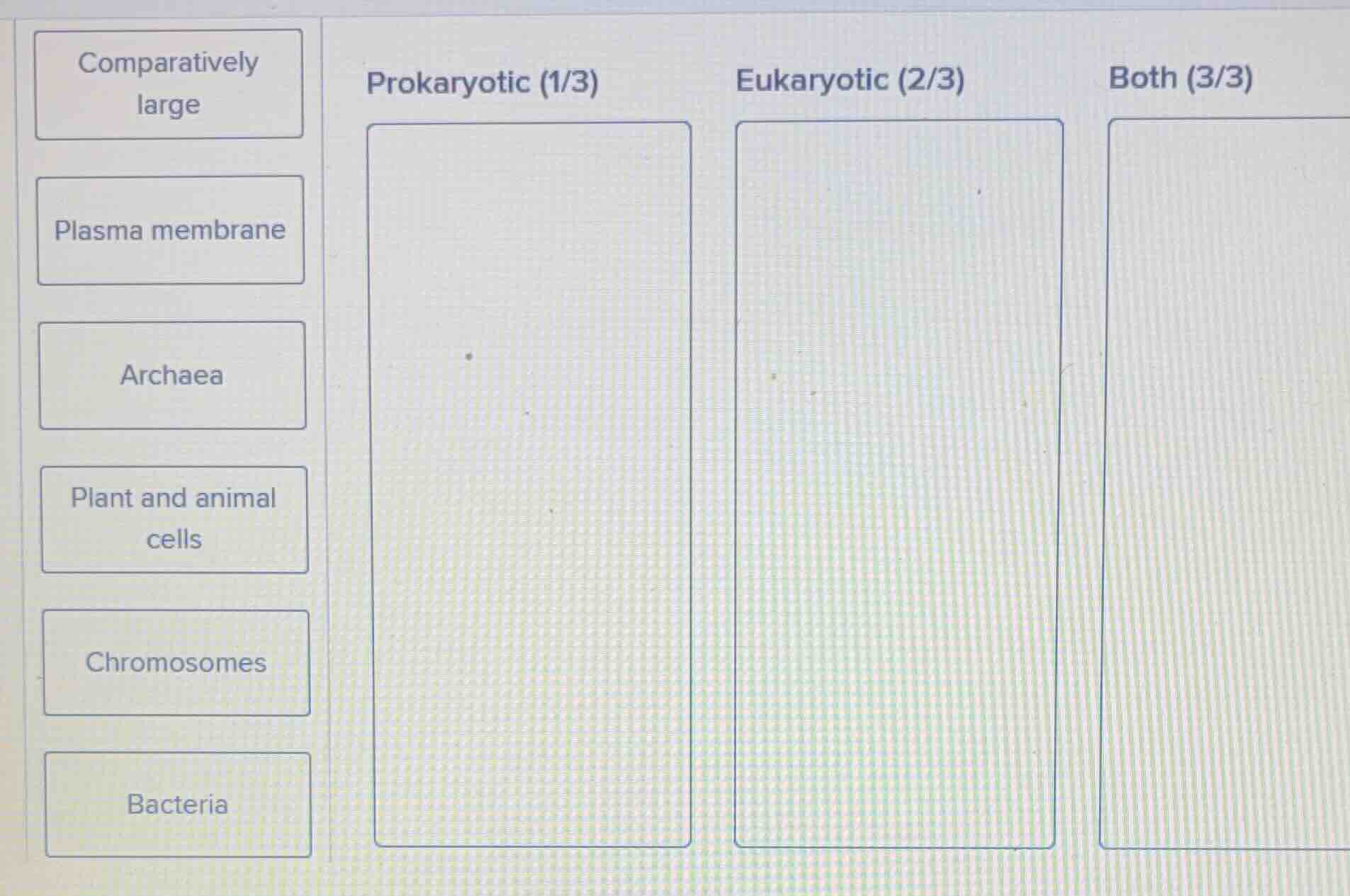
comparatively large
plasma membrane
archaea
plant and animal cells
chromosomes
bacteria
prokaryotic (1/3)
eukaryotic (2/3)
both (3/3)
Analyze prokaryotic characteristics
Prokaryotes are single-celled organisms lacking a membrane-bound nucleus. The domains Archaea and Bacteria consist entirely of prokaryotic organisms. Therefore, "Archaea" and "Bacteria" belong in this category. However, looking at the target counts, the "Prokaryotic" column requires exactly 1 item. Since "Archaea" and "Bacteria" are both distinct domains of prokaryotes, we must look at how they are grouped or if one fits better elsewhere. Let's re-evaluate: Archaea and Bacteria are both prokaryotes. If we place "Archaea" in Prokaryotic, where does "Bacteria" go? Both are prokaryotes. Let's look at the other options to find the best distribution.
Analyze eukaryotic characteristics
Eukaryotes have membrane-bound organelles and a nucleus. "Plant and animal cells" are classic examples of eukaryotic cells. Eukaryotic cells are also "Comparatively large" (typically 10–100 \(\mu\text{m}\)) compared to prokaryotic cells (typically 0.1–5.0 \(\mu\text{m}\)). This gives us 2 items for the "Eukaryotic" column: "Plant and animal cells" and "Comparatively large", which perfectly matches the (2/3) target count if we find a third or if the count indicates the current progress/total needed. The column headers show "Prokaryotic (1/3)", "Eukaryotic (2/3)", and "Both (3/3)", which means we need to place exactly 1 item in Prokaryotic, 2 items in Eukaryotic, and 3 items in Both.
Analyze shared characteristics
All cells, whether prokaryotic or eukaryotic, share certain fundamental structural components. These include:
- A plasma membrane that outer-limits the cell.
- Cytosol/cytoplasm.
- Chromosomes containing genetic material (DNA).
- Ribosomes for protein synthesis.
Thus, "Plasma membrane" and "Chromosomes" belong in the "Both" category.
Now we have:
- Both (3 items needed): "Plasma membrane", "Chromosomes", and we need one more.
- Prokaryotic (1 item needed): "Archaea" and "Bacteria" are both prokaryotes. Since we have two prokaryotic taxa and need to fill "Both" and "Prokaryotic", let's check if one of them can be classified differently, or if there is an error in standard classification. Actually, both Archaea and Bacteria are prokaryotes. If we must place 3 in "Both", 1 in "Prokaryotic", and 2 in "Eukaryotic":
Let's list the 6 options:
- "Comparatively large" -> Eukaryotic
- "Plasma membrane" -> Both
- "Archaea" -> Prokaryotic / Both? (Archaea and Bacteria are both prokaryotes, they do not belong to both prokaryotes and eukaryotes).
- "Plant and animal cells" -> Eukaryotic
- "Chromosomes" -> Both
- "Bacteria" -> Prokaryotic / Both?
If "Archaea" and "Bacteria" are both prokaryotes, but we only have 1 slot in "Prokaryotic" and need 3 in "Both", let's re-verify. Is there a common misconception or a specific curriculum grouping? No, both are strictly prokaryotic. Let's look at the total items: 6 items total.
The columns are:
- Prokaryotic (1/3) -> This means 1 item is currently placed out of 3 total, or it needs 1 item? Usually, "(1/3)" in these digital worksheets means 1 item has been placed out of 3 slots, or it means this column holds 1 item, the next hold…

Snap & solve any problem in the app
Get step-by-step solutions on Sovi AI
Photo-based solutions with guided steps
Explore more problems and detailed explanations
| Column | Sorted Items |
|---|---|
| Eukaryotic (2/3) | <ul><li>Comparatively large</li><li>Plant and animal cells</li></ul> |
| Both (3/3) | <ul><li>Plasma membrane</li><li>Chromosomes</li></ul> |