QUESTION IMAGE
Question
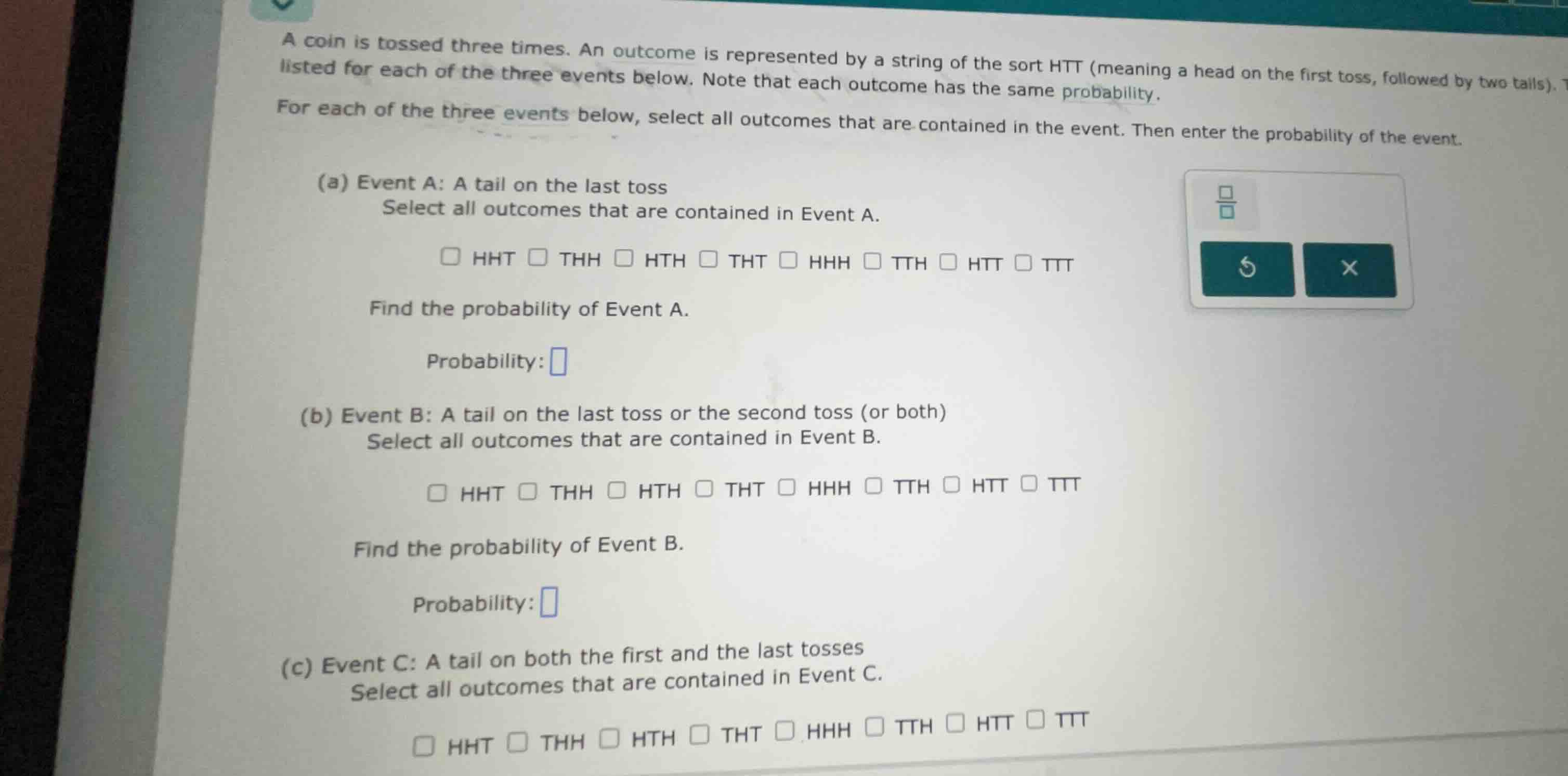
a coin is tossed three times. an outcome is represented by a string of the sort htt (meaning a head on the first toss, followed by two tails). the outcomes are listed for each of the three events below. note that each outcome has the same probability.
for each of the three events below, select all outcomes that are contained in the event. then enter the probability of the event.
(a) event a: a tail on the last toss
select all outcomes that are contained in event a.
hht thh hth tht hhh tth htt ttt
find the probability of event a.
probability:
(b) event b: a tail on the last toss or the second toss (or both)
select all outcomes that are contained in event b.
hht thh hth tht hhh tth htt ttt
find the probability of event b.
probability:
(c) event c: a tail on both the first and the last tosses
select all outcomes that are contained in event c.
hht thh hth tht hhh tth htt ttt
Define the sample space
Using the Sample Space knowledge point, we list all possible outcomes when a fair coin is tossed three times. Each toss has 2 possible outcomes: Head (H) or Tail (T). The total number of outcomes is \(2^3 = 8\).
The sample space \(S\) is:
Each outcome is equally likely, with a probability of \(\frac{1}{8}\).
Analyze Event A
Using the Probability of Events knowledge point, we identify the outcomes in Event A: "A tail on the last toss".
We look for outcomes ending with 'T':
- \(HHT\) (ends in T)
- \(THT\) (ends in T)
- \(TTH\) (ends in H) - No
- \(HTT\) (ends in T)
- \(TTT\) (ends in T)
The outcomes contained in Event A are:
Since there are 4 outcomes out of 8:
Analyze Event B
Using the Probability of Events knowledge point, we identify the outcomes in Event B: "A tail on the last toss or the second toss (or both)".
We look for outcomes where the second letter is 'T', the third letter is 'T', or both:
- \(HHT\): second is H, third is T (Yes)
- \(THH\): second is H, third is H (No)
- \(HTH\): second is T, third is H (Yes)
- \(THT\): second is H, third is T (Yes)
- \(HHH\): second is H, third is H (No)
- \(TTH\): second is T, third is H (Yes)
- \(HTT\): second is T, third is T (Yes)
- \(TTT\): second is T, third is T (Yes)
The outcomes contained in Event B are:
Since there are 6 outcomes out of 8:
Analyze Event C
Using the Probability of Events knowledge point, we identify the outcomes in Event C: "A tail on both the first and the last tosses".
We look for outcomes where the first letter is 'T' and the third letter is 'T':
- \(THT\) (starts with T, ends with T)
- \(TTT\) (starts with T, ends with T)
The outcomes contained in Event C are:
Since there are 2 outcomes out of 8:

Snap & solve any problem in the app
Get step-by-step solutions on Sovi AI
Photo-based solutions with guided steps
Explore more problems and detailed explanations
Question (a)
- Outcomes in Event A: HHT, THT, HTT, TTT
- Probability: \(\frac{1}{2}\)
Question (b)
- Outcomes in Event B: HHT, HTH, THT, TTH, HTT, TTT
- Probability: \(\frac{3}{4}\)
Question (c)
- Outcomes in Event C: THT, TTT
- Probability: \(\frac{1}{4}\)