QUESTION IMAGE
Question
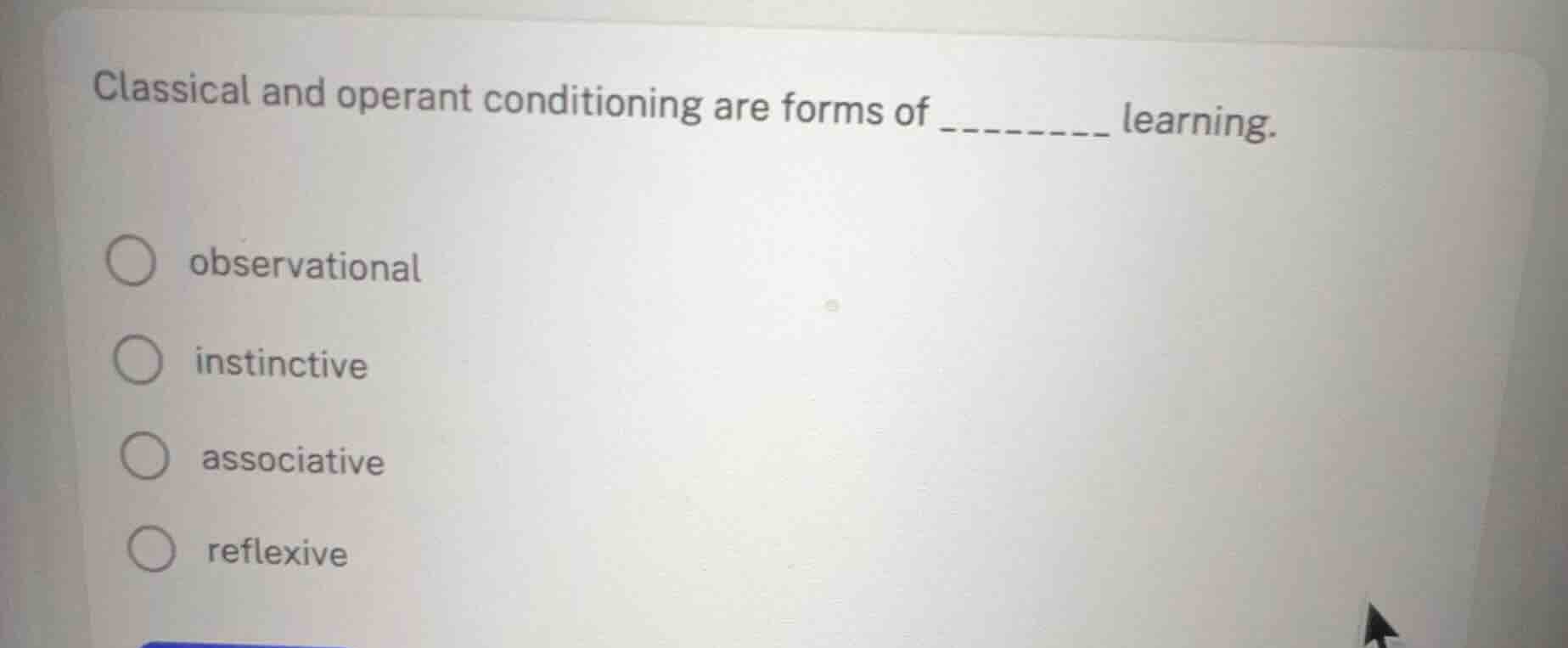
classical and operant conditioning are forms of ________ learning.
observational
instinctive
associative
reflexive
<pre_analysis>
{
"quality": "clear",
"question_count": 1,
"skills_matched": [
"direct_cot",
"multiple_choice_formatter",
"explain_then_answer",
"tutor",
"mastery_adaptive_brevity"
],
"needs_drawing": false,
"concepts_used": [
"Classical Conditioning",
"Operant Conditioning"
],
"new_concepts": [
"Associative Learning"
],
"current_concepts": [
"Classical Conditioning",
"Operant Conditioning",
"Associative Learning"
]
}
</pre_analysis>
<reasoning>
Analyze the question stem
Using the Classical Conditioning and Operant Conditioning knowledge points
The question asks to identify the broad category of learning that encompasses both classical and operant conditioning.
Define the core learning categories
Using the Classical Conditioning and Operant Conditioning knowledge points
- Associative learning occurs when an organism makes a connection, or association, between two events.
- Classical conditioning involves associating an involuntary response and a stimulus.
- Operant conditioning involves associating a voluntary behavior and a consequence.
Evaluate the given options
Using the Classical Conditioning and Operant Conditioning knowledge points
- observational: Learning by watching others (e.g., Bandura's modeling).
- instinctive: Innate behaviors, not learned.
- associative: Learning that involves connecting stimuli or behaviors with outcomes, which directly includes both classical and operant conditioning.
- reflexive: Automatic, unlearned responses to stimuli.
Therefore, the correct term to fill in the blank is "associative".
</reasoning>
<answer>
<mcq-option>observational</mcq-option>
<mcq-option>instinctive</mcq-correct>
<mcq-correct>associative</mcq-correct>
<mcq-option>reflexive</mcq-option>
</answer>
<post_analysis>
{
"subject": "Social Science",
"question_type": "Multiple Choice",
"knowledge_point": [
"Social Science",
"Psychology",
"Associative Learning"
]
}
</post_analysis>
Snap & solve any problem in the app
Get step-by-step solutions on Sovi AI
Photo-based solutions with guided steps
Explore more problems and detailed explanations
<pre_analysis>
{
"quality": "clear",
"question_count": 1,
"skills_matched": [
"direct_cot",
"multiple_choice_formatter",
"explain_then_answer",
"tutor",
"mastery_adaptive_brevity"
],
"needs_drawing": false,
"concepts_used": [
"Classical Conditioning",
"Operant Conditioning"
],
"new_concepts": [
"Associative Learning"
],
"current_concepts": [
"Classical Conditioning",
"Operant Conditioning",
"Associative Learning"
]
}
</pre_analysis>
<reasoning>
Analyze the question stem
Using the Classical Conditioning and Operant Conditioning knowledge points
The question asks to identify the broad category of learning that encompasses both classical and operant conditioning.
Define the core learning categories
Using the Classical Conditioning and Operant Conditioning knowledge points
- Associative learning occurs when an organism makes a connection, or association, between two events.
- Classical conditioning involves associating an involuntary response and a stimulus.
- Operant conditioning involves associating a voluntary behavior and a consequence.
Evaluate the given options
Using the Classical Conditioning and Operant Conditioning knowledge points
- observational: Learning by watching others (e.g., Bandura's modeling).
- instinctive: Innate behaviors, not learned.
- associative: Learning that involves connecting stimuli or behaviors with outcomes, which directly includes both classical and operant conditioning.
- reflexive: Automatic, unlearned responses to stimuli.
Therefore, the correct term to fill in the blank is "associative".
</reasoning>
<answer>
<mcq-option>observational</mcq-option>
<mcq-option>instinctive</mcq-correct>
<mcq-correct>associative</mcq-correct>
<mcq-option>reflexive</mcq-option>
</answer>
<post_analysis>
{
"subject": "Social Science",
"question_type": "Multiple Choice",
"knowledge_point": [
"Social Science",
"Psychology",
"Associative Learning"
]
}
</post_analysis>