QUESTION IMAGE
Question
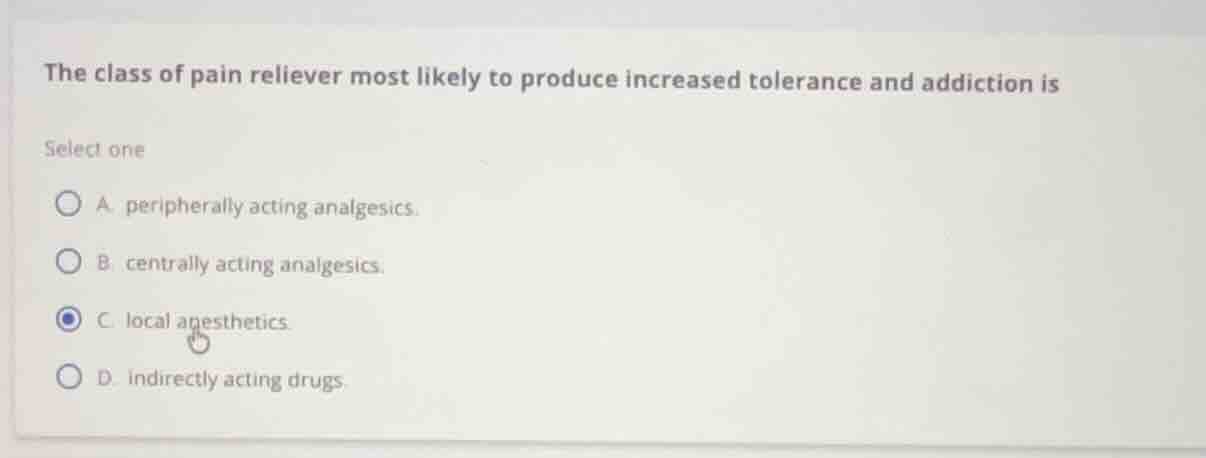
the class of pain reliever most likely to produce increased tolerance and addiction is
select one
a. peripherally acting analgesics.
b. centrally acting analgesics.
c. local anesthetics.
d. indirectly acting drugs.
Analyze the mechanism of pain relievers
Peripherally acting analgesics (like NSAIDs) act at the site of injury and do not carry a high risk of physical addiction or tolerance. Centrally acting analgesics (such as narcotics/opioids) bind to receptors in the brain and spinal cord, which directly activates reward pathways and leads to a high risk of tolerance and addiction.
Evaluate the remaining options
Local anesthetics block nerve conduction locally and do not produce systemic addiction or tolerance. Indirectly acting drugs do not represent the primary class of strong pain relievers associated with clinical addiction. Therefore, centrally acting analgesics are the most likely to produce tolerance and addiction.

Snap & solve any problem in the app
Get step-by-step solutions on Sovi AI
Photo-based solutions with guided steps
Explore more problems and detailed explanations
- (A) peripherally acting analgesics.
- (B) centrally acting analgesics. (Correct answer)
- (C) local anesthetics.
- (D) indirectly acting drugs.