QUESTION IMAGE
Question
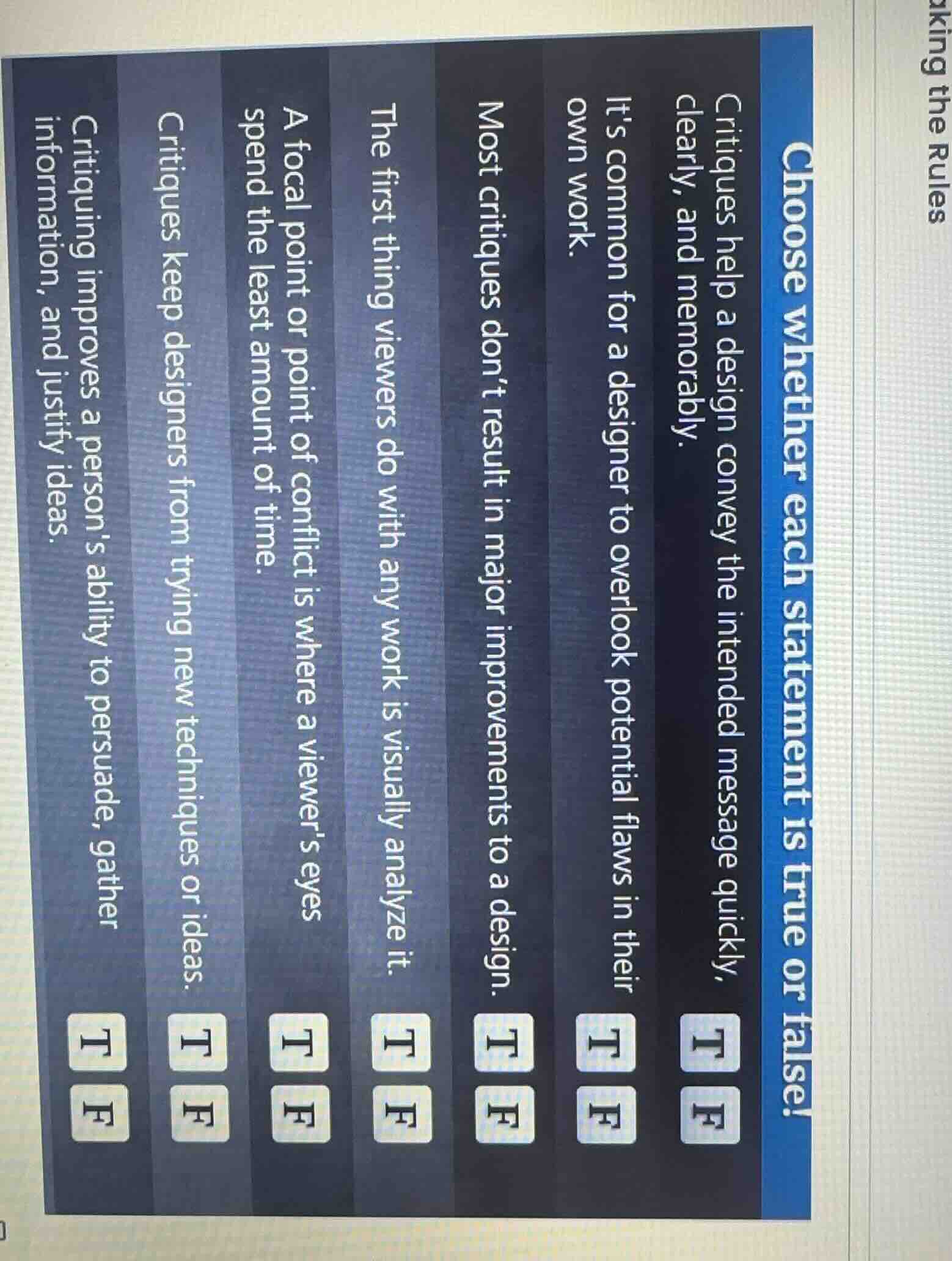
choose whether each statement is true or false!
critiques help a design convey the intended message quickly, clearly, and memorably. t f
its common for a designer to overlook potential flaws in their own work. t f
most critiques dont result in major improvements to a design. t f
the first thing viewers do with any work is visually analyze it. t f
a focal point or point of conflict is where a viewer’s eyes spend the least amount of time. t f
critiques keep designers from trying new techniques or ideas. t f
critiquing improves a person’s ability to persuade, gather information, and justify ideas. t f
To solve this, we analyze each statement about design critiques:
1. "Critiques help a design convey the intended message quickly, clearly, and memorably."
Critiques identify areas to improve communication in design, so this is True (T).
2. "It’s common for a designer to overlook potential flaws in their own work."
Designers often miss their own flaws (bias toward their work), so this is True (T).
3. "Most critiques don’t result in major improvements to a design."
Critiques are meant to drive significant improvements; this statement is false. So False (F).
4. "The first thing viewers do with any work is visually analyze it."
Viewers initially engage with a design visually, so this is True (T).
5. "A focal point or point of conflict is where a viewer’s eyes spend the least amount of time."
Focal points attract attention (most time, not least), so this is False (F).
6. "Critiques keep designers from trying new techniques or ideas."
Critiques should inspire growth, not restrict innovation; this is False (F).
7. "Critiquing improves a person’s ability to persuade, gather information, and justify ideas."
Critiquing hones communication and analytical skills, so this is True (T).

Snap & solve any problem in the app
Get step-by-step solutions on Sovi AI
Photo-based solutions with guided steps
Explore more problems and detailed explanations
s (per statement, T/F):
- T
- T
- F
- T
- F
- F
- T