QUESTION IMAGE
Question
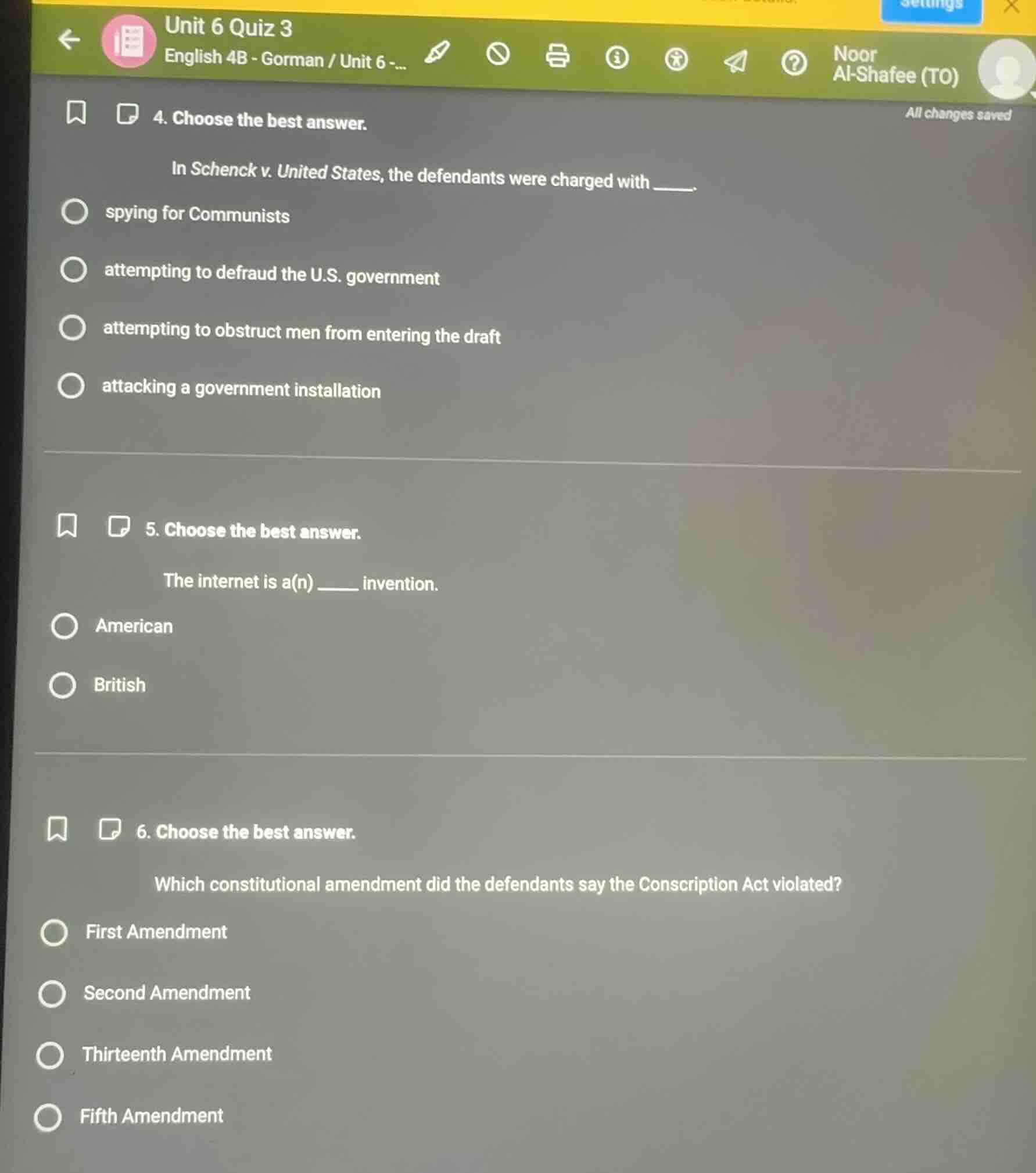
- choose the best answer.
in schenck v. united states, the defendants were charged with ______.
spying for communists
attempting to defraud the u.s. government
attempting to obstruct men from entering the draft
attacking a government installation
- choose the best answer.
the internet is a(n) ______ invention.
american
british
- choose the best answer.
which constitutional amendment did the defendants say the conscription act violated?
first amendment
second amendment
thirteenth amendment
fifth amendment
Analyze charges in Schenck v. United States
In the landmark Supreme Court case Schenck v. United States, Charles Schenck and Elizabeth Baer were prosecuted under the Espionage Act of 1917. They were charged with conspiracy to obstruct the recruiting and enlistment service of the United States by distributing leaflets to draftees that urged resistance to the military draft. Therefore, the defendants were charged with attempting to obstruct men from entering the draft.
Determine the origin of the internet
The internet developed from research commissioned by the United States federal government in the 1960s to build robust, fault-tolerant communication with computer networks. The primary precursor network, ARPANET, was funded by the U.S. Department of Defense Advanced Research Projects Agency (DARPA). Thus, the internet is an American invention.
Identify the constitutional amendment argued against conscription
In Schenck v. United States, the defendants distributed leaflets asserting that the draft (conscription) violated the Thirteenth Amendment, which prohibits involuntary servitude. Although the case is famous for its First Amendment free speech ruling, the specific argument they made against the Conscription Act itself was that it violated the Thirteenth Amendment.

Snap & solve any problem in the app
Get step-by-step solutions on Sovi AI
Photo-based solutions with guided steps
Explore more problems and detailed explanations
Question 4
- spying for Communists
- attempting to defraud the U.S. government
- attempting to obstruct men from entering the draft (Correct answer)
- attacking a government installation
Question 5
- American (Correct answer)
- British
Question 6
- First Amendment
- Second Amendment</mcq-correct>
- Thirteenth Amendment (Correct answer)
<mcq-option>Fifth Amendment