Sovi.AI - AI Math Tutor

Scan to solve math questions

QUESTION IMAGE

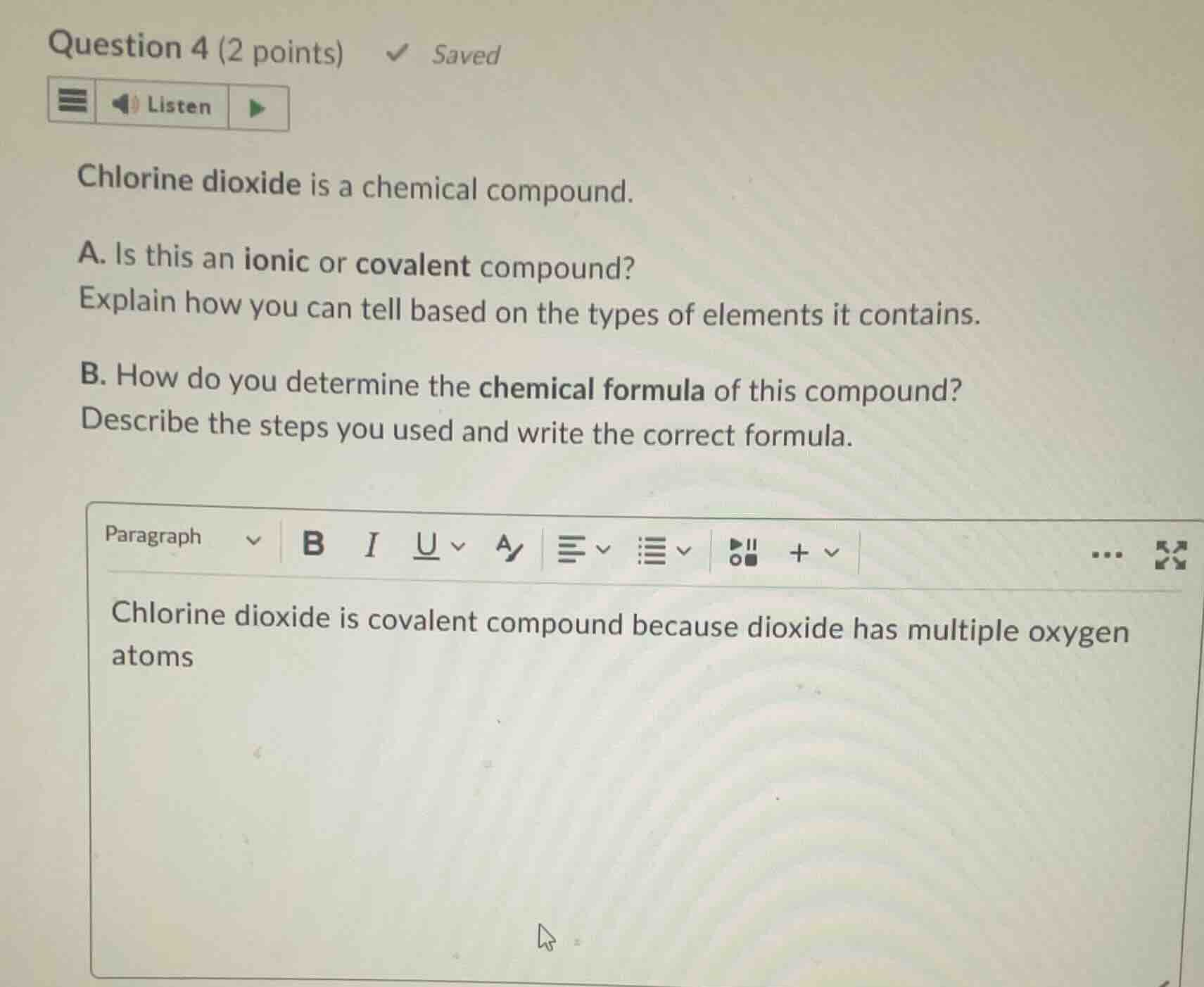
chlorine dioxide is a chemical compound. a. is this an ionic or covalen…

Question

chlorine dioxide is a chemical compound.

a. is this an ionic or covalent compound?
explain how you can tell based on the types of elements it contains.

b. how do you determine the chemical formula of this compound?
describe the steps you used and write the correct formula.

Explanation:

Response

<pre_analysis>
{
"quality": "clear",
"question_count": 1,
"skills_matched": [
"direct_cot",
"explain_then_answer",
"tutor"
],
"needs_drawing": false,
"concepts_used": [],
"new_concepts": [
"Chemical Nomenclature",
"Covalent Bonding"
],
"current_concepts": [
"Chemical Nomenclature",
"Covalent Bonding",
"Chemical Formulas"
]
}
</pre_analysis>

<reasoning>

Identify compound elements

Chlorine dioxide contains chlorine and oxygen. Both elements are nonmetals.

Determine bond type

Compounds formed between nonmetals are covalent. They share electrons rather than transferring them.

Analyze naming prefixes

The prefix "di-" in dioxide indicates two oxygen atoms. No prefix on chlorine means one chlorine atom.

Write chemical formula

Combining one chlorine atom and two oxygen atoms yields the formula \(\text{ClO}_2\).
</reasoning>

<answer>
A. Chlorine dioxide is a covalent compound. This is because both chlorine and oxygen are nonmetals, and bonds between nonmetals are covalent.

B. To determine the chemical formula, look at the prefixes in the name:

  1. "Chlorine" has no prefix, indicating one chlorine atom (\(\text{Cl}\)).
  2. "Dioxide" has the prefix "di-", indicating two oxygen atoms (\(\text{O}_2\)).

Combining these gives the chemical formula: \(\text{ClO}_2\).
</answer>

<post_analysis>
{
"subject": "Natural Science",
"question_type": "Free Response",
"knowledge_point": [
"Natural Science",
"Chemistry",
"Chemical Nomenclature"
]
}
</post_analysis>

Answer:

<pre_analysis>
{
"quality": "clear",
"question_count": 1,
"skills_matched": [
"direct_cot",
"explain_then_answer",
"tutor"
],
"needs_drawing": false,
"concepts_used": [],
"new_concepts": [
"Chemical Nomenclature",
"Covalent Bonding"
],
"current_concepts": [
"Chemical Nomenclature",
"Covalent Bonding",
"Chemical Formulas"
]
}
</pre_analysis>

<reasoning>

Identify compound elements

Chlorine dioxide contains chlorine and oxygen. Both elements are nonmetals.

Determine bond type

Compounds formed between nonmetals are covalent. They share electrons rather than transferring them.

Analyze naming prefixes

The prefix "di-" in dioxide indicates two oxygen atoms. No prefix on chlorine means one chlorine atom.

Write chemical formula

Combining one chlorine atom and two oxygen atoms yields the formula \(\text{ClO}_2\).
</reasoning>

<answer>
A. Chlorine dioxide is a covalent compound. This is because both chlorine and oxygen are nonmetals, and bonds between nonmetals are covalent.

B. To determine the chemical formula, look at the prefixes in the name:

  1. "Chlorine" has no prefix, indicating one chlorine atom (\(\text{Cl}\)).
  2. "Dioxide" has the prefix "di-", indicating two oxygen atoms (\(\text{O}_2\)).

Combining these gives the chemical formula: \(\text{ClO}_2\).
</answer>

<post_analysis>
{
"subject": "Natural Science",
"question_type": "Free Response",
"knowledge_point": [
"Natural Science",
"Chemistry",
"Chemical Nomenclature"
]
}
</post_analysis>