QUESTION IMAGE
Question
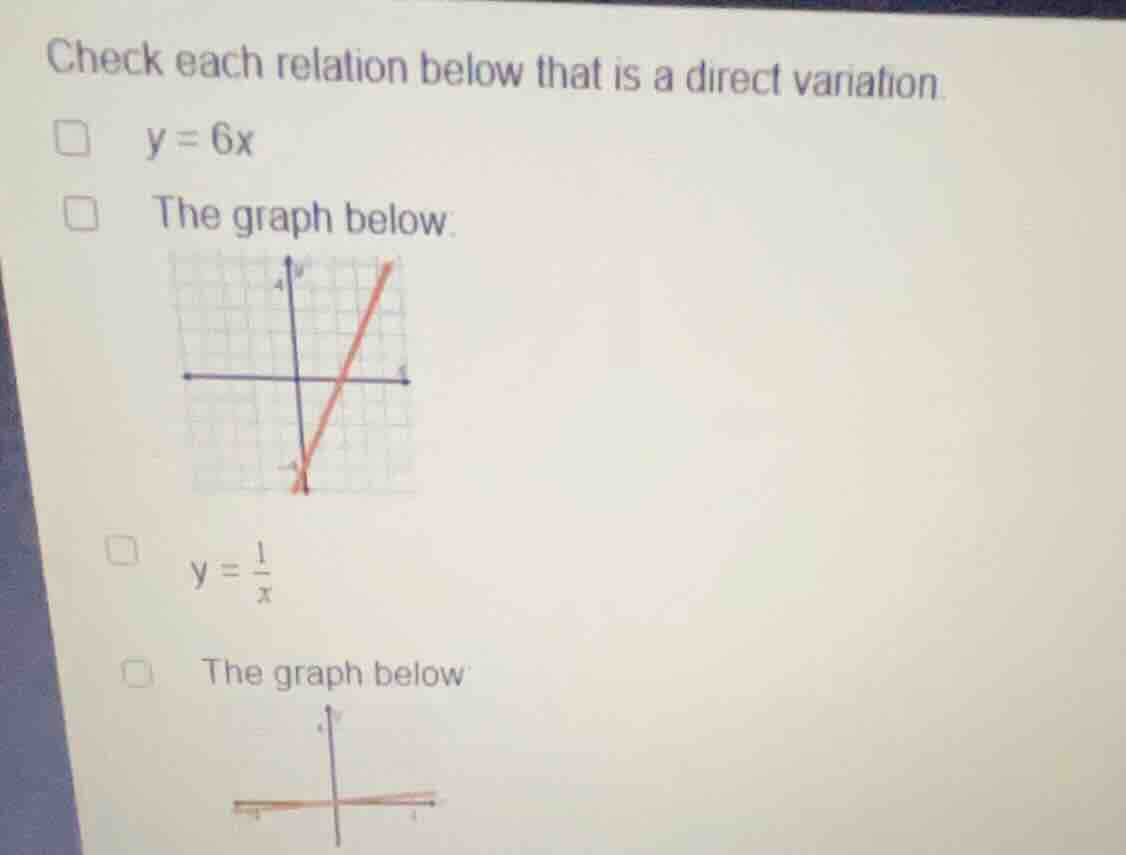
check each relation below that is a direct variation.
\\(y = 6x\\)
the graph below:
\\(y = \frac{1}{x}\\)
the graph below:
Define direct variation
A direct variation is a linear relationship between two variables that can be written in the form \(y = kx\), where \(k\) is a non-zero constant called the constant of variation.
Key characteristics of direct variation include:
- The equation is of the form \(y = kx\).
- The graph of a direct variation is a straight line that passes through the origin \((0,0)\).
Analyze the first relation
The first relation is given by the equation:
This equation is in the form \(y = kx\) with \(k = 6\). Therefore, this relation represents a direct variation.
Analyze the second relation
The second relation is represented by a graph showing a straight line.
Let's check if it passes through the origin \((0,0)\). Looking closely at the axes, the line crosses the y-axis below the origin (at approximately \((0, -3)\)). Since it does not pass through the origin \((0,0)\), it is not a direct variation.
Analyze the third relation
The third relation is given by the equation:
This equation represents an inverse variation, not a direct variation. In a direct variation, \(y\) is directly proportional to \(x\), whereas here \(y\) is inversely proportional to \(x\). Thus, this is not a direct variation.
Analyze the fourth relation
The fourth relation is represented by a graph showing a straight line.
Looking closely at the axes, this line passes directly through the intersection of the x-axis and y-axis, which is the origin \((0,0)\). Since it is a straight line passing through the origin, it represents a direct variation.

Snap & solve any problem in the app
Get step-by-step solutions on Sovi AI
Photo-based solutions with guided steps
Explore more problems and detailed explanations
- [x] \(y = 6x\) (Correct answer)
- [ ] The first graph (line with a negative y-intercept)
- [ ] \(y = \frac{1}{x}\)
- [x] The second graph (line passing through the origin) (Correct answer)