QUESTION IMAGE
Question
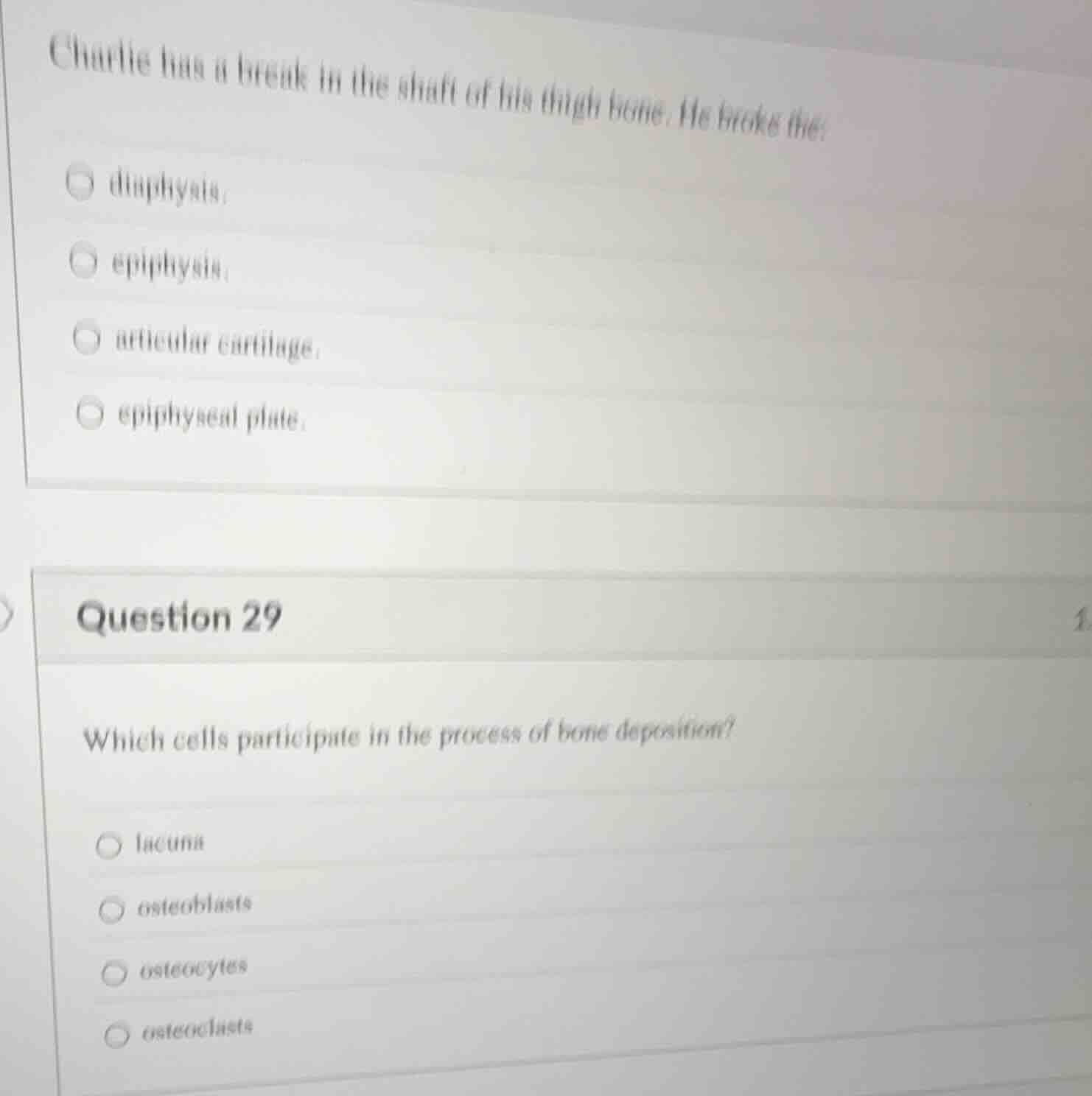
charlie has a break in the shaft of his thigh bone. he broke the:
diaphysis.
epiphysis.
articular cartilage.
epiphyseal plate.
question 29
which cells participate in the process of bone deposition?
lacuna
osteoblasts
osteocytes
osteoclasts
Identify the anatomical region of the thigh bone shaft
Using the Long Bone Anatomy knowledge point
The first question states that Charlie has a break in the shaft of his thigh bone (femur). In long bone anatomy, the tubular shaft that runs between the proximal and distal ends of the bone is called the diaphysis. The epiphysis refers to the rounded end of a long bone, articular cartilage covers the epiphysis at joints, and the epiphyseal plate is the growth plate located in the metaphysis. Therefore, a break in the shaft is a break in the diaphysis.
Determine the cells responsible for bone deposition
The second question asks which cells participate in the process of bone deposition. Bone deposition is the process of laying down new bone matrix.
- Osteoblasts are the bone-building cells that actively synthesize and secrete the organic components of the bone matrix (osteoid) and assist in its mineralization.
- Osteocytes are mature bone cells housed in lacunae that maintain the bone matrix.
- Osteoclasts are large, multinucleated cells responsible for bone resorption (breaking down bone).
- Lacunae are the small cavities containing osteocytes, not cells themselves.
Thus, osteoblasts are the cells that participate in bone deposition.

Snap & solve any problem in the app
Get step-by-step solutions on Sovi AI
Photo-based solutions with guided steps
Explore more problems and detailed explanations
Question 1
- (A) diaphysis (Correct answer)
- (B) epiphysis
- (C) articular cartilage
- (D) epiphyseal plate
Question 2
- (A) lacuna
- (B) osteoblasts (Correct answer)
- (C) osteocytes
- (D) osteoclasts