QUESTION IMAGE
Question
chapter quiz: processes of evolution
total points: --/100
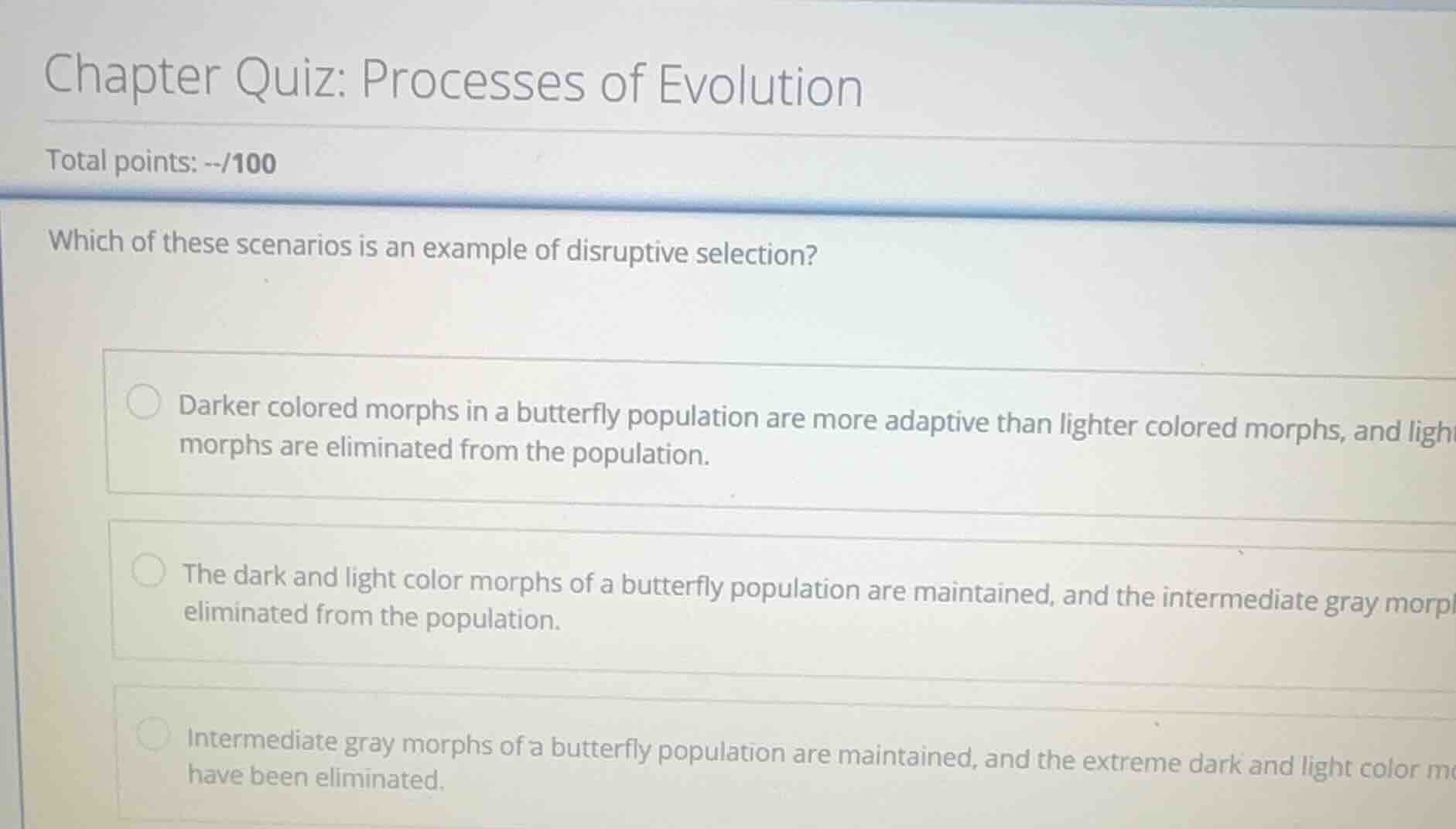
which of these scenarios is an example of disruptive selection?
darker colored morphs in a butterfly population are more adaptive than lighter colored morphs, and light morphs are eliminated from the population.
the dark and light color morphs of a butterfly population are maintained, and the intermediate gray morphs are eliminated from the population.
intermediate gray morphs of a butterfly population are maintained, and the extreme dark and light color morphs have been eliminated.
Define disruptive selection
Disruptive selection is a mode of Natural Selection Modes where extreme phenotypes are favored over intermediate ones.
Analyze the first scenario
The first option describes a shift toward one extreme (darker morphs) while eliminating the other (lighter morphs). This is directional selection.
Analyze the second scenario
The second option describes favoring both extremes (dark and light morphs) while eliminating the intermediate phenotype (gray morphs). This matches disruptive selection.
Analyze the third scenario
The third option describes favoring the intermediate phenotype (gray morphs) while eliminating both extremes. This is stabilizing selection.
Identify the correct choice
The second scenario is the correct example of disruptive selection.

Snap & solve any problem in the app
Get step-by-step solutions on Sovi AI
Photo-based solutions with guided steps
Explore more problems and detailed explanations
- Darker colored morphs in a butterfly population are more adaptive than lighter colored morphs, and light morphs are eliminated from the population.
- The dark and light color morphs of a butterfly population are maintained, and the intermediate gray morphs are eliminated from the population. (Correct answer)
- Intermediate gray morphs of a butterfly population are maintained, and the extreme dark and light color morphs have been eliminated.