QUESTION IMAGE
Question
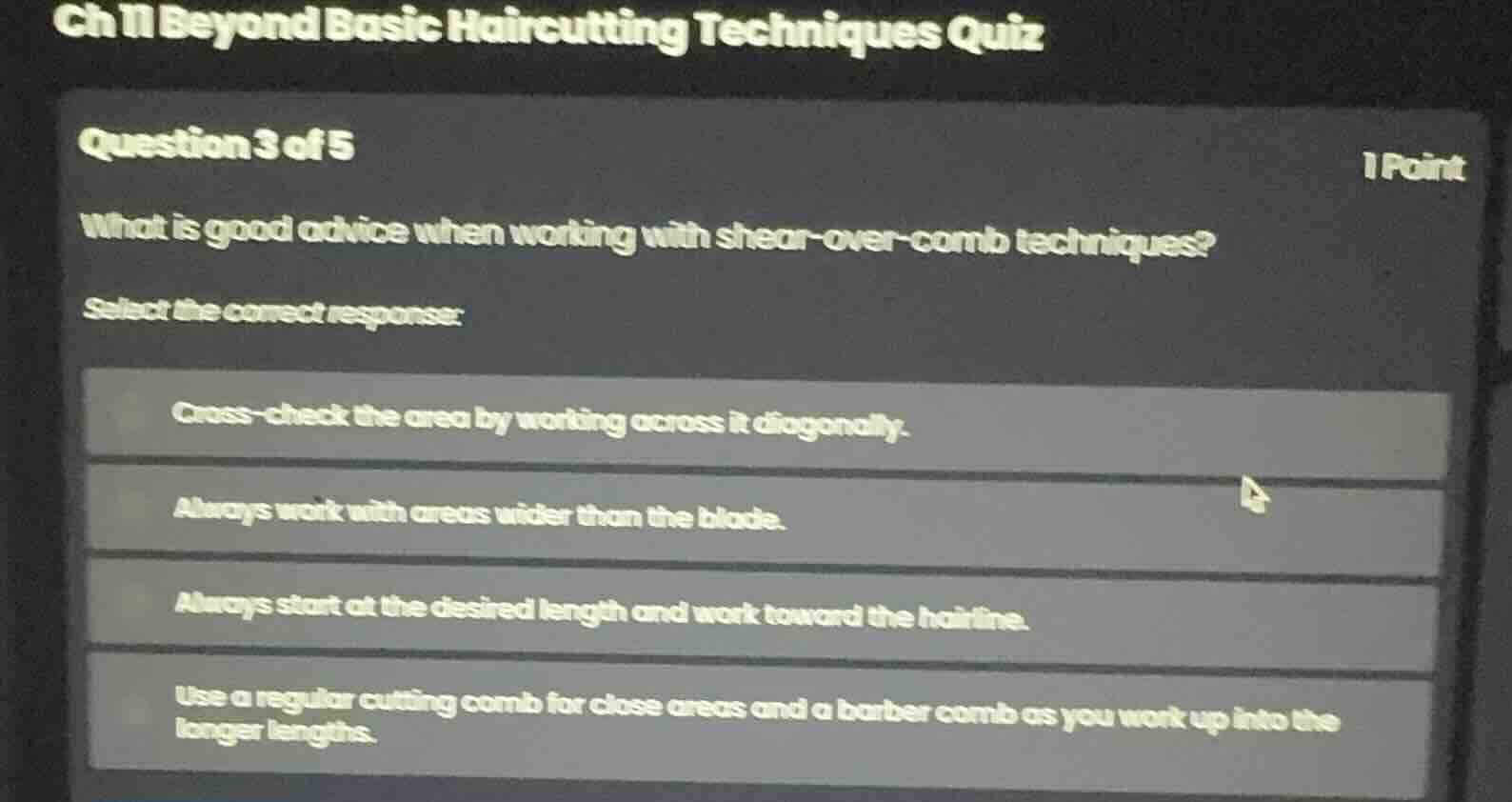
ch 11 beyond basic haircutting techniques quiz
question 3 of 5
what is good advice when working with shear-over-comb techniques?
select the correct response:
cross-check the area by working across it diagonally.
always work with areas wider than the blade.
always start at the desired length and work toward the hairline.
use a regular cutting comb for close areas and a barber comb as you work up into the longer lengths.
Analyze the question and options
The question asks for good advice when working with the shear-over-comb technique. Let's evaluate each option:
- Option 1: "Cross-check the area by working across it diagonally." This is standard practice in haircutting to ensure precision and evenness.
- Option 2: "Always work with areas wider than the blade." This is incorrect because working with areas wider than the blade can lead to uneven cuts and loss of control.
- Option 3: "Always start at the desired length and work toward the hairline." This is incorrect; you typically start at the hairline and work up to the desired length.
- Option 4: "Use a regular cutting comb for close areas and a barber comb as you work up into the longer lengths." This is reversed; a barber comb is thinner and used for close-tapered areas, while a regular cutting comb is used for longer lengths.
Apply the mastered concept
Using the Shear-over-comb Technique knowledge point
- Cross-checking is performed by working across the area diagonally to verify the accuracy of the cut.
- Working with sections wider than the shear blade leads to a lack of control and uneven results.
- The technique should begin at the hairline and move upward toward the longer lengths.
- A barber comb is used for close-cut areas, whereas a regular cutting comb is used for longer lengths.

Snap & solve any problem in the app
Get step-by-step solutions on Sovi AI
Photo-based solutions with guided steps
Explore more problems and detailed explanations
- (A) Cross-check the area by working across it diagonally. (Correct answer)
- (B) Always work with areas wider than the blade.
- (C) Always start at the desired length and work toward the hairline.
- (D) Use a regular cutting comb for close areas and a barber comb as you work up into the longer lengths.