QUESTION IMAGE
Question
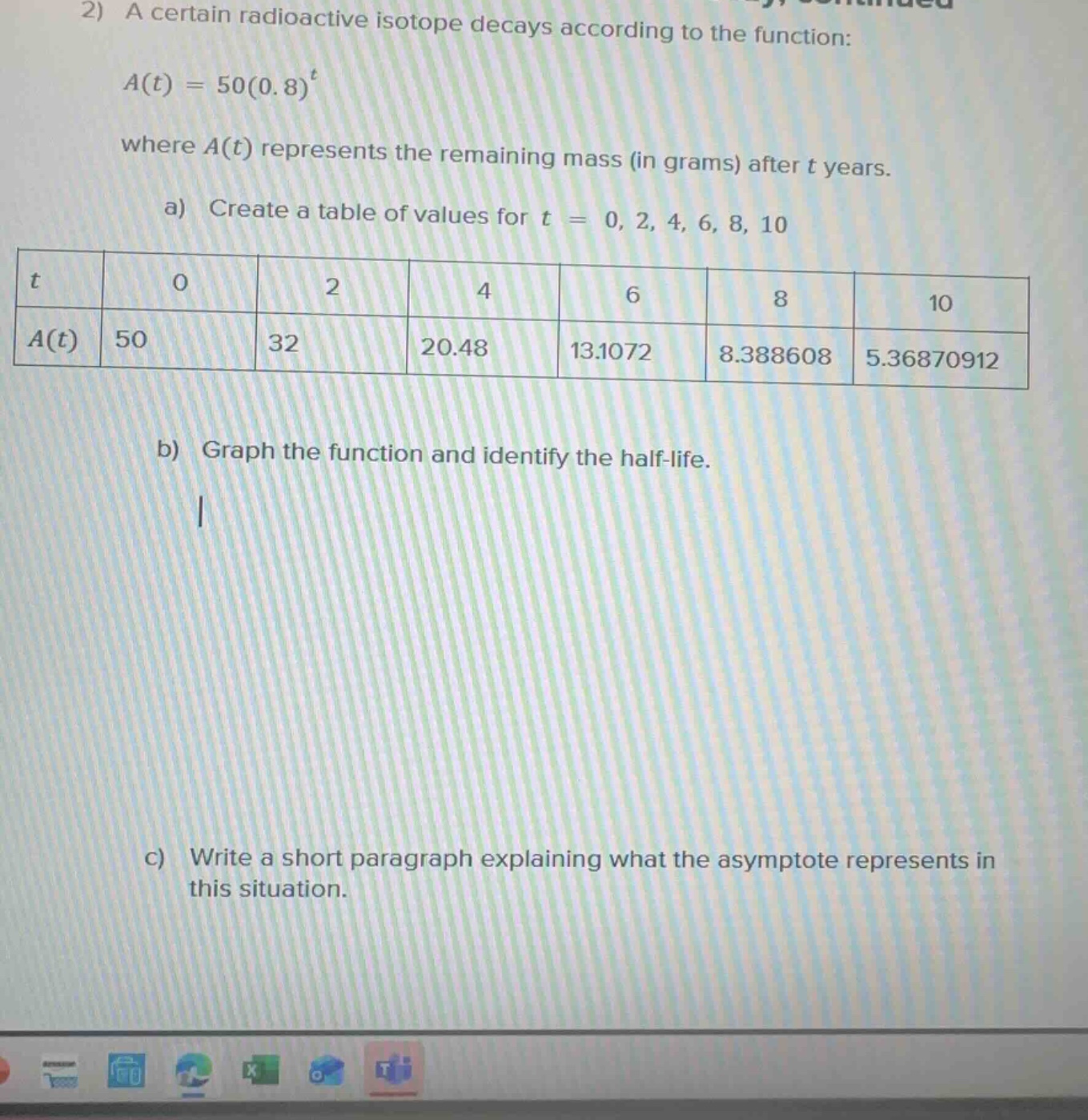
- a certain radioactive isotope decays according to the function:
\\a(t) = 50(0.8)^t\\
where \\(a(t)\\) represents the remaining mass (in grams) after \\(t\\) years.
a) create a table of values for \\(t = 0, 2, 4, 6, 8, 10\\)
b) graph the function and identify the half-life.
c) write a short paragraph explaining what the asymptote represents in this situation.
Evaluate the exponential function
We calculate the values of \(A(t) = 50(0.8)^t\) for the given values of \(t\).
- For \(t = 0\): \(A(0) = 50(0.8)^0 = 50\)
- For \(t = 2\): \(A(2) = 50(0.8)^2 = 32\)
- For \(t = 4\): \(A(4) = 50(0.8)^4 = 20.48\)
- For \(t = 6\): \(A(6) = 50(0.8)^6 = 13.1072\)
- For \(t = 8\): \(A(8) = 50(0.8)^8 \approx 8.3886\)
- For \(t = 10\): \(A(10) = 50(0.8)^{10} \approx 5.3687\)
Determine the half-life
The initial mass is \(50\text{ g}\). Half of this mass is \(25\text{ g}\).
We solve for \(t\) when \(A(t) = 25\):
The half-life is approximately \(3.11\text{ years}\).
Analyze the horizontal asymptote
As \(t \to \infty\), the term \((0.8)^t \to 0\).
Thus, \(A(t) \to 0\).
The horizontal asymptote is the line \(A(t) = 0\) (the \(t\)-axis).
In this physical context, it represents that the mass of the radioactive isotope continuously decreases and approaches \(0\text{ grams}\) over a very long period, but theoretically never reaches absolute zero.

Snap & solve any problem in the app
Get step-by-step solutions on Sovi AI
Photo-based solutions with guided steps
Explore more problems and detailed explanations
Part a)
The completed table of values is:
| \(t\) | 0 | 2 | 4 | 6 | 8 | 10 |
|---|
Part b)
The half-life of the isotope is approximately \(3.11\text{ years}\).
Part c)
The horizontal asymptote is \(A(t) = 0\). In this situation, it represents that as time goes on indefinitely, the remaining mass of the radioactive isotope approaches \(0\text{ grams}\). It signifies that while the substance decays continuously and becomes negligibly small, mathematically a tiny fraction of the isotope theoretically remains forever.