QUESTION IMAGE
Question
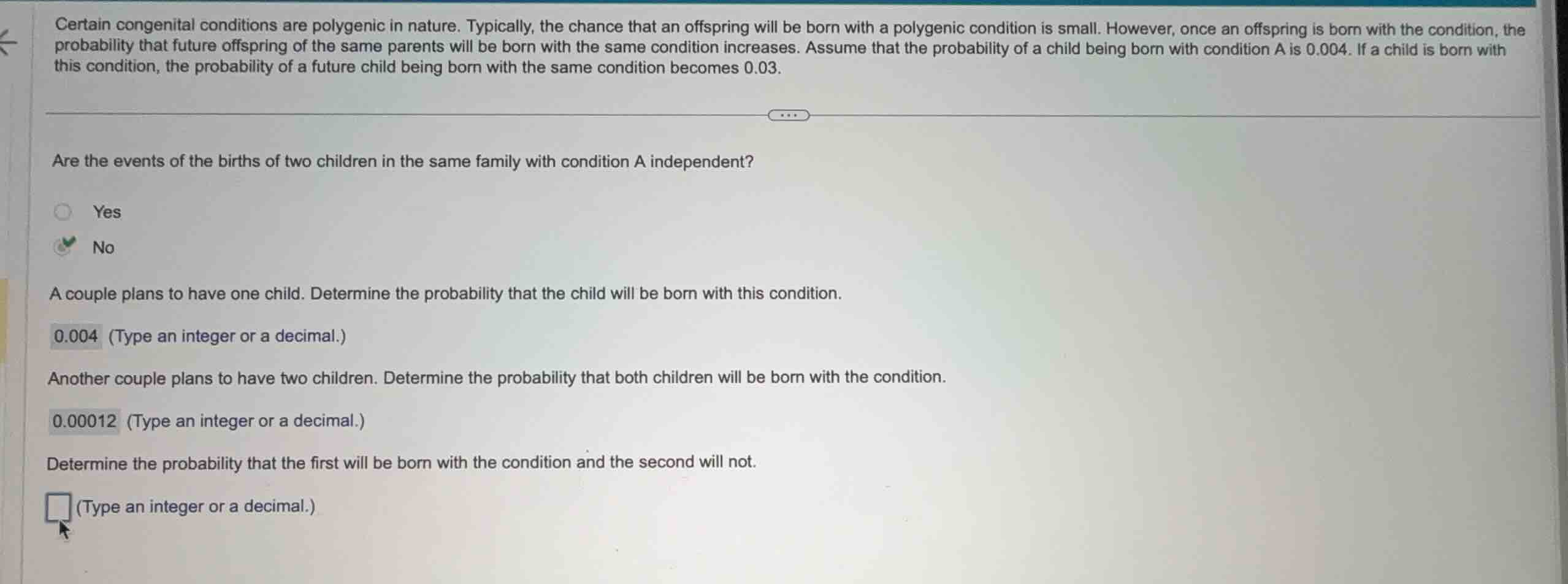
certain congenital conditions are polygenic in nature. typically, the chance that an offspring will be born with a polygenic condition is small. however, once an offspring is born with the condition, the probability that future offspring of the same parents will be born with the same condition increases. assume that the probability of a child being born with condition a is 0.004. if a child is born with this condition, the probability of a future child being born with the same condition becomes 0.03.
are the events of the births of two children in the same family with condition a independent?
yes
no
a couple plans to have one child. determine the probability that the child will be born with this condition.
0.004 (type an integer or a decimal.)
another couple plans to have two children. determine the probability that both children will be born with the condition.
0.00012 (type an integer or a decimal.)
determine the probability that the first will be born with the condition and the second will not.
(type an integer or a decimal.)
Define events and probabilities
Let \(C_1\) be the event that the first child is born with condition A, and \(C_2\) be the event that the second child is born with condition A.
Determine independence
Since the probability of the second child having the condition changes based on whether the first child has it:
Thus, the events are dependent (not independent).
Calculate probability for one child
The probability that a single child is born with the condition is:
Calculate probability that both children have the condition
Using the multiplication rule for dependent events:
Calculate probability that the first has the condition and the second does not
Using the complement of the conditional probability:

Snap & solve any problem in the app
Get step-by-step solutions on Sovi AI
Photo-based solutions with guided steps
Explore more problems and detailed explanations
Question 1
- Yes
- No (Correct answer)
Question 2
0.004
Question 3
0.00012
Question 4
0.00388