Sovi.AI - AI Math Tutor

Scan to solve math questions

QUESTION IMAGE

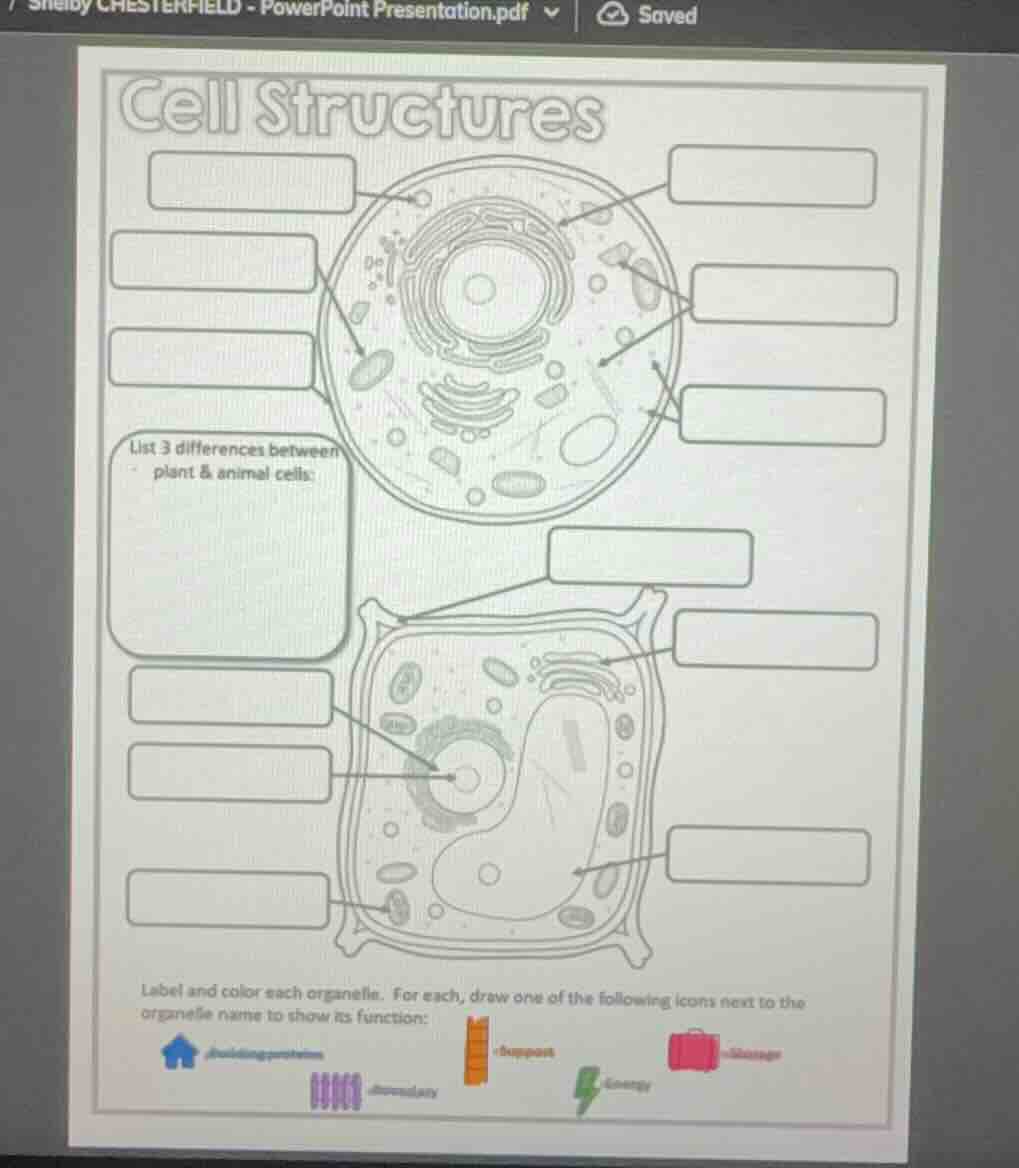
cell structures list 3 differences between plant & animal cells: label …

Question

cell structures
list 3 differences between plant & animal cells:
label and color each organelle. for each, draw one of the following icons next to the organelle name to show its function:
building proteins
boundary
support
energy
storage

Explanation:

Response

<pre_analysis>
{
"quality": "clear",
"question_count": 2,
"skills_matched": [
"direct_cot",
"explain_then_answer",
"tutor"
],
"needs_drawing": false,
"concepts_used": [
"Eukaryotic Cells"
],
"new_concepts": [
"Organelle Identification",
"Plant vs Animal Cells"
],
"current_concepts": [
"Eukaryotic Cells",
"Organelle Identification",
"Plant vs Animal Cells"
]
}
</pre_analysis>

<reasoning>

Identify the cell types

The diagram shows two distinct eukaryotic cells. The top cell is rounded with centrioles, representing an animal cell. The bottom cell has a rigid outer cell wall, chloroplasts, and a large central vacuole, representing a plant cell. This relates to our understanding of Eukaryotic Cells.

Label animal cell organelles

Let's trace the pointer lines for the top cell (animal cell):

  • Left top box points to a small circular vesicle: Lysosome.
  • Left middle box points to an oval organelle with folded inner membranes: Mitochondrion.
  • Left bottom box points to the outer boundary: Cell membrane.
  • Right top box points to the rough endoplasmic reticulum (RER) surrounding the nucleus.
  • Right upper-middle box points to small dots: Ribosomes.
  • Right lower-middle box points to the fluid filling the cell: Cytoplasm.
  • Right bottom box points to the stacked membrane structure: Golgi apparatus.

Label plant cell organelles

Let's trace the pointer lines for the bottom cell (plant cell):

  • Left top box points to the dense inner core of the nucleus: Nucleolus.
  • Left middle box points to the spherical structure containing genetic material: Nucleus.
  • Left bottom box points to the green, oval organelle with internal stacks: Chloroplast.
  • Right top box points to the rigid outermost layer: Cell wall.
  • Right middle box points to the layer just inside the cell wall: Cell membrane.
  • Right bottom box points to the large fluid-filled sac: Vacuole.

List differences between cells

We need to list three structural differences between plant and animal cells:

  1. Plant cells have a rigid outer cell wall made of cellulose, whereas animal cells only have a flexible cell membrane.
  2. Plant cells contain chloroplasts for photosynthesis, which are absent in animal cells.
  3. Plant cells typically have a single large central vacuole for storage and turgor pressure, while animal cells have several small, temporary vacuoles.

Match organelles to functional icons

Based on the key at the bottom of the worksheet:

  • Building proteins (house icon): Ribosomes, Endoplasmic reticulum.
  • Boundary (fence icon): Cell membrane, Cell wall.
  • Support (pillar icon): Cell wall, Cytoplasm.
  • Energy (lightning bolt icon): Mitochondria, Chloroplasts.
  • Storage (suitcase icon): Vacuole, Lysosome, Golgi apparatus.

</reasoning>

<answer>

Cell Diagram Labels

Animal Cell (Top)
  • Left Side (Top to Bottom):
  1. Lysosome (Function: Storage/Digestion)
  2. Mitochondrion (Function: Energy)
  3. Cell Membrane (Function: Boundary)
  • Right Side (Top to Bottom):
  1. Endoplasmic Reticulum (Function: Building proteins)
  2. Ribosome (Function: Building proteins)
  3. Cytoplasm (Function: Support)
  4. Golgi Apparatus (Function: Storage/Packaging)

---

Plant Cell (Bottom)
  • Left Side (Top to Bottom):
  1. Nucleolus (Function: Building proteins/ribosomes)
  2. Nucleus (Function: Control center)
  3. Chloroplast (Function: Energy)
  • Right Side (Top to Bottom):
  1. Cell Wall (Function: Support/Boundary)
  2. Cell Membrane (Func…

Answer:

<pre_analysis>
{
"quality": "clear",
"question_count": 2,
"skills_matched": [
"direct_cot",
"explain_then_answer",
"tutor"
],
"needs_drawing": false,
"concepts_used": [
"Eukaryotic Cells"
],
"new_concepts": [
"Organelle Identification",
"Plant vs Animal Cells"
],
"current_concepts": [
"Eukaryotic Cells",
"Organelle Identification",
"Plant vs Animal Cells"
]
}
</pre_analysis>

<reasoning>

Identify the cell types

The diagram shows two distinct eukaryotic cells. The top cell is rounded with centrioles, representing an animal cell. The bottom cell has a rigid outer cell wall, chloroplasts, and a large central vacuole, representing a plant cell. This relates to our understanding of Eukaryotic Cells.

Label animal cell organelles

Let's trace the pointer lines for the top cell (animal cell):

  • Left top box points to a small circular vesicle: Lysosome.
  • Left middle box points to an oval organelle with folded inner membranes: Mitochondrion.
  • Left bottom box points to the outer boundary: Cell membrane.
  • Right top box points to the rough endoplasmic reticulum (RER) surrounding the nucleus.
  • Right upper-middle box points to small dots: Ribosomes.
  • Right lower-middle box points to the fluid filling the cell: Cytoplasm.
  • Right bottom box points to the stacked membrane structure: Golgi apparatus.

Label plant cell organelles

Let's trace the pointer lines for the bottom cell (plant cell):

  • Left top box points to the dense inner core of the nucleus: Nucleolus.
  • Left middle box points to the spherical structure containing genetic material: Nucleus.
  • Left bottom box points to the green, oval organelle with internal stacks: Chloroplast.
  • Right top box points to the rigid outermost layer: Cell wall.
  • Right middle box points to the layer just inside the cell wall: Cell membrane.
  • Right bottom box points to the large fluid-filled sac: Vacuole.

List differences between cells

We need to list three structural differences between plant and animal cells:

  1. Plant cells have a rigid outer cell wall made of cellulose, whereas animal cells only have a flexible cell membrane.
  2. Plant cells contain chloroplasts for photosynthesis, which are absent in animal cells.
  3. Plant cells typically have a single large central vacuole for storage and turgor pressure, while animal cells have several small, temporary vacuoles.

Match organelles to functional icons

Based on the key at the bottom of the worksheet:

  • Building proteins (house icon): Ribosomes, Endoplasmic reticulum.
  • Boundary (fence icon): Cell membrane, Cell wall.
  • Support (pillar icon): Cell wall, Cytoplasm.
  • Energy (lightning bolt icon): Mitochondria, Chloroplasts.
  • Storage (suitcase icon): Vacuole, Lysosome, Golgi apparatus.

</reasoning>

<answer>

Cell Diagram Labels

Animal Cell (Top)
  • Left Side (Top to Bottom):
  1. Lysosome (Function: Storage/Digestion)
  2. Mitochondrion (Function: Energy)
  3. Cell Membrane (Function: Boundary)
  • Right Side (Top to Bottom):
  1. Endoplasmic Reticulum (Function: Building proteins)
  2. Ribosome (Function: Building proteins)
  3. Cytoplasm (Function: Support)
  4. Golgi Apparatus (Function: Storage/Packaging)

---

Plant Cell (Bottom)
  • Left Side (Top to Bottom):
  1. Nucleolus (Function: Building proteins/ribosomes)
  2. Nucleus (Function: Control center)
  3. Chloroplast (Function: Energy)
  • Right Side (Top to Bottom):
  1. Cell Wall (Function: Support/Boundary)
  2. Cell Membrane (Function: Boundary)
  3. Vacuole (Function: Storage)

---

Differences Between Plant and Animal Cells

  1. Cell Wall: Plant cells have a rigid outer cell wall made of cellulose that provides structural support, whereas animal cells lack a cell wall.
  2. Chloroplasts: Plant cells contain chloroplasts to perform photosynthesis and produce food, which are completely absent in animal cells.
  3. Vacuole Size: Plant cells have one large central vacuole that stores water and maintains turgor pressure, while animal cells contain only small, temporary vacuoles.

</answer>

<post_analysis>
{
"subject": "Natural Science",
"question_type": "Multi-part",
"knowledge_point": [
"Natural Science",
"Biology",
"Cell Biology"
]
}
</post_analysis>