QUESTION IMAGE
Question
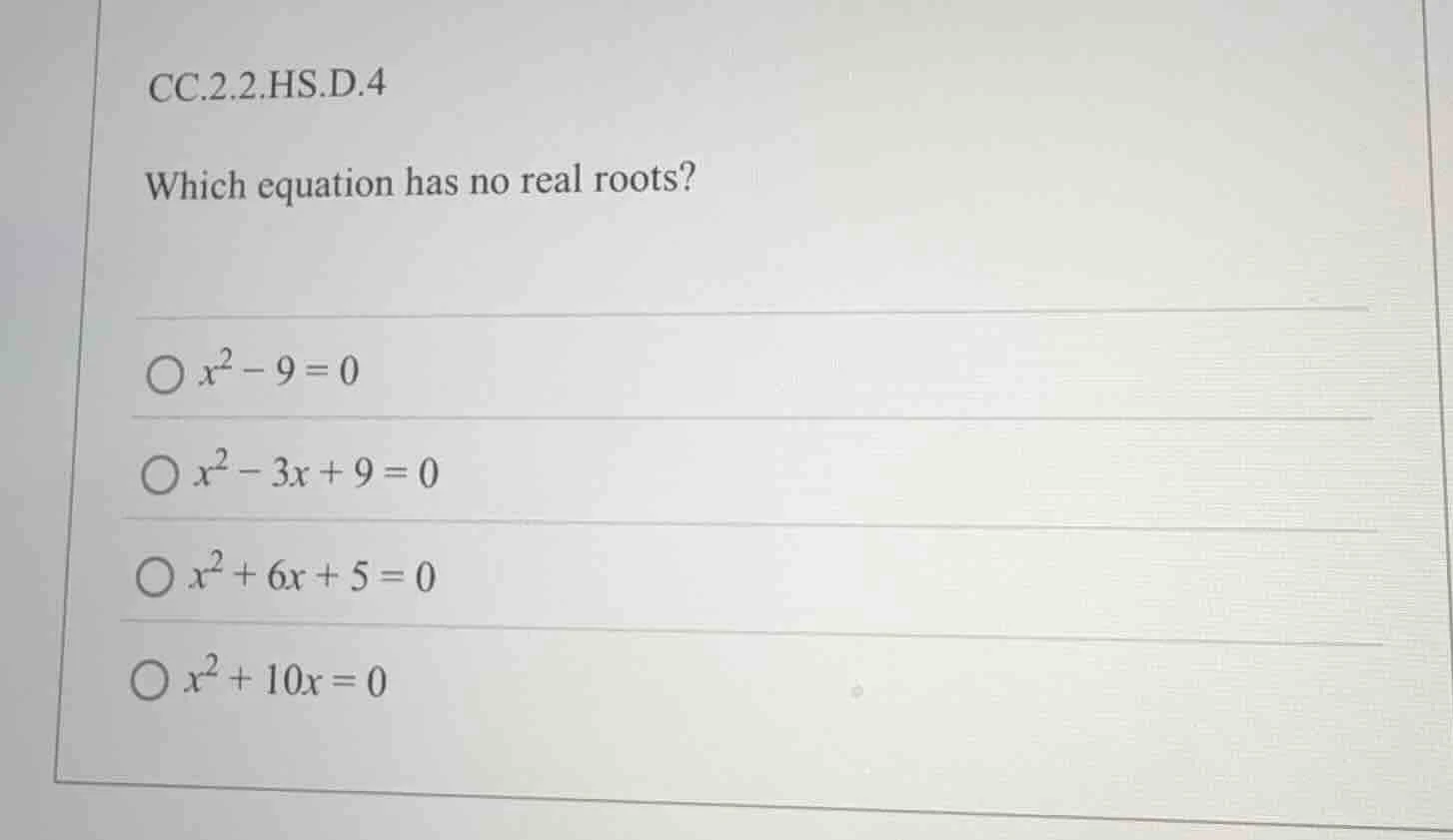
cc.2.2.hs.d.4
which equation has no real roots?
\\( x^2 - 9 = 0 \\)
\\( x^2 - 3x + 9 = 0 \\)
\\( x^2 + 6x + 5 = 0 \\)
\\( x^2 + 10x = 0 \\)
To determine which quadratic equation has no real roots, we use the discriminant formula for a quadratic equation \(ax^2 + bx + c = 0\), which is \(\Delta = b^2 - 4ac\). If \(\Delta < 0\), the equation has no real roots.
Step 1: Analyze \(x^2 - 9 = 0\)
For \(x^2 - 9 = 0\), we have \(a = 1\), \(b = 0\), \(c = -9\).
Calculate the discriminant: \(\Delta = 0^2 - 4(1)(-9) = 0 + 36 = 36\).
Since \(\Delta = 36 > 0\), this equation has two real roots.
Step 2: Analyze \(x^2 - 3x + 9 = 0\)
For \(x^2 - 3x + 9 = 0\), we have \(a = 1\), \(b = -3\), \(c = 9\).
Calculate the discriminant: \(\Delta = (-3)^2 - 4(1)(9) = 9 - 36 = -27\).
Since \(\Delta = -27 < 0\), this equation has no real roots. (We can stop here, but we'll check the other equations for completeness.)
Step 3: Analyze \(x^2 + 6x + 5 = 0\)
For \(x^2 + 6x + 5 = 0\), we have \(a = 1\), \(b = 6\), \(c = 5\).
Calculate the discriminant: \(\Delta = 6^2 - 4(1)(5) = 36 - 20 = 16\).
Since \(\Delta = 16 > 0\), this equation has two real roots.
Step 4: Analyze \(x^2 + 10x = 0\)
For \(x^2 + 10x = 0\), we can rewrite it as \(x^2 + 10x + 0 = 0\), so \(a = 1\), \(b = 10\), \(c = 0\).
Calculate the discriminant: \(\Delta = 10^2 - 4(1)(0) = 100 - 0 = 100\).
Since \(\Delta = 100 > 0\), this equation has two real roots.

Snap & solve any problem in the app
Get step-by-step solutions on Sovi AI
Photo-based solutions with guided steps
Explore more problems and detailed explanations
The equation \(x^2 - 3x + 9 = 0\) has no real roots. So the answer is the option with \(x^2 - 3x + 9 = 0\).