QUESTION IMAGE
Question
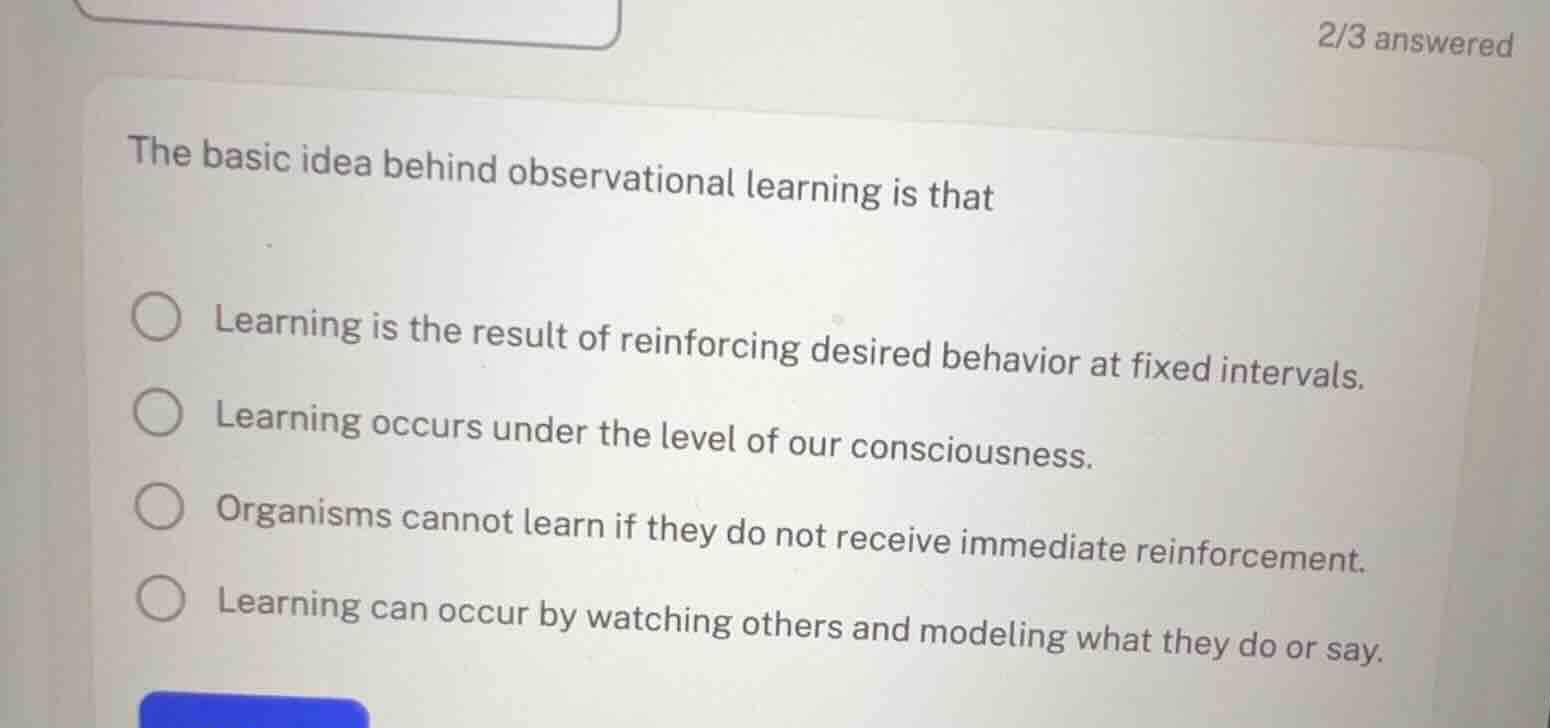
the basic idea behind observational learning is that
learning is the result of reinforcing desired behavior at fixed intervals.
learning occurs under the level of our consciousness.
organisms cannot learn if they do not receive immediate reinforcement.
learning can occur by watching others and modeling what they do or say.
<pre_analysis>
{
"quality": "clear",
"question_count": 1,
"skills_matched": [
"direct_cot",
"multiple_choice_formatter",
"explain_then_answer",
"tutor",
"mastery_adaptive_brevity"
],
"needs_drawing": false,
"concepts_used": [
"Observational Learning",
"Modeling Process Steps"
],
"new_concepts": [],
"current_concepts": [
"Observational Learning",
"Modeling Process Steps"
]
}
</pre_analysis>
<reasoning>
Define observational learning
Using the Observational Learning knowledge point
Observational learning is a type of learning that occurs through watching the behavior of others, retaining that information, and later replicating the observed behaviors.
Analyze the role of modeling
Using the Modeling Process Steps knowledge point
Individuals learn by observing a model's actions and the consequences of those actions, allowing them to acquire new behaviors without direct personal experience or immediate reinforcement.
Evaluate the given options
- Option 1 describes operant conditioning schedules.
- Option 2 describes implicit or subliminal learning.
- Option 3 is incorrect because learning can occur without direct or immediate reinforcement.
- Option 4 accurately states that learning occurs by watching others and modeling their actions or words.
</reasoning>
<answer>
<mcq-option>(A) Learning is the result of reinforcing desired behavior at fixed intervals.</mcq-option>
<mcq-option>(B) Learning occurs under the level of our consciousness.</mcq-option>
<mcq-option>(C) Organisms cannot learn if they do not receive immediate reinforcement.</mcq-option>
<mcq-correct>(D) Learning can occur by watching others and modeling what they do or say.</mcq-correct>
</answer>
<post_analysis>
{
"subject": "Social Science",
"question_type": "Multiple Choice",
"knowledge_point": [
"Social Science",
"Psychology",
"Observational Learning"
]
}
</post_analysis>
Snap & solve any problem in the app
Get step-by-step solutions on Sovi AI
Photo-based solutions with guided steps
Explore more problems and detailed explanations
<pre_analysis>
{
"quality": "clear",
"question_count": 1,
"skills_matched": [
"direct_cot",
"multiple_choice_formatter",
"explain_then_answer",
"tutor",
"mastery_adaptive_brevity"
],
"needs_drawing": false,
"concepts_used": [
"Observational Learning",
"Modeling Process Steps"
],
"new_concepts": [],
"current_concepts": [
"Observational Learning",
"Modeling Process Steps"
]
}
</pre_analysis>
<reasoning>
Define observational learning
Using the Observational Learning knowledge point
Observational learning is a type of learning that occurs through watching the behavior of others, retaining that information, and later replicating the observed behaviors.
Analyze the role of modeling
Using the Modeling Process Steps knowledge point
Individuals learn by observing a model's actions and the consequences of those actions, allowing them to acquire new behaviors without direct personal experience or immediate reinforcement.
Evaluate the given options
- Option 1 describes operant conditioning schedules.
- Option 2 describes implicit or subliminal learning.
- Option 3 is incorrect because learning can occur without direct or immediate reinforcement.
- Option 4 accurately states that learning occurs by watching others and modeling their actions or words.
</reasoning>
<answer>
<mcq-option>(A) Learning is the result of reinforcing desired behavior at fixed intervals.</mcq-option>
<mcq-option>(B) Learning occurs under the level of our consciousness.</mcq-option>
<mcq-option>(C) Organisms cannot learn if they do not receive immediate reinforcement.</mcq-option>
<mcq-correct>(D) Learning can occur by watching others and modeling what they do or say.</mcq-correct>
</answer>
<post_analysis>
{
"subject": "Social Science",
"question_type": "Multiple Choice",
"knowledge_point": [
"Social Science",
"Psychology",
"Observational Learning"
]
}
</post_analysis>