Sovi.AI - AI Math Tutor

Scan to solve math questions

QUESTION IMAGE

based on \aint i a woman?,\ how did truth most likely feel about the an…

Question

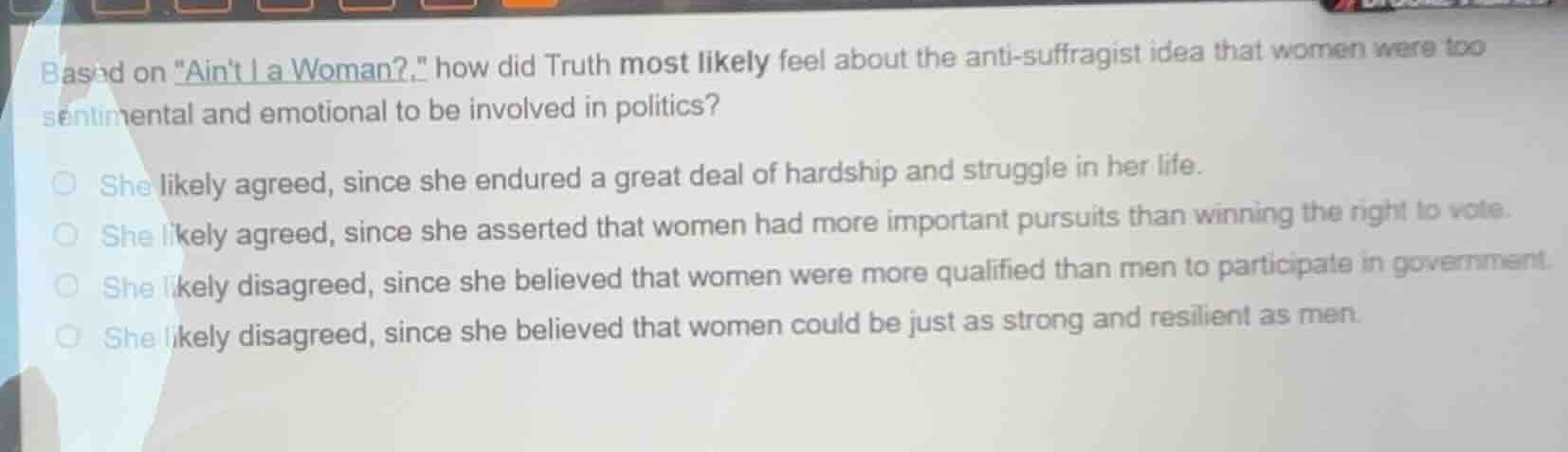
based on \aint i a woman?,\ how did truth most likely feel about the anti-suffragist idea that women were too sentimental and emotional to be involved in politics?

she likely agreed, since she endured a great deal of hardship and struggle in her life.
she likely agreed, since she asserted that women had more important pursuits than winning the right to vote.
she likely disagreed, since she believed that women were more qualified than men to participate in government.
she likely disagreed, since she believed that women could be just as strong and resilient as men.

Explanation:

Response

<pre_analysis>
{
"quality": "clear",
"question_count": 1,
"skills_matched": [
"direct_cot",
"multiple_choice_formatter",
"explain_then_answer",
"tutor",
"mastery_adaptive_brevity"
],
"needs_drawing": false,
"concepts_used": [
"Sojourner Truth Analysis",
"Historical Speeches"
],
"new_concepts": [],
"current_concepts": [
"Sojourner Truth Analysis",
"Historical Speeches",
"Rhetorical Analysis"
]
}
</pre_analysis>

<reasoning>

Analyze the prompt and historical context

Using the Sojourner Truth Analysis and Historical Speeches knowledge points:
In her famous 1851 speech "Ain't I a Woman?", Sojourner Truth challenges prevailing 19th-century notions of female fragility, sentimentality, and intellectual inferiority used by anti-suffragists to deny women the right to vote.

Evaluate Truth's arguments on strength and resilience

Using the Sojourner Truth Analysis knowledge point:
Truth highlights her own life experiences—working in fields, enduring physical lashings, and bearing children sold into slavery—to demonstrate that women possess immense physical and emotional strength, directly countering the idea that women are too delicate, sentimental, or emotional for public and political life.

Assess the given options

Using the Sojourner Truth Analysis knowledge point:

  • Option 1 suggests she agreed, which is incorrect as she actively campaigned for women's rights.
  • Option 2 suggests she agreed and valued other pursuits over voting, which contradicts her advocacy.
  • Option 3 suggests she believed women were more qualified than men, which misrepresents her plea for equal rights.
  • Option 4 correctly identifies that she disagreed because she believed and demonstrated that women could be just as strong and resilient as men.

</reasoning>

<answer>
<mcq-option>She likely agreed, since she endured a great deal of hardship and struggle in her life.</mcq-option>
<mcq-option>She likely agreed, since she asserted that women had more important pursuits than winning the right to vote.</mcq-option>
<mcq-option>She likely disagreed, since she believed that women were more qualified than men to participate in government.</mcq-option>
<mcq-correct>She likely disagreed, since she believed that women could be just as strong and resilient as men.</mcq-correct>
</answer>

<post_analysis>
{
"subject": "Social Science",
"question_type": "Multiple Choice",
"knowledge_point": [
"Social Science",
"US History",
"Sojourner Truth Analysis"
]
}
</post_analysis>

Answer:

<pre_analysis>
{
"quality": "clear",
"question_count": 1,
"skills_matched": [
"direct_cot",
"multiple_choice_formatter",
"explain_then_answer",
"tutor",
"mastery_adaptive_brevity"
],
"needs_drawing": false,
"concepts_used": [
"Sojourner Truth Analysis",
"Historical Speeches"
],
"new_concepts": [],
"current_concepts": [
"Sojourner Truth Analysis",
"Historical Speeches",
"Rhetorical Analysis"
]
}
</pre_analysis>

<reasoning>

Analyze the prompt and historical context

Using the Sojourner Truth Analysis and Historical Speeches knowledge points:
In her famous 1851 speech "Ain't I a Woman?", Sojourner Truth challenges prevailing 19th-century notions of female fragility, sentimentality, and intellectual inferiority used by anti-suffragists to deny women the right to vote.

Evaluate Truth's arguments on strength and resilience

Using the Sojourner Truth Analysis knowledge point:
Truth highlights her own life experiences—working in fields, enduring physical lashings, and bearing children sold into slavery—to demonstrate that women possess immense physical and emotional strength, directly countering the idea that women are too delicate, sentimental, or emotional for public and political life.

Assess the given options

Using the Sojourner Truth Analysis knowledge point:

  • Option 1 suggests she agreed, which is incorrect as she actively campaigned for women's rights.
  • Option 2 suggests she agreed and valued other pursuits over voting, which contradicts her advocacy.
  • Option 3 suggests she believed women were more qualified than men, which misrepresents her plea for equal rights.
  • Option 4 correctly identifies that she disagreed because she believed and demonstrated that women could be just as strong and resilient as men.

</reasoning>

<answer>
<mcq-option>She likely agreed, since she endured a great deal of hardship and struggle in her life.</mcq-option>
<mcq-option>She likely agreed, since she asserted that women had more important pursuits than winning the right to vote.</mcq-option>
<mcq-option>She likely disagreed, since she believed that women were more qualified than men to participate in government.</mcq-option>
<mcq-correct>She likely disagreed, since she believed that women could be just as strong and resilient as men.</mcq-correct>
</answer>

<post_analysis>
{
"subject": "Social Science",
"question_type": "Multiple Choice",
"knowledge_point": [
"Social Science",
"US History",
"Sojourner Truth Analysis"
]
}
</post_analysis>