QUESTION IMAGE
Question
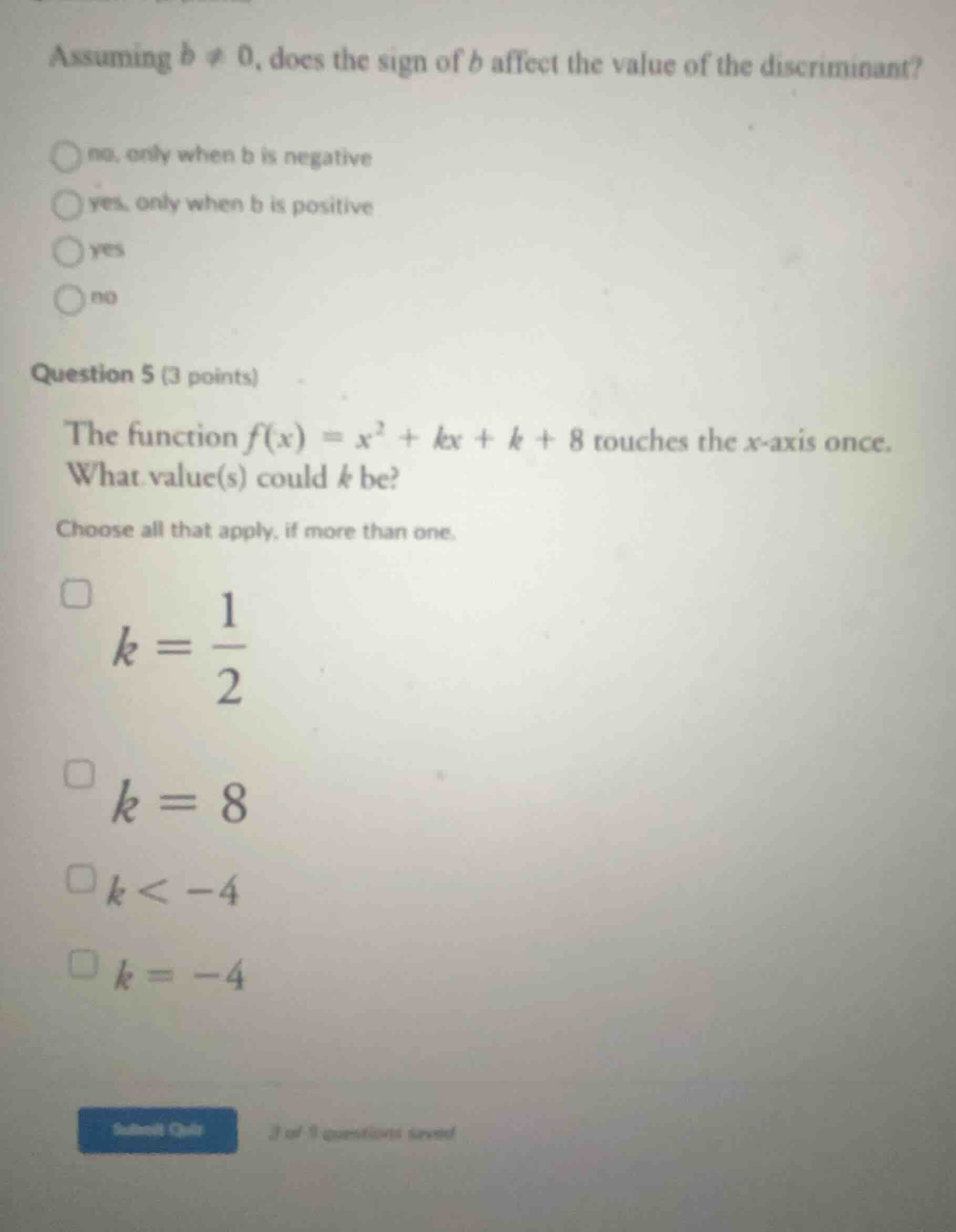
assuming \\(b \
eq 0\\), does the sign of \\(b\\) affect the value of the discriminant?
no, only when b is negative
yes, only when b is positive
yes
no
question 5 (3 points)
the function \\(f(x) = x^2 + kx + k + 8\\) touches the \\(x\\)-axis once. what value(s) could \\(k\\) be?
choose all that apply, if more than one.
\\(k = \frac{1}{2}\\)
\\(k = 8\\)
\\(k < -4\\)
\\(k = -4\\)
Analyze the effect of the sign of \(b\) on the discriminant
$$
LATEXBLOCK0
$$
Solve for \(k\) when the quadratic function touches the x-axis once
$$
LATEXBLOCK1
$$
Find the roots of the quadratic equation in \(k\)
$$
LATEXBLOCK2
$$

Snap & solve any problem in the app
Get step-by-step solutions on Sovi AI
Photo-based solutions with guided steps
Explore more problems and detailed explanations
Question 1
- no, only when b is negative
- yes, only when b is positive
- yes
- no (Correct answer)
Question 2
- \(k = \frac{1}{2}\)
- \(k = 8\) (Correct answer)
- \(k < -4\)
- \(k = -4\) (Correct answer)