QUESTION IMAGE
Question
assignment 3
ifp3701-2026
question 2
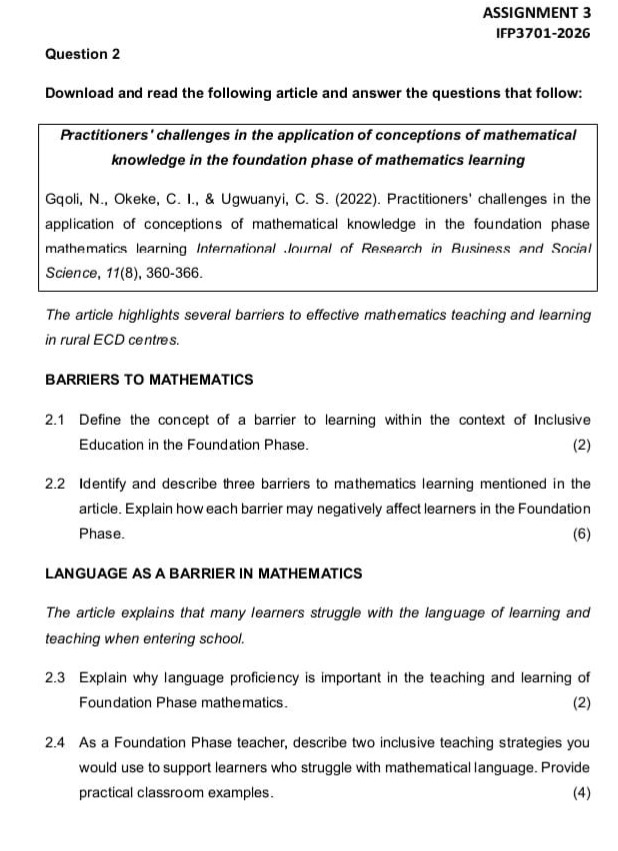
download and read the following article and answer the questions that follow:
practitioners challenges in the application of conceptions of mathematical knowledge in the foundation phase of mathematics learning
gqoli, n., okeke, c. i., & ugwuanyi, c. s. (2022). practitioners challenges in the application of conceptions of mathematical knowledge in the foundation phase mathematics learning. international journal of research in business and social science, 11(8), 360-366.
the article highlights several barriers to effective mathematics teaching and learning in rural ecd centres.
barriers to mathematics
2.1 define the concept of a barrier to learning within the context of inclusive education in the foundation phase. (2)
2.2 identify and describe three barriers to mathematics learning mentioned in the article. explain how each barrier may negatively affect learners in the foundation phase. (6)
language as a barrier in mathematics
the article explains that many learners struggle with the language of learning and teaching when entering school.
2.3 explain why language proficiency is important in the teaching and learning of foundation phase mathematics. (2)
2.4 as a foundation phase teacher, describe two inclusive teaching strategies you would use to support learners who struggle with mathematical language. provide practical classroom examples. (4)
🆕 New Concept Discovered: Inclusive Pedagogical Strategies
Adapting instruction to support diverse learning needs in early mathematics.
---
Step 1: Define "Barrier to Learning" (Question 2.1)
In the context of Inclusive Education in the Foundation Phase, a barrier to learning refers to any factor—whether internal (intrinsic to the learner, such as a developmental delay or sensory impairment) or external (extrinsic, such as systemic, environmental, socio-economic, or linguistic challenges)—that hinders or prevents a child from fully accessing, participating in, and benefiting from the educational curriculum.
In an inclusive framework, the focus is on identifying and minimizing these obstacles within the learning environment so that every child has equal opportunities to succeed.
---
Step 2: Identify and Describe Barriers to Mathematics Learning (Question 2.2)
Based on the study of early childhood development (ECD) and mathematics teaching in rural contexts (such as the cited article by Gqoli, Okeke, & Ugwuanyi, 2022), three key barriers to mathematics learning are:
- Inadequate Teaching Resources and Concrete Learning Materials
- Description: A lack of physical, age-appropriate mathematical manipulatives (such as counters, shapes, abacuses, and educational games) in rural or under-resourced classrooms.
- Negative Impact: Foundation Phase learners are in the concrete-operational stage of cognitive development. Without physical objects to touch and manipulate, abstract mathematical concepts (like addition, subtraction, or spatial relations) remain incomprehensible, leading to rote memorization rather than conceptual understanding.
- Language and Communication Barriers (Language of Learning and Teaching - LoLT)
- Description: A mismatch between the learner's home language and the language used for instruction, or a general lack of proficiency in the specialized vocabulary of mathematics.
- Negative Impact: Learners struggle to understand word problems, follow teacher instructions, or express their mathematical thinking. This leads to confusion, anxiety, and an inability to grasp basic mathematical terms (e.g., "more than," "less than," "altogether").
- Underqualified Practitioners / Lack of Specialized Pedagogical Content Knowledge
- Description: Teachers or ECD practitioners who lack specialized training in early childhood mathematics pedagogy, leading to ineffective instructional methods.
- Negative Impact: Teachers may rely on passive, teacher-centered methods rather than play-based, active learning. This fails to stimulate mathematical thinking, leading to disengagement, low motivation, and gaps in foundational mathematical concepts that persist throughout the child's schooling.
---
Step 3: Importance of Language Proficiency in Foundation Phase Mathematics (Question 2.3)
Language proficiency is crucial in Foundation Phase mathematics because mathematics is not just about numbers; it is a highly symbolic language with its own unique vocabulary, syntax, and semantic rules.
- Conceptual Understanding: Learners must understand relational terms (such as equal to, heavy, light, before, after) to build basic number sense and spatial awareness.
- Cognitive Processing: Language serves as the tool for internal thought. If a child lacks the vocabulary to label and categorize mathematical ideas, they cannot effectively process, organize, or retrieve mathematical concepts, nor can they explain their problem-solving reasoning to others.
---
#…

Snap & solve any problem in the app
Get step-by-step solutions on Sovi AI
Photo-based solutions with guided steps
Explore more problems and detailed explanations
2.1 Definition of a Barrier to Learning
A barrier to learning is any internal (intrinsic) or external (extrinsic/systemic) factor that prevents a learner from fully accessing, participating in, or benefiting from the educational curriculum within an inclusive classroom environment.
---
2.2 Three Barriers to Mathematics Learning & Their Impact
- Lack of Concrete Learning Resources:
- Impact: Prevents hands-on, concrete exploration, forcing abstract learning too early and leading to poor conceptual understanding.
- Language Barriers (LoLT mismatch):
- Impact: Learners cannot comprehend mathematical instructions, word problems, or specialized terms, leading to cognitive overload and academic exclusion.
- Inadequate Teacher Pedagogical Content Knowledge:
- Impact: Results in rote, teacher-centered instruction that fails to foster critical thinking, play-based learning, or foundational mathematical skills.
---
2.3 Importance of Language Proficiency
Language proficiency is essential because mathematics has its own distinct vocabulary and syntax. Without language proficiency, learners cannot decode word problems, understand relational concepts (e.g., "more than", "half of"), or express their mathematical reasoning.
---
2.4 Two Inclusive Teaching Strategies
- Multilingual Visual Word Walls: Displaying key mathematical terms alongside pictures, symbols, and home-language translations (e.g., displaying the word "Half" next to a picture of a sliced apple and its home-language equivalent).
- Concrete-Representational-Abstract (CRA) with Peer Discussion: Scaffolding lessons using physical objects (like bottle caps) and encouraging learners to explain their mathematical actions to a peer in their home language before writing down abstract equations (e.g., \(5 - 2 = 3\)).