QUESTION IMAGE
Question
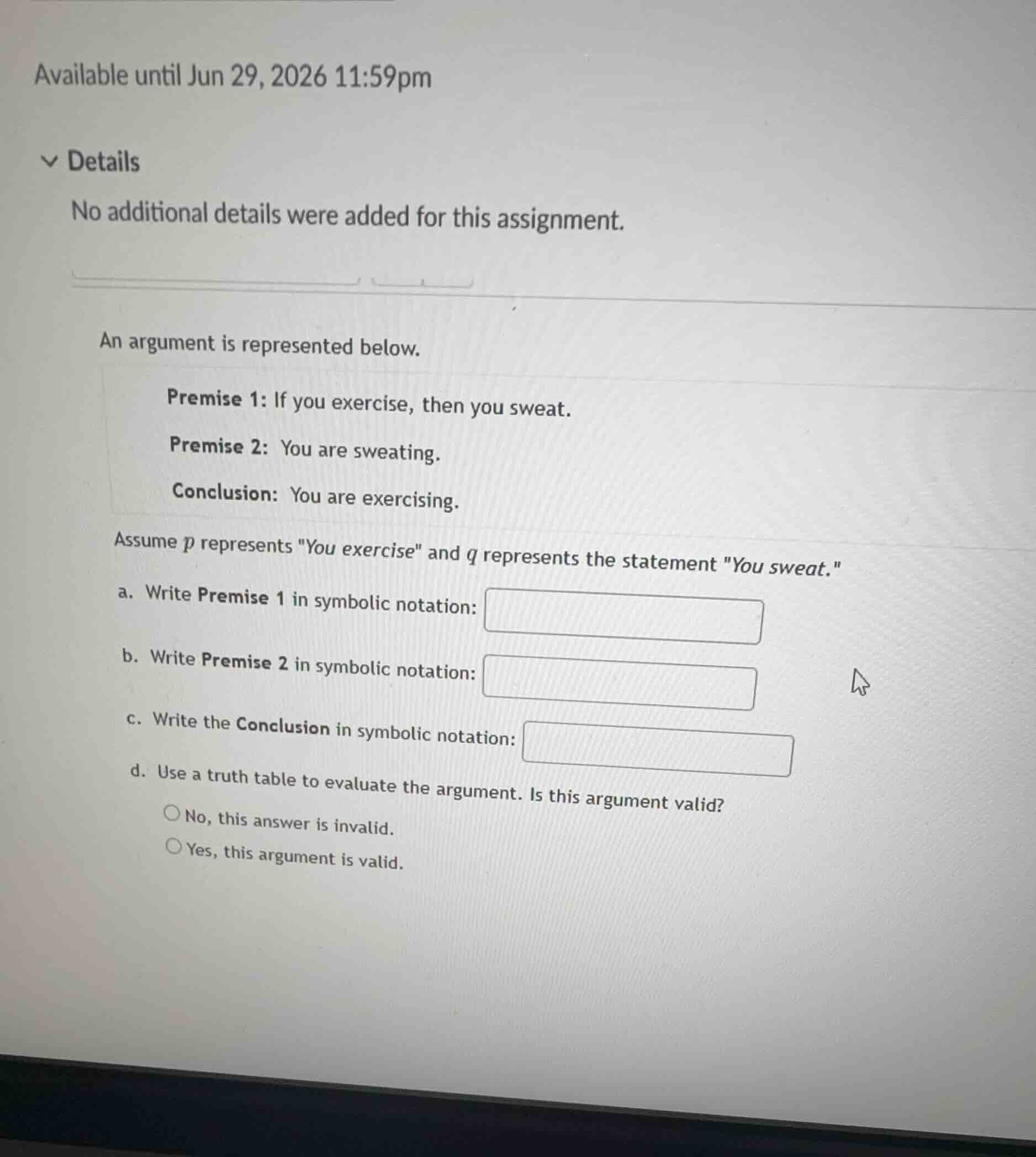
an argument is represented below.
premise 1: if you exercise, then you sweat.
premise 2: you are sweating.
conclusion: you are exercising.
assume \\(p\\) represents \you exercise\ and \\(q\\) represents the statement \you sweat.\
a. write premise 1 in symbolic notation:
b. write premise 2 in symbolic notation:
c. write the conclusion in symbolic notation:
d. use a truth table to evaluate the argument. is this argument valid?
- no, this answer is invalid.
- yes, this argument is valid.
Translate premises and conclusion to symbolic form
Analyze argument form for validity

Snap & solve any problem in the app
Get step-by-step solutions on Sovi AI
Photo-based solutions with guided steps
Explore more problems and detailed explanations
Question a
Write Premise 1 in symbolic notation: <blank>\(p
ightarrow q\)</blank>
Question b
Write Premise 2 in symbolic notation: <blank>\(q\)</blank>
Question c
Write the Conclusion in symbolic notation: <blank>\(p\)</blank>
Question d
Use a truth table to evaluate the argument. Is this argument valid?
- No, this argument is invalid. (Correct answer)
- Yes, this argument is valid.