QUESTION IMAGE
Question
another example!
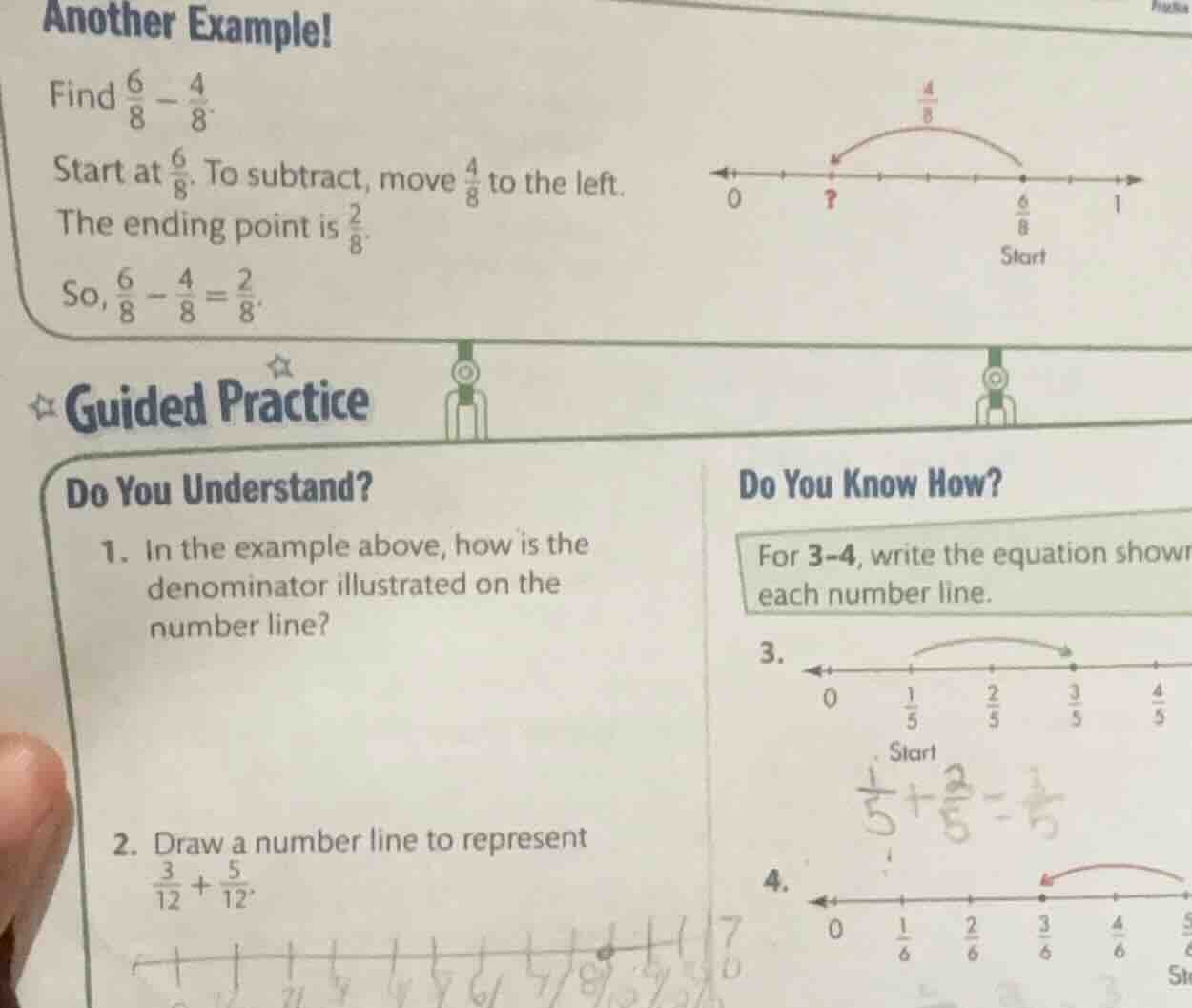
find \\(\frac{6}{8} - \frac{4}{8}\\).
start at \\(\frac{6}{8}\\). to subtract, move \\(\frac{4}{8}\\) to the left.
the ending point is \\(\frac{2}{8}\\).
so, \\(\frac{6}{8} - \frac{4}{8} = \frac{2}{8}\\).
☆guided practice
do you understand?
- in the example above, how is the denominator illustrated on the number line?
- draw a number line to represent \\(\frac{3}{12} + \frac{5}{12}\\).
do you know how?
for 3–4, write the equation shown each number line.
3.
4.
Question 3
Step1: Identify start, movement, end
Start at $\frac{1}{5}$, move right by $\frac{2}{5}$ (from $\frac{1}{5}$ to $\frac{3}{5}$: $\frac{3}{5}-\frac{1}{5}=\frac{2}{5}$).
Step2: Write addition equation
Add start and movement: $\frac{1}{5} + \frac{2}{5} = \frac{3}{5}$.
Step1: Identify start, movement, end
Start at $\frac{5}{6}$, move left by $\frac{2}{6}$ (since $\frac{5}{6}-\frac{2}{6}=\frac{3}{6}$).
Step2: Write subtraction equation
Subtract movement from start: $\frac{5}{6} - \frac{2}{6} = \frac{3}{6}$.
The denominator 8 means the number line from 0 to 1 is divided into 8 equal parts (each part is $\frac{1}{8}$). The tick marks between 0 and 1 represent these 8 equal segments, showing the denominator's role in dividing the whole into 8 parts.

Snap & solve any problem in the app
Get step-by-step solutions on Sovi AI
Photo-based solutions with guided steps
Explore more problems and detailed explanations
$\frac{1}{5} + \frac{2}{5} = \frac{3}{5}$