QUESTION IMAGE
Question
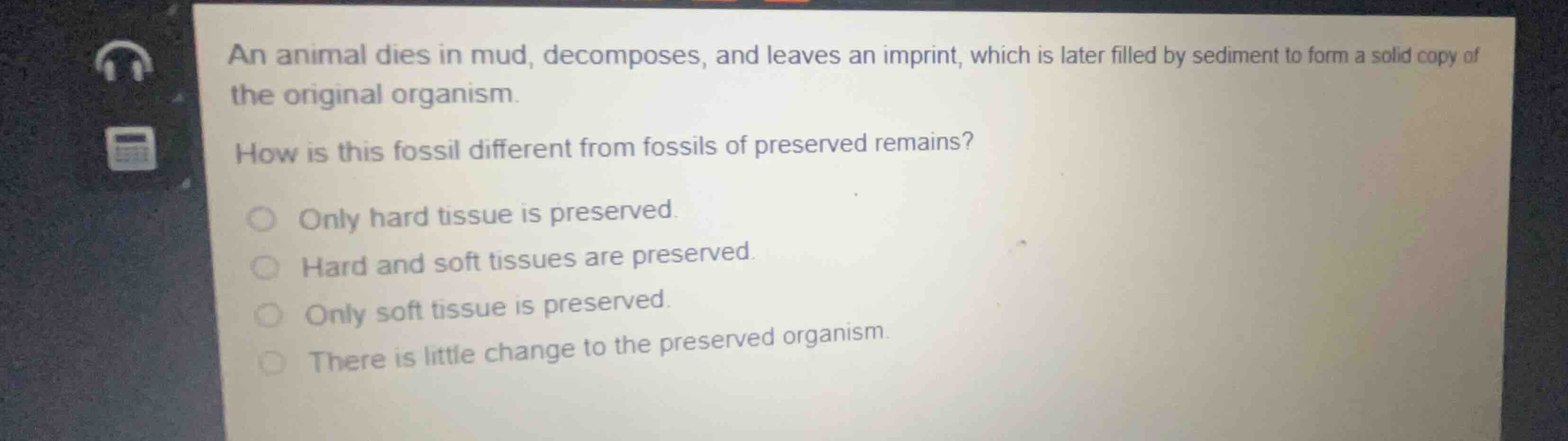
an animal dies in mud, decomposes, and leaves an imprint, which is later filled by sediment to form a solid copy of the original organism.
how is this fossil different from fossils of preserved remains?
only hard tissue is preserved.
hard and soft tissues are preserved.
only soft tissue is preserved.
there is little change to the preserved organism.
Identify the fossil type described
The prompt describes an animal that dies in mud, decomposes, and leaves an imprint (a mold), which is later filled by sediment to form a solid copy (a cast). This process describes Mold and Cast Fossils.
Analyze preserved remains
Fossils of preserved remains, also known as Original Remains, are formed when an organism is preserved with little or no change. This occurs when organisms are trapped in substances like amber, tar, or ice, preventing decomposition.
Compare the two fossil types
In a mold and cast fossil, the original organic material completely decomposes, leaving only a rock replica. In contrast, Original Remains preserve the actual tissues of the organism with virtually no alteration.
Evaluate the given options
- "Only hard tissue is preserved": Incorrect, as no original tissue is preserved in a cast.
- "Hard and soft tissues are preserved": Incorrect, as decomposition occurs.
- "Only soft tissue is preserved": Incorrect.
- "There is little change to the preserved organism": Correct, because this describes the characteristic of preserved remains (original remains) from which the described mold/cast fossil differs.

Snap & solve any problem in the app
Get step-by-step solutions on Sovi AI
Photo-based solutions with guided steps
Explore more problems and detailed explanations
- Only hard tissue is preserved.
- Hard and soft tissues are preserved.
- Only soft tissue is preserved.
- There is little change to the preserved organism. (Correct answer)