QUESTION IMAGE
Question
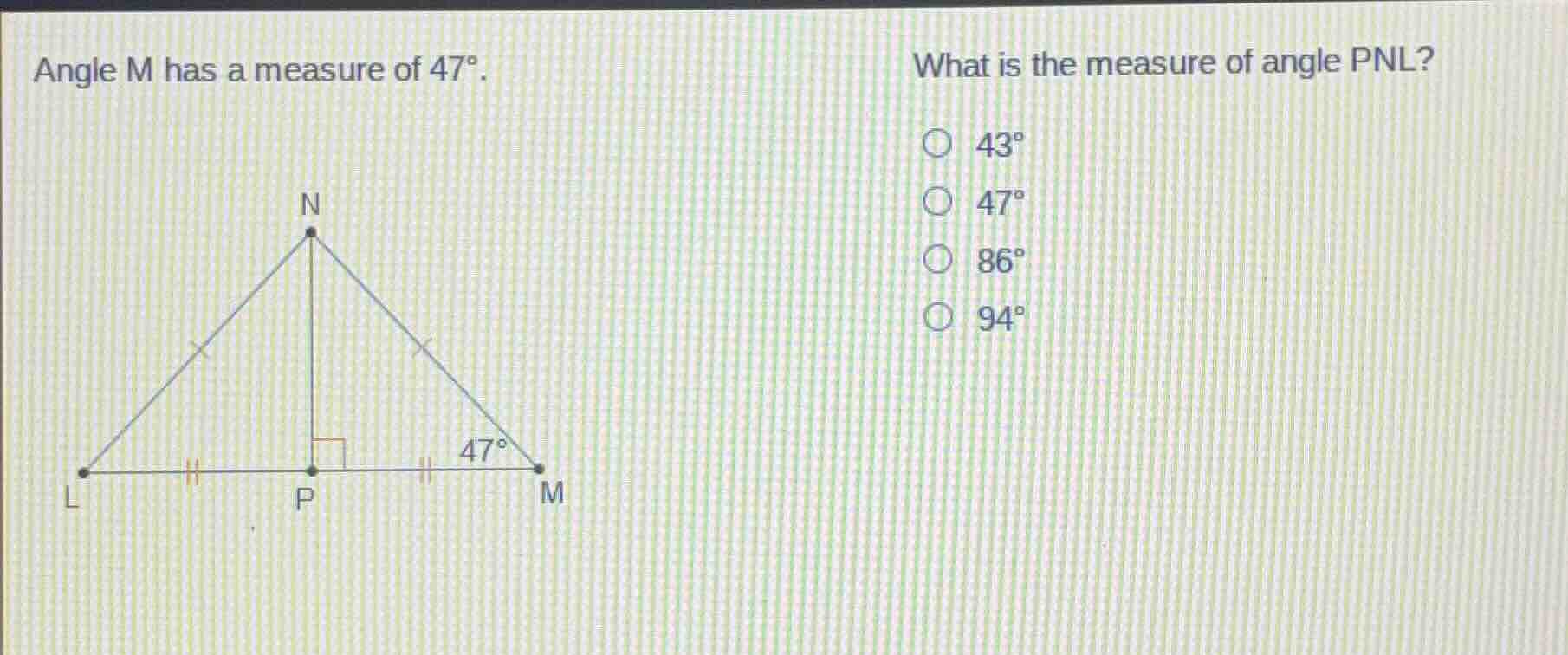
angle m has a measure of 47°. what is the measure of angle pnl? 43° 47° 86° 94°
Step1: Analyze triangle NPM
In triangle \( NPM \), \( \angle NPM = 90^\circ \) (right angle) and \( \angle M = 47^\circ \). The sum of angles in a triangle is \( 180^\circ \), so \( \angle PNM = 180^\circ - 90^\circ - 47^\circ = 43^\circ \). But wait, looking at the diagram, \( LP = PM \) (marked with equal segments) and \( NP \) is perpendicular to \( LM \), so triangle \( LNM \) is isosceles with \( LN = MN \)? Wait, no, actually, since \( NP \) is the perpendicular bisector (because \( LP = PM \) and \( \angle NPL = \angle NPM = 90^\circ \)), so triangles \( NPL \) and \( NPM \) are congruent. But maybe easier: in triangle \( NPM \), right-angled at \( P \), so \( \angle PNM = 90^\circ - 47^\circ = 43^\circ \)? Wait, no, the question is about \( \angle PNL \). Wait, maybe I made a mistake. Wait, \( \angle M = 47^\circ \), \( \angle NPM = 90^\circ \), so \( \angle PNM = 43^\circ \). But since \( LP = PM \) and \( NP \perp LM \), triangle \( LNM \) is isosceles with \( LN = MN \), so \( \angle L = \angle M = 47^\circ \). Then in triangle \( NPL \), right-angled at \( P \), \( \angle PNL = 90^\circ - 47^\circ = 43^\circ \)? Wait, no, wait the options: 43, 47, 86, 94. Wait, maybe I messed up. Wait, let's re-examine. The diagram: \( L---P---M \), \( NP \perp LM \), \( LP = PM \), so \( NP \) is the perpendicular bisector, so \( LN = MN \), so triangle \( LNM \) is isosceles with \( LN = MN \). Therefore, \( \angle L = \angle M = 47^\circ \). Now, in triangle \( NPL \), \( \angle NPL = 90^\circ \), \( \angle L = 47^\circ \), so \( \angle PNL = 90^\circ - 47^\circ = 43^\circ \)? Wait, but let's check the other way. Wait, maybe the triangle is isosceles, so \( \angle LNM = 180^\circ - 47^\circ - 47^\circ = 86^\circ \), and since \( NP \) is the angle bisector (because it's the perpendicular bisector in an isosceles triangle), so \( \angle PNL = \frac{86^\circ}{2} = 43^\circ \)? Wait, no, \( \angle LNM = 86^\circ \), so if \( NP \) splits it into two angles, \( \angle PNL \) and \( \angle PNM \), each would be \( 43^\circ \), since \( NP \) is the altitude, median, and angle bisector in an isosceles triangle. So \( \angle PNL = 43^\circ \)? Wait, but let's check the options. The first option is 43°, so that should be it. Wait, maybe I made a mistake earlier. Let's do it again. In triangle \( NPM \), right-angled at \( P \), angles sum to 180. So \( \angle PNM = 180 - 90 - 47 = 43 \). Since \( LP = PM \) and \( NP \perp LM \), triangles \( NPL \) and \( NPM \) are congruent (SAS: \( LP = PM \), \( \angle NPL = \angle NPM = 90^\circ \), \( NP = NP \)). Therefore, \( \angle PNL = \angle PNM = 43^\circ \). So the measure of angle \( PNL \) is \( 43^\circ \).
Snap & solve any problem in the app
Get step-by-step solutions on Sovi AI
Photo-based solutions with guided steps
Explore more problems and detailed explanations
\( 43^\circ \) (corresponding to the option with \( 43^\circ \))