QUESTION IMAGE
Question
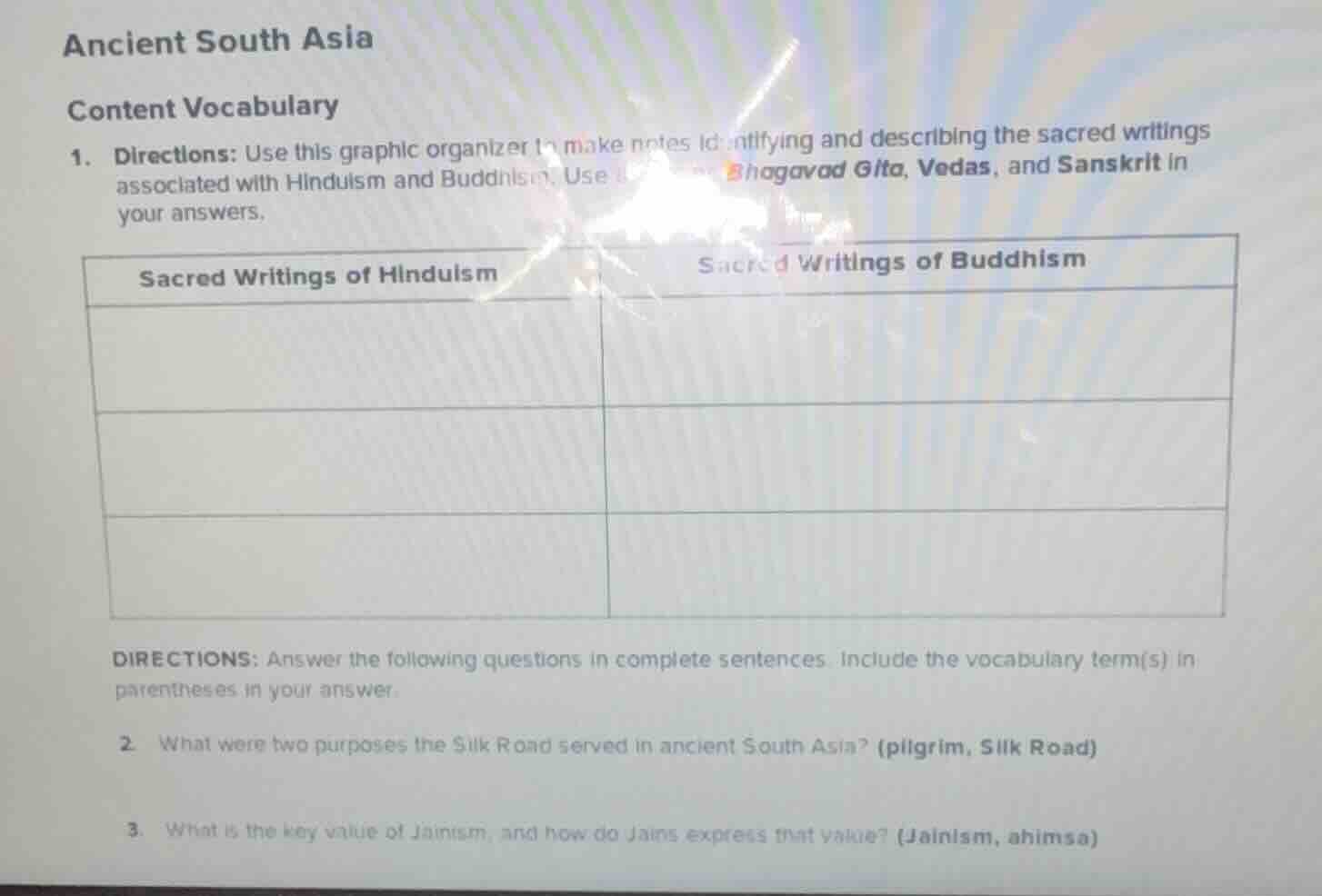
ancient south asia
content vocabulary
- directions: use this graphic organizer to make notes identifying and describing the sacred writings associated with hinduism and buddhism. use bhagavad gita, vedas, and sanskrit in your answers.
sacred writings of hinduism sacred writings of buddhism
directions: answer the following questions in complete sentences. include the vocabulary term(s) in parentheses in your answer.
- what were two purposes the silk road served in ancient south asia? (pilgrim, silk road)
- what is the key value of jainism, and how do jains express that value? (jainism, ahimsa)
Question 1 (Graphic Organizer for Sacred Writings)
Brief Explanations
- Sacred Writings of Hinduism:
- Vedas: The oldest and most sacred Hindu texts, written in Sanskrit, containing hymns, rituals, and philosophical ideas.
- Bhagavad Gita: A part of the Mahabharata, written in Sanskrit, it’s a dialogue on dharma, duty, and spirituality, guiding Hindu ethical and spiritual life.
- Sanskrit: The ancient language in which most Hindu sacred texts (like Vedas, Bhagavad Gita) are written, preserving religious and philosophical knowledge.
- Sacred Writings of Buddhism:
- Tripitaka (Pali Canon): The earliest Buddhist texts, containing teachings of the Buddha, rules for monastics, and philosophical discourses.
- Mahayana Sutras (e.g., Lotus Sutra): Texts emphasizing universal enlightenment (Bodhisattva path), written in Sanskrit (and later translated to other languages).
- Sanskrit was also used in some Buddhist texts, though Pali was prominent in early Buddhism.
Brief Explanations
The Silk Road was a network of trade routes. In South Asia, it served two key purposes:
- Trade: Facilitated exchange of goods (spices, textiles, gems from South Asia; silk, horses from other regions).
- Pilgrimage: Enabled pilgrims (e.g., Buddhist/Hindu pilgrims) to travel to sacred sites (e.g., Buddhist monasteries, Hindu temples) across South Asia and beyond, spreading religious ideas.
Brief Explanations
- Key Value of Jainism: Ahimsa (non - violence) is the core value. It emphasizes not harming any living being, including animals, plants, and even microscopic life.
- How Jains Express Ahimsa: Jains practice ahimsa through:
- Diet: Many are vegetarian (or vegan) to avoid harming animals.
- Lifestyle: Avoiding activities that harm life (e.g., careful walking to not step on insects, using filtered water to avoid ingesting small organisms, non - violent occupations).
- Monastic Practices: Monks/nuns follow strict non - violence, wearing masks to avoid inhaling insects, sweeping paths to avoid stepping on life.

Snap & solve any problem in the app
Get step-by-step solutions on Sovi AI
Photo-based solutions with guided steps
Explore more problems and detailed explanations
(Filled Table):
| Sacred Writings of Hinduism | Sacred Writings of Buddhism |
|---|