QUESTION IMAGE
Question
analyzing evidence
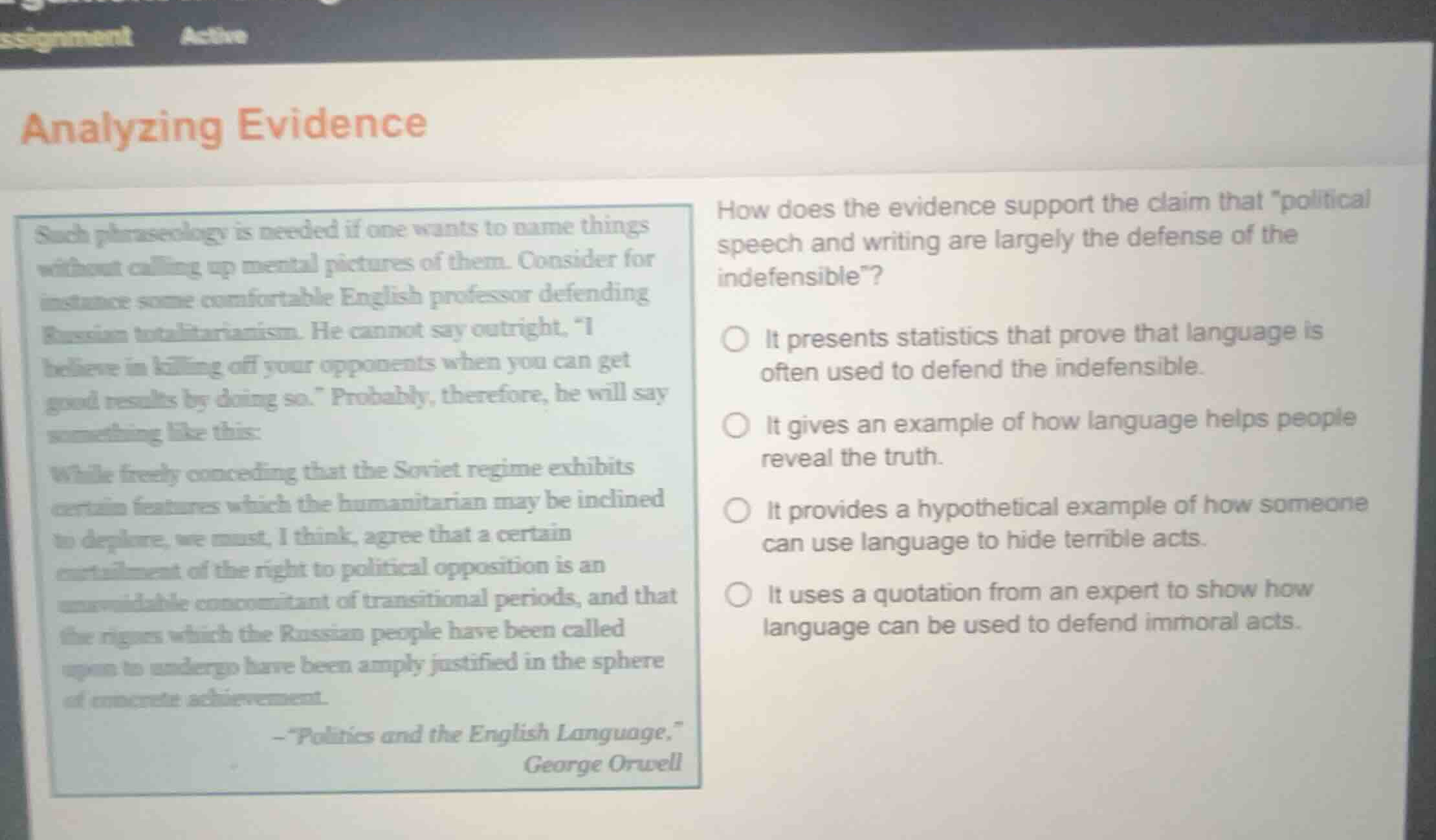
such phraseology is needed if one wants to name things without calling up mental pictures of them. consider for instance some comfortable english professor defending russian totalitarianism. he cannot say outright, \i believe in killing off your opponents when you can get good results by doing so.\ probably, therefore, he will say something like this:
while freely conceding that the soviet regime exhibits certain features which the humanitarian may be inclined to deplore, we must, i think, agree that a certain curtailment of the right to political opposition is an unavoidable concomitant of transitional periods, and that the rigors which the russian people have been called upon to undergo have been amply justified in the sphere of concrete achievement.
-\politics and the english language,\
george orwell
how does the evidence support the claim that \political speech and writing are largely the defense of the indefensible\?
it presents statistics that prove that language is often used to defend the indefensible.
it gives an example of how language helps people reveal the truth.
it provides a hypothetical example of how someone can use language to hide terrible acts.
it uses a quotation from an expert to show how language can be used to defend immoral acts.
Analyze the prompt and claim
The question asks how the provided passage supports the claim that "political speech and writing are largely the defense of the indefensible."
Examine the provided text
The text is an excerpt from George Orwell's "Politics and the English Language."
- It begins: "Such phraseology is needed if one wants to name things without calling up mental pictures of them."
- It sets up a scenario: "Consider for instance some comfortable English professor defending Russian totalitarianism."
- It notes that the professor cannot say outright: "I believe in killing off your opponents when you can get good results by doing so."
- Instead, the professor uses euphemistic, bloated language to frame atrocities ("curtailment of the right to political opposition", "amply justified in the sphere of concrete achievement") to hide the grim reality.
Evaluate the nature of the evidence
Using Rhetorical Analysis, we can determine that the scenario of the "comfortable English professor" is not a real historical event with statistics or a direct quote from an actual expert. Instead, Orwell constructs a "hypothetical example" ("Consider for instance...", "Probably, therefore, he will say something like this:") to demonstrate how euphemistic language is used to obscure and hide terrible acts (like totalitarian violence).
Compare with the given options
- Option 1: "It presents statistics..." — Incorrect. There are no statistics in the passage.
- Option 2: "It gives an example of how language helps people reveal the truth." — Incorrect. The passage shows how language is used to conceal or soften the truth.
- Option 3: "It provides a hypothetical example of how someone can use language to hide terrible acts." — Correct. Orwell uses a hypothetical professor to show how euphemisms hide the reality of totalitarian violence.
- Option 4: "It uses a quotation from an expert..." — Incorrect. The quote provided is a hypothetical statement created by Orwell to represent what such a person would "probably" say, not an actual expert quote.

Snap & solve any problem in the app
Get step-by-step solutions on Sovi AI
Photo-based solutions with guided steps
Explore more problems and detailed explanations
- (A) It presents statistics that prove that language is often used to defend the indefensible.
- (B) It gives an example of how language helps people reveal the truth.
- (C) It provides a hypothetical example of how someone can use language to hide terrible acts. (Correct answer)
- (D) It uses a quotation from an expert to show how language can be used to defend immoral acts.