QUESTION IMAGE
Question
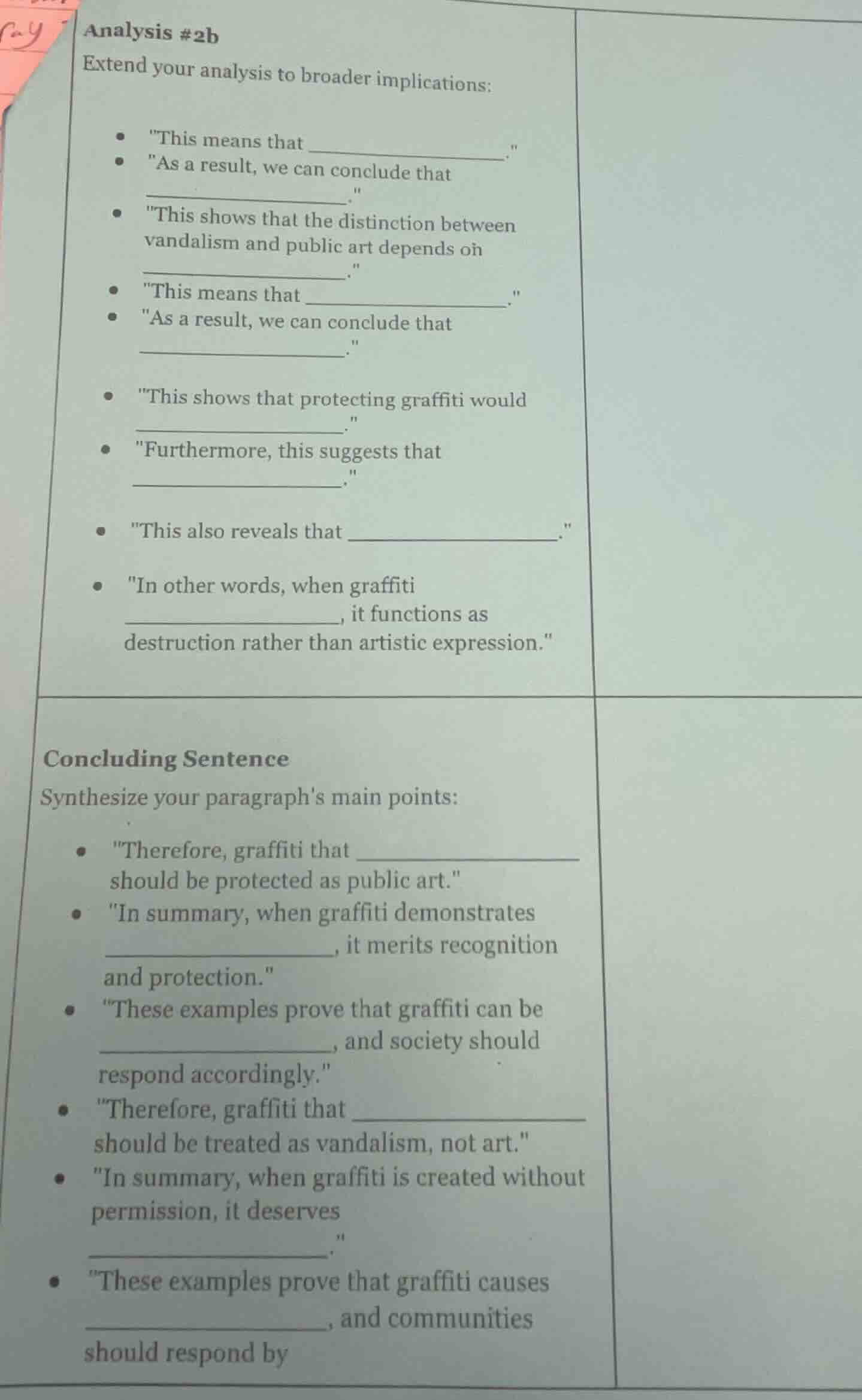
analysis #2b
extend your analysis to broader implications:
- \this means that ________.\
- \as a result, we can conclude that ________.\
- \this shows that the distinction between vandalism and public art depends on ________.\
- \this means that ________.\
- \as a result, we can conclude that ________.\
- \this shows that protecting graffiti would ________.\
- \furthermore, this suggests that ________.\
- \this also reveals that ________.\
- \in other words, when graffiti ________, it functions as destruction rather than artistic expression.\
concluding sentence
synthesize your paragraphs main points:
- \therefore, graffiti that ________ should be protected as public art.\
- \in summary, when graffiti demonstrates ________, it merits recognition and protection.\
- \these examples prove that graffiti can be ________, and society should respond accordingly.\
- \therefore, graffiti that ________ should be treated as vandalism, not art.\
- \in summary, when graffiti is created without permission, it deserves ________.\
- \these examples prove that graffiti causes ______, and communities should respond by ______.\
Analyze the sentence frames for Analysis #2b
The first section provides sentence frames to extend analysis regarding the debate between graffiti as vandalism versus public art. The blanks require logical completions that connect textual evidence to broader societal, legal, or artistic implications.
Analyze the sentence frames for Concluding Sentence
The second section provides concluding sentence templates to synthesize a paragraph's main points. These frames are split between arguments supporting graffiti as protected public art and arguments treating it as vandalism. The completions must logically maintain these opposing argumentative stances.

Snap & solve any problem in the app
Get step-by-step solutions on Sovi AI
Photo-based solutions with guided steps
Explore more problems and detailed explanations
Analysis #2b
- "This means that artistic value is not determined solely by its location or legality."
- "As a result, we can conclude that the boundary between illegal acts and cultural contributions is often blurred."
- "This shows that the distinction between vandalism and public art depends on the intent of the creator and the reception of the community."
- "This means that unauthorized self-expression can still hold significant social value."
- "As a result, we can conclude that laws regulating public space must adapt to recognize cultural merit."
- "This shows that protecting graffiti would encourage diverse voices and revitalize neglected urban spaces."
- "Furthermore, this suggests that censoring these works deprives the public of meaningful cultural dialogue."
- "This also reveals that property damage remains a primary concern for local authorities."
- "In other words, when graffiti is applied to private property without consent and lacks community relevance, it functions as destruction rather than artistic expression."
Concluding Sentence
- "Therefore, graffiti that displays artistic skill and engages with community themes should be protected as public art."
- "In summary, when graffiti demonstrates cultural significance and aesthetic value, it merits recognition and protection."
- "These examples prove that graffiti can be a powerful tool for social commentary, and society should respond accordingly."
- "Therefore, graffiti that defaces property without consent or artistic merit should be treated as vandalism, not art."
- "In summary, when graffiti is created without permission, it deserves to be removed and penalized under local ordinances."
- "These examples prove that graffiti causes financial damage and visual blight, and communities should respond by enforcing stricter property laws."