QUESTION IMAGE
Question
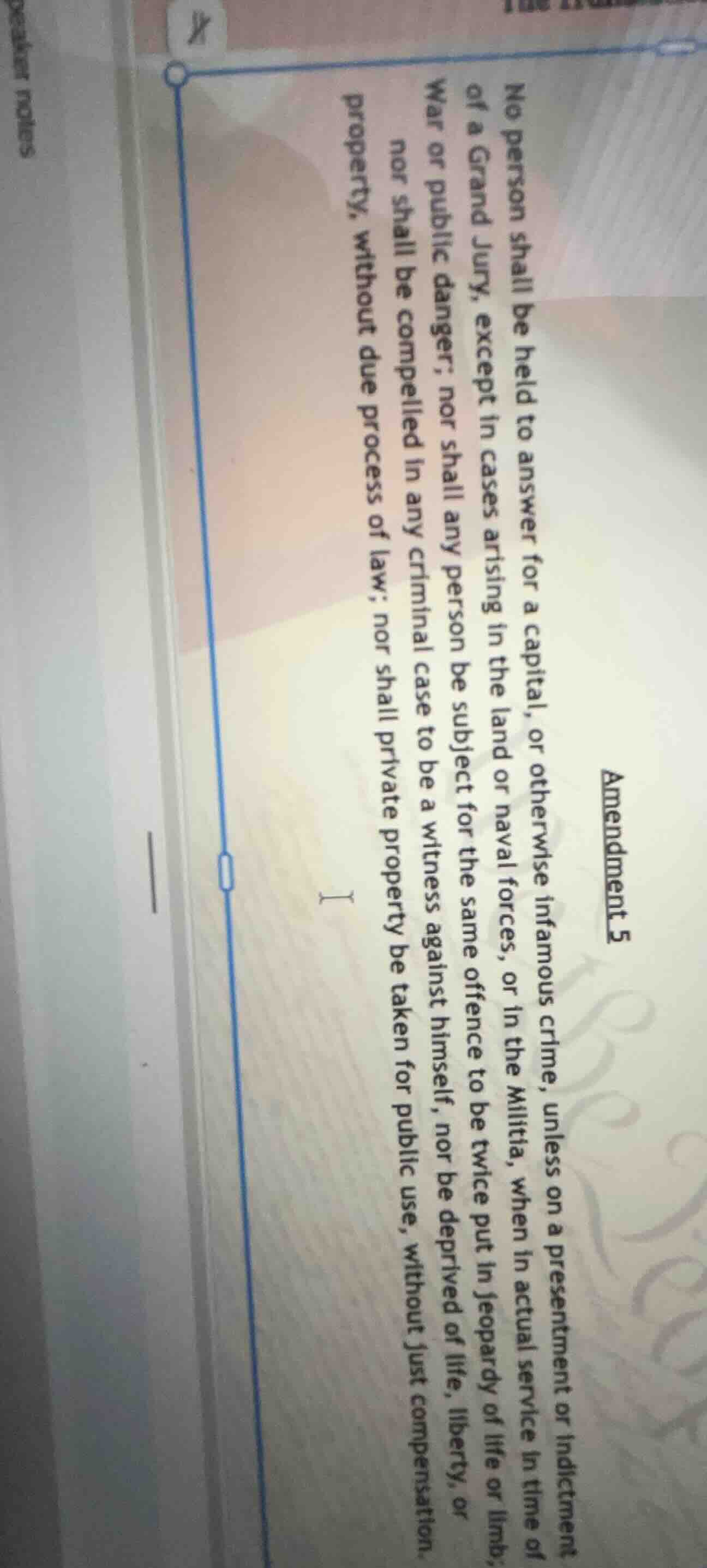
amendment 5
no person shall be held to answer for a capital, or otherwise infamous crime, unless on a presentment or indictment of a grand jury, except in cases arising in the land or naval forces, or in the militia, when in actual service in time of war or public danger; nor shall any person be subject for the same offence to be twice put in jeopardy of life or limb; nor shall be compelled in any criminal case to be a witness against himself, nor be deprived of life, liberty, or property, without due process of law; nor shall private property be taken for public use, without just compensation.
The text is the 5th Amendment of the United States Constitution, which relates to legal rights and procedures. The subfield of Law within Social Science is the most appropriate as it deals with constitutional law, legal procedures (like grand jury, due process), and rights (against self - incrimination, double jeopardy, eminent domain).

Snap & solve any problem in the app
Get step-by-step solutions on Sovi AI
Photo-based solutions with guided steps
Explore more problems and detailed explanations
This text is related to the subfield of Law (within Social Science), as it is the 5th Amendment of the US Constitution, covering legal rights, procedures (e.g., grand jury, due process), and legal protections (e.g., against self - incrimination, double jeopardy, and rules for taking private property for public use).