QUESTION IMAGE
Question
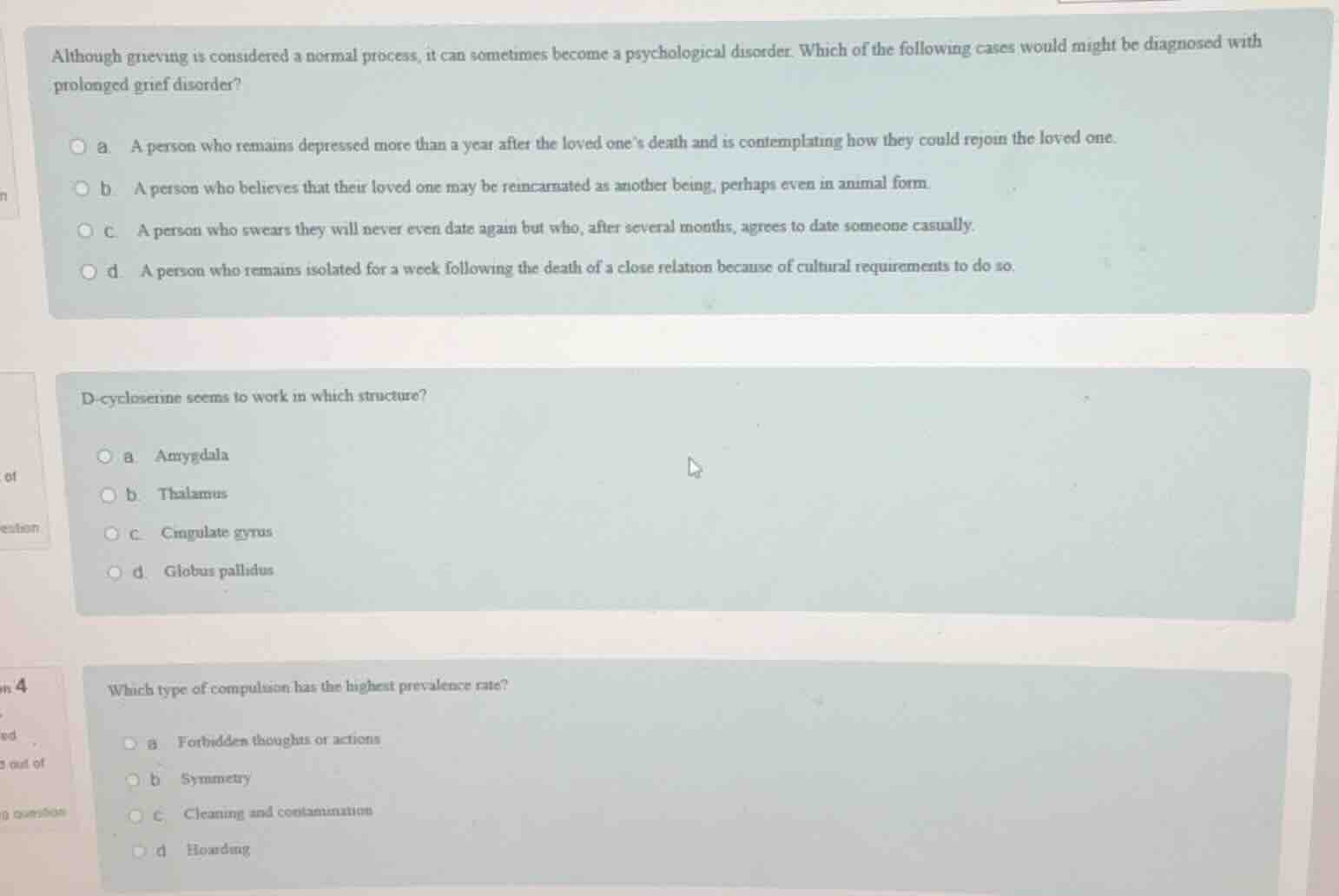
although grieving is considered a normal process, it can sometimes become a psychological disorder. which of the following cases would might be diagnosed with prolonged grief disorder?
a. a person who remains depressed more than a year after the loved ones death and is contemplating how they could rejoin the loved one.
b. a person who believes that their loved one may be reincarnated as another being, perhaps even in animal form.
c. a person who swears they will never even date again but who, after several months, agrees to date someone casually.
d. a person who remains isolated for a week following the death of a close relation because of cultural requirements to do so.
d-cycloserine seems to work in which structure?
a. amygdala
b. thalamus
c. cingulate gyrus
d. globus pallidus
which type of compulsion has the highest prevalence rate?
a. forbidden thoughts or actions
b. symmetry
c. cleaning and contamination
d. hoarding
Analyze prolonged grief disorder criteria
Prolonged grief disorder (PGD) is characterized by intense, persistent yearning or preoccupation with a deceased loved one, lasting at least 12 months (one year) after the loss in adults. The symptoms must significantly impair daily functioning and exceed cultural norms. Option (a) describes a person who remains depressed more than a year after the death and is contemplating rejoining them, which aligns with the diagnostic criteria. Other options describe normal cultural practices, typical temporary reactions, or spiritual beliefs.
Identify D-cycloserine mechanism site
D-cycloserine is an NMDA receptor partial agonist often used to facilitate extinction learning in exposure therapy for anxiety disorders, OCD, and PTSD. Research indicates that its therapeutic effects on fear extinction and emotional learning primarily occur within the amygdala, a brain structure central to processing fear and emotional memories.
Determine highest prevalence compulsion type
Among individuals diagnosed with Obsessive-Compulsive Disorder (OCD), symmetry, ordering, and repeating compulsions, along with cleaning/washing (contamination) compulsions, are highly prevalent. Epidemiological and clinical data consistently show that symmetry-related compulsions (ordering, arranging, repeating) have the highest prevalence rate among the major compulsion categories.

Snap & solve any problem in the app
Get step-by-step solutions on Sovi AI
Photo-based solutions with guided steps
Explore more problems and detailed explanations
Question 1
- a. A person who remains depressed more than a year after the loved one's death and is contemplating how they could rejoin the loved one. (Correct answer)
- b. A person who believes that their loved one may be reincarnated as another being, perhaps even in animal form.
- c. A person who swears they will never even date again but who, after several months, agrees to date someone casually.
- d. A person who remains isolated for a week following the death of a close relation because of cultural requirements to do so.
Question 2
- a. Amygdala (Correct answer)
- b. Thalamus
- c. Cingulate gyrus
- d. Globus pallidus
Question 3
- a. Forbidden thoughts or actions
- b. Symmetry (Correct answer)
- c. Cleaning and contamination
- d. Hoarding